

Replacing a water main involves more than the pipe itself. Water main replacement cost in the UK depends on the route, ground and surface conditions, installation method and reinstatement. The cost is specific to the property and can be established from a quote. The water supply is typically interrupted for a few hours while the new pipe is connected.
It’s understandable to want a clear idea of the cost and disruption before work begins. This guide explains what affects the total, how trenching compares with moling, and what to expect from planning the route to reinstating the surface.
Key Takeaways
- Separate the communication pipe from your private supply pipe to understand which section may be your responsibility.
- Compare trenching and moling by looking at the route, surface disruption and reinstatement needed, not just the installation method.
- For a driveway or road crossing, access, permits and traffic management can all affect the work involved.
- Allow for the connection stage as well as installation, since water is typically interrupted for a few hours while the new pipe is connected.
- Use the cost factors in the article to understand what should be included in a quote for your property.
How Much Does Water Supply Pipe Replacement Cost?
The cost depends on which section of pipe needs replacing and the route to your home. Pipe length, excavation, access and reinstatement all affect the work involved.
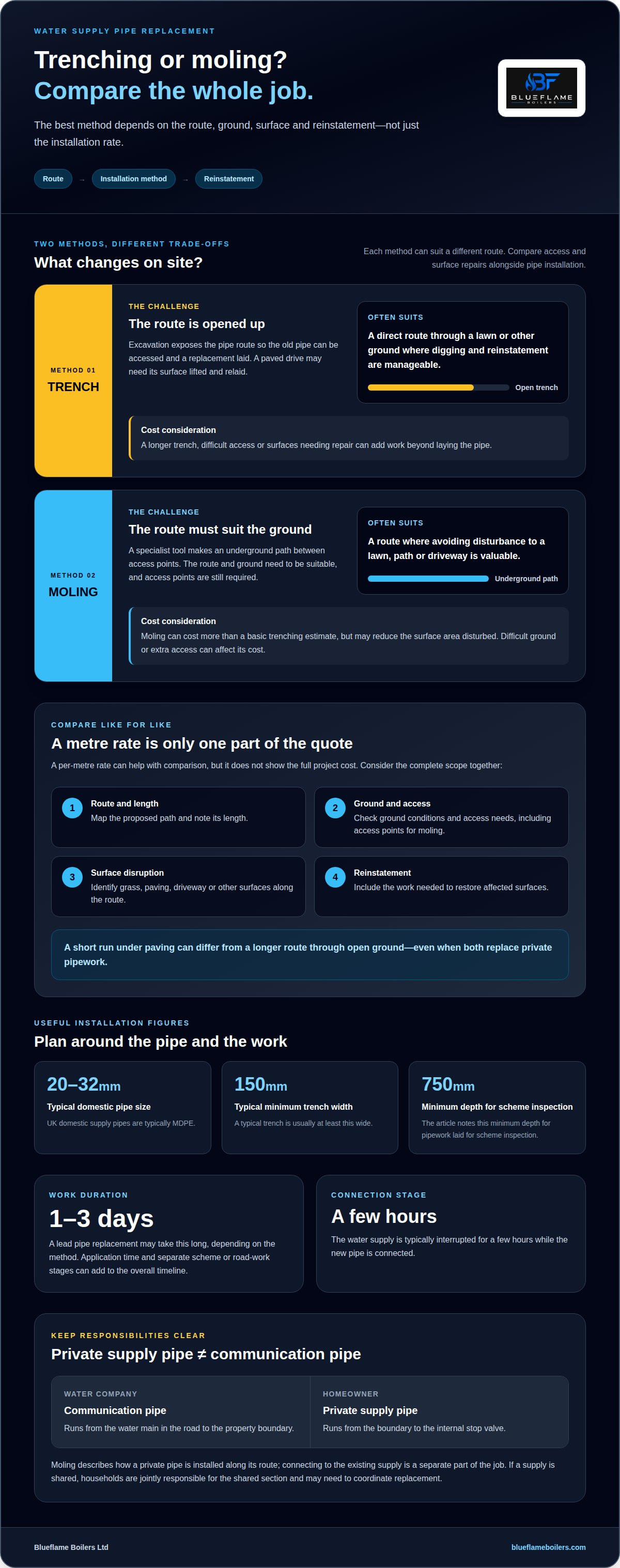
In the UK, the water company is responsible for the communication pipe, which runs from the water main in the road to the property boundary. The homeowner is responsible for the private supply pipe, from the boundary to the internal stop valve. This distinction matters: replacing a private lead pipe is different from work on the water company’s section.
Some homes share a supply pipe. Households sharing it are jointly responsible for the shared section, so replacement may need to be coordinated with neighbours. The individual branch serving one property and the shared section can involve different work and arrangements.
An average UK water supply pipe replacement cost can obscure substantial differences between properties. A short, accessible route is not the same job as a long pipe beneath a driveway. The cost depends on the property and is established through a quote; length, depth, access, installation method and reinstatement all affect it.
Pipe size, depth and installation standards
Pipe size and installation conditions determine what can be fitted and how much excavation or reinstatement the route requires. UK domestic water supply pipes are typically 20mm to 32mm MDPE, while a typical trench is usually at least 150mm wide.
Depth matters because it affects digging and the route around existing features. For scheme inspection, pipework must be laid at a minimum depth of 750mm. In England and Wales, water supply pipe replacement follows the Water Supply (Water Fittings) Regulations 1999, according to the UK legislation register. These details can affect the installation plan and the work needed to leave the route properly reinstated.
Regional and water company charges
Water company charges vary according to the work, including whether it covers a private supply pipe, a communication pipe or a new connection. There is no single UK-wide charge for communication pipe replacement or a new water connection. The responsible water company sets charges for its work and connection arrangements.
London and the South East can have higher water main installation costs than other UK areas. For a homeowner, the practical first distinction is responsibility: the water company handles the communication pipe, while the private supply pipe falls to the property owner. That difference affects which work is included in a replacement.
Replacing a supply pipe during driveway, garden or kitchen improvements can coordinate the work with planned excavation and surface reinstatement. For example, a driveway project may already involve lifting and relaying the surface. Planning pipe replacement alongside it can avoid arranging excavation and reinstatement separately.
Moving or rerouting a mains water pipe changes its path as well as the pipe itself. A new route around an extension, garden feature or driveway may involve more excavation, a longer supply pipe or different reinstatement. The route from the boundary to the internal stop valve helps define the work and quote.
Traditional trench excavation versus moling
Replacing a private supply pipe usually involves either opening a trench or installing the pipe underground using moling. The right method depends on the route, ground conditions, surface above it and reinstatement required. These choices affect disruption around your home as well as the final cost.
Traditional trench excavation exposes the route so the old pipe can be accessed and a replacement laid. It can suit a direct path through a lawn or other ground where excavation and reinstatement are manageable. A route beneath a paved drive, however, may mean lifting and relaying the surface, adding work beyond laying the pipe itself.
The route and work required determine how the cost is assessed. A longer trench, difficult access or surfaces needing reinstatement can increase the total. A per-metre rate is useful for comparison, but it does not represent the full project cost.
Moling is a trenchless method. A specialist tool creates an underground path between access points, allowing a new pipe to be installed without opening a continuous trench. It can help avoid disturbing a lawn, path or driveway along the route. Moling still requires access points, and the route and ground must suit the method.
Moling can cost more than a basic trenching estimate, but comparing rates per metre alone misses reinstatement. For example, trenching across a landscaped garden may require surface repairs, while moling may reduce the area disturbed. Difficult ground or a route requiring extra access can also affect the cost of moling.
Neither method is automatically cheaper for every lead pipe replacement. Compare the full scope: excavation or moling, pipe installation, access points and reinstatement. A quote for a short run under paving may differ from one for a longer route through open ground, even when both replace private pipework.
Moling is not the same as a new water company connection. It describes how the private pipe is installed along its route; connecting to the existing supply is a separate part of the job. If the route starts near the road and continues to the house, identify which work concerns the private pipe and which involves the water company.
For a useful comparison, map the proposed route and note surfaces such as grass, paving or a driveway. Then compare the method, access work and reinstatement together, rather than choosing by metre rate alone. Discuss your supply-pipe route to explore the options for your property.
Replacement process and reinstatement
A lead pipe replacement has two parts: installing the new supply and restoring the route. The work may take 1-3 days, depending on the method used. That is the installation period, not necessarily the full time from an application to a completed connection. Scheme arrangements and road work can add separate stages.
Before excavation begins, establish the proposed route. It may run from the property boundary to the home, pass beneath a driveway or connect to a shared supply. The route affects access, excavation and reinstatement. A clear plan also helps homeowners understand which section is being replaced and where the work will take place.
For a water-company scheme, the application and approval can precede the physical work. A domestic water main installation can take 1 to 3 weeks for application approval, while some schemes aim to complete the new pipework connection within 6 weeks. These timescales cover different stages, so the installation itself can be shorter than the overall process.
Scheme requirements can affect when a trench is closed. The replacement trench must be lined with soft earth or sand and left fully exposed for inspection, so the pipework can be viewed before it is covered. For work under a scheme, build the inspection into the work sequence rather than treating it as an optional final check.
Once the new pipe is ready to connect, the water supply is typically interrupted for a few hours. The old pipe can then be disconnected and the new line connected to the supply. If the property shares a common pipe, the plumber must disconnect the old supply where it joins the shared section. That connection point matters to neighbouring households. Experienced residential specialists, such as Ultra Plumbing, similarly note that coordinating these pipe connections efficiently is key to keeping water downtime to a minimum.
Reinstatement follows pipe installation and inspection. Depending on the route, this may involve replacing soil, paving or driveway surfaces disturbed during excavation. Homeowners planning garden or driveway work can coordinate the projects so excavation and surface restoration are considered together. A written quote should state which reinstatement work is included.
Road crossings need added coordination. Road crossings for UK water main works are subject to the New Roads and Street Works Act 1991, according to the UK legislation register. A route crossing a road may therefore involve street works arrangements as well as pipe installation. The crossing can affect the programme and the work required to restore the road surface.
For a private replacement, compare the proposed method, inspection requirements, connection work and reinstatement together. This gives a more useful picture than considering only how long excavation lasts. Where a scheme applies, acceptance may be required before work starts, and inspection must take place while the trench remains exposed.
Typical UK water main installation costs
A new water main installation involves more than laying pipework. The total reflects the route, connection arrangements, installation method and reinstatement, so a typical project can differ considerably from a straightforward private supply pipe replacement. An estimate should clearly state which sections and tasks it covers.
Start by separating the pipe route from the connection work. A 20-metre installation from the street across a driveway to the property boundary can involve several distinct elements: excavation or trenchless installation, materials, connection fees and surface restoration. A single per-metre figure may not cover every part of that job.
Ground and surface conditions shape the work. A 15-metre route through soft garden ground presents a different job from pipework crossing a paved drive or road. The contractor must consider the access needed, the method that suits the route and what must be reinstated afterwards. Driveways can add surface work even when the pipe run itself is direct.
Connection and administration charges may be separate from installation work. For example, a new connection can involve water company charges, while a route affecting a road may require traffic management or permits. These costs depend on the connection and work involved, so ask for them to be identified separately in the estimate.
Compliance is another part of planning a new installation. The pipe route, materials and connection must be considered together, rather than treating the pipe as an isolated item. A project involving a road crossing or several property sections can be more involved than a route contained within one garden.
For a useful comparison, review each estimate against the same scope. Check whether it covers the full route, connection work, excavation or moling, reinstatement and any applicable charges. A quote for pipework alone cannot be compared directly with one that includes restoring a driveway or completing connection work.
The cost depends on the property and is established through a quote. Route length, ground, access, installation method, connection arrangements and reinstatement all affect it. Describe the property boundary, proposed route and surfaces to clarify the scope. For example, note whether the route crosses a lawn, driveway or road, and whether it serves one property or shared pipework.
When planning the project, consider whether driveway or garden improvements are already scheduled. Coordinating the work may avoid separate excavation and reinstatement. A written estimate should describe the included work, so you can see how each section and connection has been allowed for.
If you’re planning a replacement or new route, discuss your water pipe installation and outline the property layout, route and surfaces involved.
How much does it cost to replace a water main under a driveway or road?
A driveway or road crossing can add excavation, access and reinstatement work to a water main project.
These examples show why the route matters as much as pipe length. Work may need to pass through or beneath a hard surface, which then has to be restored. A driveway crossing can involve lifting and replacing paving, while a road crossing may require additional street works arrangements.
Some cost components are estimated separately. These figures describe individual elements, not charges that should automatically be added to every project estimate.
Identifying underground services before excavation begins can help shape the route and work required to install the pipe, particularly if the route crosses a driveway or road.
The method also affects disruption and reinstatement. Trenching exposes the route and may require more surface restoration across a driveway. Moling installs a pipe underground with less continuous excavation, but its suitability depends on the route and ground. Limited access or difficult ground can still mean additional work.
Responsibility determines which work appears in a homeowner’s estimate. The water company is responsible for the communication pipe between the road main and property boundary. The homeowner is responsible for the private supply pipe from the boundary to the internal stop valve. An estimate should clarify whether it covers a private section, a connection or both.
Compare estimates by checking the route length, installation method, connection work, permits and reinstatement. Confirm whether driveway paving or road-surface restoration is included, rather than assuming it is part of the pipe-laying charge. The cost depends on the property and is established through a quote; crossing distance, access, method and surface repairs all affect the estimate.
For a water pipe route beneath a driveway or road, discuss your replacement project.
Blueflame Boilers Ltd: Gas Boiler Installation
Blueflame Boilers Ltd can help when your home also needs heating work. Water supply pipe replacement and boiler installation are separate projects, but planning both can help you organise work around your home’s needs.
For a new or replacement gas boiler, Blueflame Boilers Ltd provides Gas Boiler Installation, carried out by Gas Safe Registered engineers. If your existing boiler has developed a fault, Boiler Repair or an Emergency Callout may be relevant; Boiler Servicing supports routine maintenance. Choose the service that matches whether you need a new installation, a repair or maintenance for your current boiler.
If your heating system needs attention alongside your plumbing project, contact Blueflame Boilers Ltd to discuss the relevant service. You can also visit blueflameboilers.com.
Plan the next step with confidence
Before arranging work, record the proposed pipe route, affected surfaces and scope included in each estimate. This gives you a practical basis for planning access to your home and coordinating other improvements. A clear scope also helps explain how water main replacement cost in the UK relates to your property’s particular route and requirements.
If your plans also involve your heating system, Blueflame Boilers Ltd offers Gas Boiler Installation, Boiler Repair and Emergency Callouts, carried out by Gas Safe Registered engineers. These services address separate household needs, but considering them alongside planned property work can help you organise what needs attention.
For a calm next step, get in touch to discuss your enquiry.
A clear plan and the right information can help you prepare for the work ahead.
Frequently Asked Questions
How Long Will You Be Without Water?
The water supply is typically interrupted for a few hours while the new pipe is connected. That is different from the full installation period, which can take 1-3 days depending on the method. Before work begins, plan for essential water use during the connection stage. If your home shares a supply pipe, the connection arrangements may also affect neighbours using the shared section.
Can Your Water Company Help with Costs?
Some water companies offer free or subsidised lead pipe replacement in certain circumstances, including where a young child or pregnant resident is affected. Schemes have conditions, so contact your water company before commissioning lead pipe replacement to find out whether one applies.
Do You Need Planning Permission?
There isn’t one yes-or-no answer based on pipe replacement alone; the proposed route and affected land matter. Work within a property boundary is different from a crossing beneath a public road. Road crossings for UK water main works are subject to the New Roads and Street Works Act 1991, according to the UK legislation register. Planning permission and street works arrangements are separate considerations.
What Can Increase the Cost Significantly?
A long or deep route can mean more excavation and pipework, while a driveway or road crossing may require additional surface reinstatement. The installation method matters too: trenching and moling have different access and ground requirements. A short run through an accessible garden is a different project from replacing pipe beneath a paved drive and restoring the surface.
Who pays for what?
The water company is responsible for the communication pipe between the water main in the road and the property boundary. The homeowner is responsible for the private supply pipe from the boundary to the internal stop valve. If several households share a supply pipe, they are jointly responsible for the shared section. One owner may have a private branch as well as a shared stretch.
How much does water main replacement cost in the UK?
These are market estimates for supply pipe replacement, not a fixed price for every home. The total depends on the route’s length and depth, what lies above it, the installation method and the reinstatement required.
What is the average cost per metre to replace a water main in the UK?
This is a useful starting point for comparing estimates, but it may not represent every part of the project. Check whether the figure includes connection work and reinstatement, especially if the route crosses a driveway or another finished surface.
What factors affect the cost of replacing a water supply pipe, such as length, depth and ground conditions?
Length and depth affect how much pipe and excavation the work requires. The surface above the route, such as a lawn, paving or driveway, affects reinstatement. Ground conditions and installation method also shape the scope. A deep route beneath a hard surface may need a different approach from a direct run through accessible garden ground.


