
A heating emergency needs a clear, safe response. A domestic gas engineer in Weybridge can help with boiler breakdowns, servicing and gas installations, but only a Gas Safe registered engineer is legally allowed to service gas boilers in the UK, according to the Health and Safety Executive.
It’s sensible to want the work handled properly, whether your boiler has stopped working, you’re planning a replacement or you need a gas safety check. If you suspect a gas leak, call the National Gas Emergency Service on 0800 111 999.
This guide explains what boiler servicing, repairs and installations involve, what to expect from landlord gas safety checks and how local coverage across Weybridge and KT13 fits in. You’ll also learn how to identify the right kind of help for your heating or gas issue, so you can take the next step with a clearer picture of the work involved.
Key Takeaways
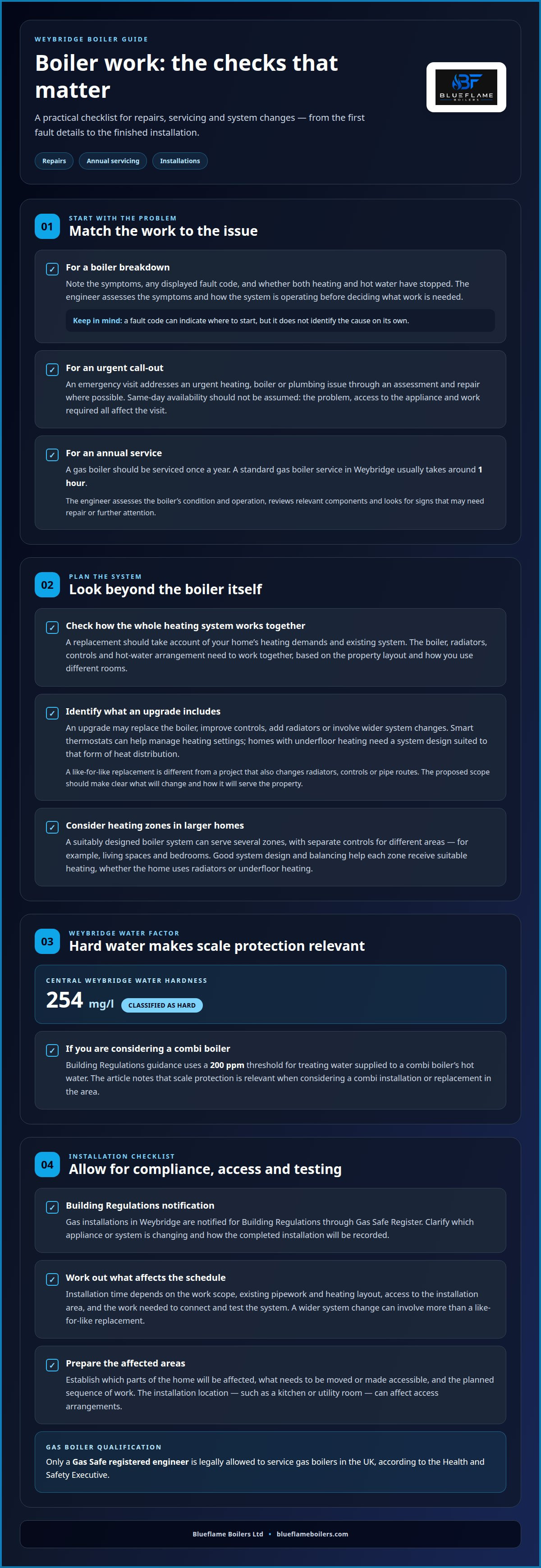
- Understand what a boiler service, repair or replacement can involve, and which details help determine the right work for your heating system.
- Gas installations in Weybridge are notified for Building Regulations through Gas Safe Register, so the installation process includes more than fitting an appliance.
- Local service coverage includes Weybridge and KT13, including St George’s Hill and nearby roads.
- Use Gas Safe registration as a key qualification when arranging work on a gas boiler or appliance.
- Landlords in Weybridge need a gas safety check every 12 months for rented homes, according to the Health and Safety Executive.
Boiler installation, replacement, servicing and repairs
A domestic gas engineer in Weybridge can help with boiler repairs, installation, replacement and servicing. The right service depends on the fault, your existing central heating system and your home’s heating needs.
For a same-day heating, boiler or plumbing problem, an emergency call-out addresses an urgent issue through an assessment and repair where possible. A boiler breakdown can affect heating and hot water, so describe the symptoms, any displayed fault code and whether both have stopped working.
Boiler repairs and same-day call-outs
Repairs address faults that prevent a boiler from heating water or supplying central heating. An engineer assesses the reported symptoms and how the system is operating before deciding what work is needed. A displayed fault code can indicate where to start, but it does not identify the cause on its own.
An urgent call-out is intended for problems that need prompt attention, including a boiler breakdown or loss of heating. Same-day availability shouldn’t be assumed. The issue, access to the appliance and the work required all shape the visit.
Boiler installation and upgrades
A replacement starts with understanding your home’s heating demands and existing system. The boiler, radiators, controls and hot-water arrangement need to work together. A suitable installation takes account of the property layout and how you use different rooms, rather than treating the boiler as a standalone appliance.
An upgrade may involve replacing the boiler or improving controls on an existing heating system. Smart thermostats can provide a way to manage heating settings, while radiator installation can form part of wider system changes. Homes with underfloor heating also need a system design suited to that form of heat distribution.
Ask for the proposed work to be explained in practical terms: what will be installed or changed, how it will serve your property, and what happens to the existing system. These details help distinguish a straightforward replacement from a larger central heating upgrade.
Annual boiler service checks
A gas boiler should be serviced once a year. A standard gas boiler service in Weybridge usually takes around 1 hour. The engineer assesses the boiler’s condition and operation, reviews relevant components and identifies signs that may need repair or further attention.
A service differs from a repair: servicing assesses how the boiler is operating, while a repair responds to a fault. If an issue is found, the next step depends on its nature and effect on the appliance. Clear findings help you understand whether corrective work is needed.
Water hardness is another factor in boiler care. Central Weybridge water has a total hardness of 254 mg/l and is classified as hard. Building Regulations guidance uses a 200 ppm threshold for treating water supplied to a combi boiler’s hot water. Scale protection is therefore relevant when considering a combi installation or replacement in the area.
Heating zones matter in larger homes. A boiler can serve several zones when the system is designed appropriately, with separate controls for different areas. For example, a household may want independent settings for living spaces and bedrooms. Good system design and balancing help each zone receive suitable heating, whether the home uses radiators or underfloor heating.
Gas installations and Building Regulations notification
A gas installation needs to suit the property and its existing heating system. In Weybridge, the work also includes the appropriate Building Regulations notification.
Gas installations and notification
For a boiler replacement, the engineer considers the appliance location, heating controls and how the system serves each room. Room-by-room temperature control can be a useful consideration when planning a boiler replacement. This makes room-by-room control part of the planning, rather than an afterthought once the boiler is running.
Gas installations in Weybridge are notified for Building Regulations through Gas Safe Register. The notification records that relevant installation work has followed the applicable process. Gas appliances also need a suitable connection and a position that works with the property layout. A clear scope should explain which appliance or system is changing and how the completed installation will be recorded.
Installation timescales
Installation time depends on the scope of work, existing pipework and heating layout, and whether the job involves a replacement or a wider system change. A like-for-like boiler replacement differs from work that also changes radiators, controls or pipe routes. Access to the installation area and the work needed to connect and test the system also affect the schedule.
Before work starts, establish which parts of the home will be affected and what needs to be moved or made accessible. For example, replacing a boiler in a kitchen may involve different access arrangements from work in a utility room. Understanding the planned sequence helps you prepare for disruption without assuming every installation follows the same timetable.
Radiator installation or replacement can be part of a central heating project. The engineer considers where each radiator sits and how it connects to the system, so the layout supports the rooms being heated. Replacing one radiator is different from changing several connections during a broader upgrade. Radiator locations and the existing system layout help define the work.
A gas fire installation or service is separate from boiler work. Gas work must be carried out by a Gas Safe registered engineer. The appliance and its position in the room shape the installation requirements, while servicing focuses on the fire itself. Keeping the intended appliance clear in the job scope helps distinguish this work from boiler servicing or central heating changes.
Air conditioning installation and maintenance involve a system separate from gas central heating. If your property has both air conditioning and a boiler, plan for each system independently. A heating upgrade concerns the boiler and radiators, while air conditioning work concerns the cooling system. This distinction helps keep different installation tasks within a clear scope.
For a planned boiler change, discuss a gas boiler installation with the property layout, existing system and intended controls in mind. Clear details help define the installation and its notification requirements.
Service coverage across Weybridge and KT13
Service coverage for Weybridge and KT13 includes homes in St George’s Hill and nearby roads. The exact property address helps establish where a visit is needed and what access arrangements may affect the work. For an engineer attending a boiler fault, a clear location and description of the issue make it easier to understand the job before arrival.
Weybridge includes different housing layouts, from individual houses to larger residential estates. Templemere, for example, is a 1960s estate of 65 houses across 12 acres of historic grounds. Estate layouts can mean shared entrances, internal paths or parking arrangements. Giving the full address and any relevant access details helps avoid confusion between nearby buildings.
St George’s Hill and nearby roads form part of Weybridge. A road name matters, particularly where an estate or adjoining streets can make an address less obvious. When arranging boiler repairs or servicing, share the property location and the appliance’s symptoms to help distinguish a heating fault from an issue elsewhere in the home.
KT13 is the postcode area named for this local service coverage. A postcode helps locate a property, while the full address identifies the specific building or entrance. This is useful on estates such as Templemere, where several homes share the same wider setting. Accurate location details support clearer appointment planning for residents and engineers.
Not every home in Weybridge has an individual boiler. Some properties have a heat interface unit, or HIU, which transfers heat from a communal heating network into the home’s heating and hot-water system. This differs from a domestic boiler breakdown: the fault may relate to the HIU, the home’s controls or the shared heat supply. Identifying the equipment helps describe the repair needed.
For an HIU concern in KT13, useful details include whether heating, hot water or both are affected, and whether the issue is limited to one home. For example, a loss of hot water in one flat points to a different situation from a wider interruption affecting several homes. These observations help define the problem without assuming that every property has the same heating arrangement.
Weybridge homes can have private heating equipment or connect to shared infrastructure. In a house, a boiler may supply its own radiators; in a flat, a heat interface unit may connect to a communal system. Naming the equipment and describing the affected service helps clarify whether the issue concerns boiler repairs, routine servicing or another heating component.
When arranging a local visit, provide the Weybridge or KT13 address, the property type and a concise description of the fault. Include estate or building details where relevant, such as a block name or entrance. Those practical details help connect the reported heating problem with the right property and its system.
Gas Safe registration
Gas Safe registration matters whenever work involves a gas boiler or appliance. According to the Health and Safety Executive, only a Gas Safe registered engineer is legally allowed to service gas boilers in the UK. In Weybridge, gas work is carried out by a Gas Safe engineer. The person doing the work should have the relevant registration and skills for the job.
Registration is relevant to more than routine servicing. A boiler repair, replacement or gas installation each involves different work on an appliance or system. Before work begins, establish which gas task is needed and who will carry it out. A reported boiler fault, for example, calls for an engineer able to assess and repair that appliance, not someone attending for unrelated plumbing work.
Qualification is another part of choosing an engineer. The recommended qualification is NVQ Level 3 in gas installation, or an equivalent qualification. This sits alongside Gas Safe registration as a useful measure of relevant competence. For a domestic gas engineer in Weybridge, the practical point is to match the engineer’s registration and training to the work planned at the property.
Clear communication helps define the job. Describe the appliance, the fault or planned change, and whether heating, hot water or both are affected. This helps establish whether the visit concerns servicing, a repair or installation. A boiler displaying a fault code, for example, presents a different starting point from a planned replacement.
Gas Safe registration distinguishes gas work from other home maintenance. A radiator change or general plumbing task may form part of a wider project, but work involving a gas boiler needs an appropriately registered engineer. If your project includes several tasks, make the gas component clear so it is not confused with non-gas work.
For landlords, the same principle applies when arranging work at a rented property. A gas safety check and boiler service involve gas appliances, so the engineer must meet the applicable registration requirement. A clear job description helps distinguish a safety inspection from a repair or new installation.
Registration does not replace the need to explain the work. A clear scope identifies the appliance, requested task and any reported symptoms. State whether a gas fire or boiler needs attention, rather than describing only a general heating problem. This gives the engineer a clearer basis for assessing the visit and carrying out the relevant work.
For gas boiler servicing in Weybridge, Gas Safe registration is a legal requirement, not an optional extra. Pairing it with the relevant skills and a precise description of the task helps keep the appointment focused. This is useful when a repair, service and wider heating-system concern might otherwise be mistaken for the same job.
Gas safety inspections and CP12 certificates
For rented homes in Weybridge, a gas safety check is a recurring landlord responsibility. Landlords in Weybridge need a gas safety check every 12 months for rented homes, according to the Health and Safety Executive. Keeping the inspection date and record organised helps landlords track when the next check is due.
A CP12 is commonly known as a landlord gas safety certificate. The gas safety check is the inspection; the resulting record documents its outcome. Landlords need a valid CP12 Gas Safety Certificate for their properties. It’s useful to keep the record with the property’s tenancy documents, so it can be located when needed.
Landlords are responsible for arranging the annual gas safety check and boiler servicing for a rented home. These are related but distinct appointments. A safety check records the result of the gas inspection, while boiler servicing assesses the boiler’s condition and operation. Arranging both keeps safety records and routine boiler maintenance clear.
For a property with several gas appliances, plan the inspection around the home and its gas equipment. Providing the address, access arrangements and known appliance details helps organise the visit. Explain whether the home has a boiler, gas fire or another gas appliance requiring attention.
After the check, the landlord should retain the gas safety record and provide a copy to tenants. This creates a clear record for both parties. If a new tenancy begins or an existing tenant asks about the inspection, an organised copy helps the landlord respond with the relevant document rather than relying on memory.
A CP12 check should not be confused with a boiler repair. If an inspection identifies an issue, the record helps clarify what was found, while any required repair is separate work. Keeping the inspection outcome and repair information together makes the property’s gas-safety history easier to follow.
Landlords can help organise an appointment by sharing the Weybridge property address, access details and known gas appliances. If tenants occupy the home, coordinating access with them helps the inspection take place. Keeping the previous gas safety record available also helps maintain a consistent file.
For a portfolio of rented homes, recording each address and inspection date separately reduces the chance of overlooking a property. A property-by-property schedule can show which homes have current records and when the next checks are due. The same file can hold tenants’ copies and related boiler service records.
Landlords who need a CP12 inspection can arrange a landlord gas safety check.
Blueflame Boilers
Blueflame Boilers Ltd helps Weybridge homeowners with gas boilers and central heating. Services include gas boiler installation, repairs, servicing and emergency call-outs, covering planned work as well as unexpected faults.
If you are planning a boiler replacement, you can discuss the installation with Blueflame Boilers Ltd. If your boiler has broken down, the team can help with repairs. Servicing is also available to assess the boiler’s condition. The right service depends on whether you need maintenance, a new installation or help with a fault.
When you get in touch, describe the issue or planned work and share the property details. This gives the team a clear starting point for discussing the next step.
Take the next step for your home
Knowing what kind of work you need makes it easier to move from concern to a clear plan. Whether you have a boiler fault or are considering a heating change, focus on the outcome you need and the details that matter in your home. That gives your conversation with a domestic gas engineer in Weybridge a useful starting point.
Blueflame Boilers Ltd provides gas boiler installation, boiler repairs and emergency call-outs. Explain whether the issue is urgent or planned, and share the property details and what you want the work to achieve. The team can then discuss the relevant service and next steps.
A clear first conversation is a practical way to get your heating plans moving.
Frequently Asked Questions
Need Help with a Heating Emergency?
If your boiler has stopped working, describe the fault and whether you’ve lost heating, hot water or both when arranging help. Blueflame Boilers Ltd offers emergency call-outs for heating issues. If you suspect a gas leak, call the National Gas Emergency Service on 0800 111 999. A gas leak requires a different response from a boiler breakdown, so use the appropriate emergency service.
How do I find a Gas Safe registered domestic gas engineer in Weybridge?
Choose an engineer registered for the gas work your property needs. A domestic gas engineer in Weybridge should be suitable for the task, whether it involves a boiler fault, servicing or installation. Explain the appliance and work required when making an enquiry. This helps establish whether the visit concerns a gas boiler, another appliance or a wider heating issue.
Which domestic gas engineers serve Weybridge and nearby areas?
Blueflame Boilers Ltd serves Weybridge and nearby Surrey areas, including Cobham, Epsom, Tadworth and Woking. Coverage across these towns can help homeowners with different property locations arrange local heating work. When enquiring, give the full address and postcode, especially if the home is on an estate or within a larger development. Clear location details help identify the property and plan the visit.
Can I check a gas engineer’s Gas Safe registration and qualifications?
Yes. For gas boiler work, check that the engineer is Gas Safe registered and has a relevant qualification, such as NVQ Level 3 in gas installation or an equivalent. Registration and qualification are separate considerations: together, they help show that the engineer is appropriate for the work. The Health and Safety Executive says only a Gas Safe registered engineer may legally service gas boilers in the UK.
How soon can a gas engineer in Weybridge respond to an emergency?
Response timing depends on the call-out situation, location and work required. Blueflame Boilers Ltd offers emergency call-outs, but no specific arrival time is promised. When reporting a problem, explain whether the boiler has stopped, which services are affected and whether you suspect a gas leak. If you suspect a leak, contact the National Gas Emergency Service rather than waiting for a boiler visit.


