

A CP12 check is usually a focused appointment, not a day-long disruption. In Sutton, a gas safety check typically takes 30-60 minutes per property, depending on the number of gas appliances, so a CP12 certificate in Sutton can often be arranged around the day’s other plans.
If you’re a landlord, it helps to know what the engineer will inspect and what the certificate records. The Health and Safety Executive says landlords must arrange a gas safety check every 12 months for each rental property.
This guide explains what a CP12 covers, what can affect the appointment time, and how to arrange a professional check for a rental property in Sutton and nearby areas. You’ll also learn what happens if the engineer finds a safety issue, so you can plan the next steps with confidence.
Key Takeaways
- A gas safety check in Sutton usually takes 30-60 minutes per property, with the number of appliances affecting the appointment length.
- A CP12 records the gas appliances and flues inspected, the check results and any defects or actions needed.
- Landlords must arrange checks every 12 months and give tenants a copy of the record within 28 days of the check.
- A landlord’s gas safety check must be carried out by a Gas Safe registered engineer.
- For several rental properties, organise access and appliance details for each address to help the checks run smoothly.
What is a CP12 / Landlord Gas Safety Record?
A CP12, also called a Landlord Gas Safety Record, documents the outcome of a landlord gas safety inspection. For a Sutton rental property, it provides a written record of the gas appliances and flues checked, their condition and any required action.
It also helps landlords track inspection dates and provide tenants with the information they need. The record is specific to the property and inspection, so keep it with the relevant tenancy documents.
Written Reports for Landlords and Tenants
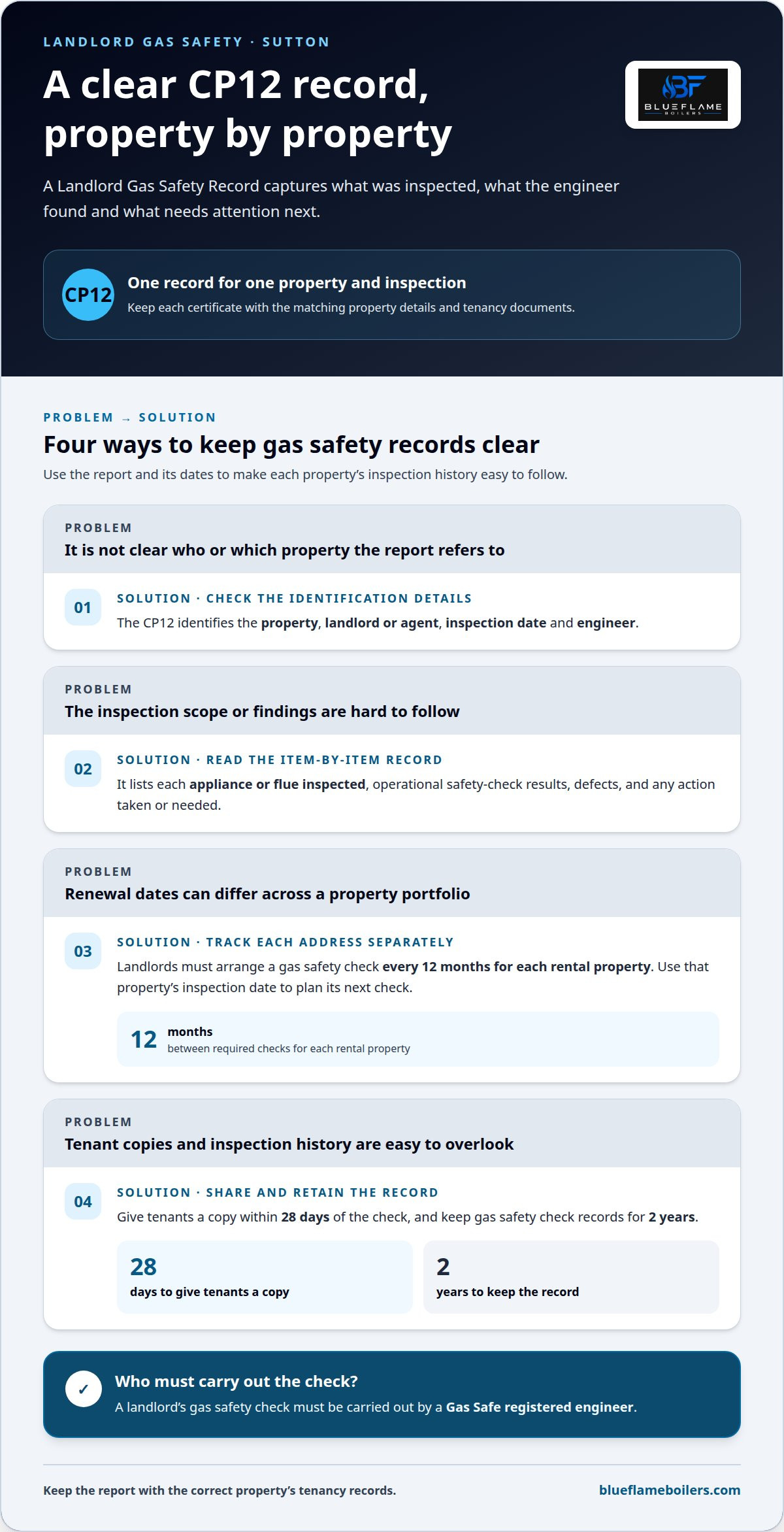
A CP12 report identifies the property, the landlord or agent, the inspection date and the engineer who carried out the check. It records each appliance or flue inspected, operational safety-check results, defects and any action taken or needed.
These details give landlords and tenants a clear account of the inspection, not merely confirmation that an appointment took place. For example, the report can identify an appliance that needs attention and explain the safety issue found by the engineer.
Annual Renewals and Inspections
Landlords must arrange a gas safety check every 12 months for each rental property they own, according to the Health and Safety Executive. That makes the inspection date a practical point for planning the next check and keeping the property’s records current.
For a property with several appliances, the inspection record helps show which items were included. A renewal is not just a new date on a document: it follows a fresh inspection of the relevant gas appliances and flues.
Landlord Certificate Requirements
The Gas Safety Regulations 1998 set out landlords’ duties to ensure gas appliances, fittings and chimneys or flues provided for tenants are safe to use, according to UK legislation. A CP12 records the outcome of the landlord gas safety inspection for the property.
Check that the report identifies the appliances and flues inspected, the results and any defects or actions required. For a rental property in Sutton, this property-specific record helps keep gas safety paperwork clear and organised.
Records and Tenant Copies
Landlords must give tenants a copy of the gas safety certificate within 28 days of the check, according to the Health and Safety Executive. The copy should be the record for the property, with the inspection date and results visible to the tenant.
The Health and Safety Executive also says landlords must keep gas safety check records for two years and issue a copy to each existing tenant. Keeping the report with the property’s tenancy records makes it easier to track the inspection history and provide the right document.
For landlords managing homes in Sutton, a consistent record for each address can reduce confusion when inspection dates come around. Keep each CP12 with the matching property details, then use its inspection date to plan the next annual check. If a report lists a defect or required action, its written findings show what needs attention before the record is treated as a successful check.
Gas Safety (Installation and Use) Regulations 1998
The regulations set out landlords’ gas safety responsibilities in rented homes. They define who needs a gas safety record, how checks fit into property management and which records support compliance.
Who Needs a Gas Safety Certificate
Landlords who provide gas appliances, fittings or flues for tenants need to arrange gas safety checks for their rental properties. The Gas Safety Regulations 1998 set out these duties, according to UK legislation. The requirement applies to accommodation occupied under a lease or licence, so it can cover more than a conventional private tenancy.
For a Sutton landlord, start by identifying each rented address where gas is provided. The record should relate to that property and its inspected appliances, rather than being treated as a general certificate for an entire portfolio.
Gas Safety Certificate Prices
The cost depends on the property and is provided after a quote request. Factors include the number of gas appliances and flues to inspect, the property layout and the scope of the appointment. A home with a boiler and gas cooker, for example, involves different items from one with additional gas appliances.
When booking, provide the Sutton address and details of the known gas appliances. Clear information helps define what the inspection covers and avoids confusion about which items should be checked. The quote should relate to the agreed inspection, not assume that every gas appliance is automatically included.
Annual Gas Safety Checks
Landlords must arrange a gas safety check every 12 months for each rental property, according to the Health and Safety Executive. Treat each property’s inspection date as its own planning point. A portfolio may therefore have different renewal dates, depending on when checks were last completed at each address.
Use the existing record to identify the inspection date and the appliances listed. Booking the next check in good time helps keep the property’s paperwork organised and gives the landlord a clear record of the latest inspection.
Gas safety checks can be coordinated with other property appointments. In Sutton, gas, EICR, EPC or PAT checks can be scheduled around the same access arrangements. These are separate checks with different purposes, so be clear about which inspections are required at the property.
An EICR concerns a property’s electrical installation, while an EPC records its energy performance. Coordinating access can be useful for landlords preparing a rental home, but it does not combine the checks into one assessment. The gas safety record remains specific to the gas appliances and flues inspected.
For a Sutton rental property, keep the gas appointment tied to its own inspection scope and record. Enquire about arranging a gas safety check for the property.
What is a Gas Safety Certificate?
A gas safety certificate records the outcome of an inspection at a rented property. A Gas Safe registered engineer carries out the check and records whether inspected gas appliances and flues are safe to use.
Gas Safe Registered Engineers
A landlord’s gas safety check must be carried out by a Gas Safe registered engineer. The engineer inspects the gas appliances, fittings and flues provided for tenants, then records the findings for that property.
The inspection can include checks for leaks or blockages, an assessment of ventilation and tests of safety devices. For example, an engineer may inspect a boiler and gas cooker, then record the safety results for each item.
Gas Safe Registration
Gas Safe registration confirms that an engineer is registered to carry out gas work. For landlords arranging annual gas safety checks, using a registered engineer is essential to obtaining a valid gas safety record.
The record identifies the engineer and their registration number, along with the inspection date and property details. Landlords can use this information to match the report to the correct Sutton address and its gas appliances.
A gas safety certificate is not the same as a boiler service record. The safety inspection focuses on whether the gas appliances, fittings and flues checked are safe to use. A boiler service may involve broader maintenance, so the appointment’s scope matters.
During a gas safety inspection, the engineer assesses appliance condition and checks relevant safety functions. The inspection can include flue flow and pressure tests, as well as checks for leaks, ventilation and working safety devices.
If an inspection identifies an unsafe appliance, the engineer may shut it off and note the issue on the record. Any repair needs should be discussed with the engineer. The written finding helps the landlord understand which appliance needs attention.
For a landlord in Sutton, the certificate should clearly relate to the inspected property and gas equipment. A report for one address does not document checks at another address, even when both homes belong to the same landlord.
Read the results alongside the list of appliances and flues inspected. Any recorded defect or action matters as much as the inspection date: it shows where follow-up work is needed and does not imply that every appliance passed.
Keep the inspection record with the property’s safety paperwork. When planning an annual check, the previous report helps identify the items inspected and provides a clear reference for the next visit. This makes the certificate useful beyond simply documenting that an engineer attended.
Can you do multiple properties on a portfolio?
Yes. Landlords can arrange gas safety inspections across a property portfolio, but each rented home needs its own inspection and record. Organise appointments by address, with a separate list of the gas appliances, fittings and flues at each property. This makes it easier to match every finding to the right home.
A portfolio schedule can group properties by location or access arrangements. For example, a landlord managing several Sutton homes can prepare each address and its available appointment times together. The engineer still inspects the relevant equipment at each property, and each gas safety record identifies the address and items checked.
What the inspection covers
A gas safety check can cover boilers, gas fires and cookers, together with the fittings and flues serving them. The engineer visually inspects appliances, tests flue flow and pressure, checks for leaks or blockages, assesses ventilation and tests safety devices. The inspection assesses how the installation operates, not just whether an appliance switches on.
Pipework matters too. If a tenant owns a gas appliance that the landlord did not provide, the landlord is responsible for maintaining the gas pipework to it, but not the tenant’s appliance. This distinction helps clarify which part of the installation falls within the landlord’s responsibility.
When an appliance is unsafe
If an inspection identifies an unsafe appliance, the engineer may shut it off and record the issue. The report should set out the defect and any action taken or needed. For example, a boiler that cannot be used safely may be recorded as unsafe, even if other appliances are working.
An unsafe appliance may need further action before it can be treated as safe. The finding therefore affects both the property’s safety record and the next steps needed for that appliance. Keep the report with the address’s portfolio file so its status is clear.
For multiple properties, organise each appointment around the equipment and access arrangements at that address. A home with a boiler and cooker has different items to inspect from one that also has a gas fire. Sharing accurate appliance details when booking helps define the inspection scope and avoid mix-ups between properties.
Once the checks are completed, keep each record paired with its property details and inspection findings. This makes it easier to identify which appliances were checked, where action is required and which homes need follow-up. A portfolio overview can track appointments, while individual records preserve the detail for each rented property.
CP12 services in Sutton and nearby areas
For landlords arranging a CP12 certificate in Sutton, the check must be carried out by a Gas Safe registered engineer. The inspection covers the rental property’s relevant gas appliances, fittings and flues, with findings recorded for that address. Each appointment should be planned around the property’s equipment and access.
Sutton and Nearby Service Areas
At booking, provide the full property address and the gas appliances known to be present, such as a boiler, cooker or gas fire. This helps define what the engineer needs to inspect. For a CP12 certificate in Sutton, keeping the address and appointment details together helps ensure the resulting record relates to the correct rental home.
Landlords with homes in Sutton and nearby areas can organise each address as a separate appointment. Keep the access arrangements and previous gas safety record with that property’s details. This helps prevent findings being mixed up and makes clear which visit relates to each rental.
A gas safety check is an inspection, not simply a test of whether the boiler operates. The engineer assesses the gas appliances, associated fittings and flues within the agreed scope. If the property has more than one appliance, include those details when booking so the visit can be planned appropriately.
Engineers Providing Sutton CP12 Certificates
Which Gas Safe registered engineers provide CP12 certificates in Sutton? Landlords must use a Gas Safe registered engineer for the gas safety check. The certificate records the engineer’s details and registration number, alongside the property address, inspection date and results.
For a Sutton inspection, the engineer attending must be Gas Safe registered for the work being carried out. The resulting record should identify the equipment inspected and any defects or actions. This gives the landlord a property-specific account, rather than a general note that someone visited.
After the inspection, use the report to understand the outcome for each appliance. If a defect is recorded, the report shows the action needed. If the inspection identifies a safety concern, follow the engineer’s advice before using the appliance. Keep the report with the correct rental address, especially when managing several homes.
When arranging a CP12 certificate in Sutton, provide the property address, appliance details and access arrangements. The check usually takes 30-60 minutes per property, depending on the number of gas appliances. Allow time for the engineer to complete the inspection and record the results.
Blueflame Boilers Ltd: Landlords Gas Safety Checks - CP12
Blueflame Boilers Ltd provides Landlords Gas Safety Checks - CP12 for landlords arranging an inspection for a rental property. It’s a practical next step when a check is due, a tenant changes, or you need an up-to-date record for your property paperwork.
Have the Sutton property address and appliance details ready when arranging the visit. The inspection records its findings, including any defects or actions needed. If it identifies a boiler issue, Blueflame Boilers Ltd also offers boiler repair. Gas boiler installation is available if a replacement is needed.
Choose a CP12 check for the landlord’s gas safety requirement, and arrange repair or installation if the inspection identifies further work.
Contact Blueflame Boilers Ltd or visit blueflameboilers.com to arrange a landlord gas safety check.
Plan the next step for your rental property
For a CP12 certificate in Sutton, make the inspection result part of a practical maintenance plan. Use the report to identify any follow-up work, then keep that information with the property’s maintenance records. This gives you a clear reference when planning future work or discussing the property with tenants.
If the findings point to a boiler problem, Blueflame Boilers Ltd offers boiler repair. Gas boiler installation is available if a replacement is needed, and emergency callouts can help with urgent boiler issues. Let the inspection findings guide which support is relevant.
Each rental property has its own equipment and maintenance history, so keep its records together. A clear file makes it easier to act on inspection findings and plan any necessary work.
Visit blueflameboilers.com to explore services or arrange a check.
With a clear record and a practical plan, you can move forward with confidence.
Frequently Asked Questions
How long does a gas safety check take?
A gas safety check usually takes 30-60 minutes per property, depending on the number of gas appliances. A boiler and cooker need inspection, for example, so allow time for both. Access to the appliances and flues also helps the engineer complete the visit efficiently. For a portfolio, plan appointments by address so each property’s inspection and record remain clearly matched.
Are there any specific Sutton Council requirements I should know about?
Sutton Council operates selective licensing in designated wards, including Sutton town centre. This is separate from landlords’ gas safety duties: a licence does not replace a gas safety check or its record. If you let a property in Sutton, consider its location and the relevant licensing scheme alongside your gas safety arrangements. Keep each property’s paperwork organised under its address.
Do you cover the whole of Sutton and the wider London area?
Blueflame Boilers Ltd serves Sutton and nearby areas, including Ewell, Cheam, Carshalton, Banstead, Epsom, Ashtead, Leatherhead, Cobham, Weybridge, Reigate, Tadworth and Woking. Its local coverage also includes Worcester Park, Bookham, Effingham, Horsley, Ripley and Kingswood in Surrey. Service is focused on Surrey and surrounding areas, not the whole of London.
How quickly can you carry out a Gas Safety in Sutton?
The check itself typically takes 30-60 minutes per property. Appointment timing depends on scheduling and access to the rental home and its gas appliances. If you manage several Sutton properties, have each address and its access arrangements ready when organising the visits. This helps keep appointments and the resulting records matched to the right homes.
What is a CP12 certificate, also called a landlord gas safety record?
A CP12 is the written record of a landlord gas safety inspection. It gives the landlord and tenant a dated account of the gas equipment inspected and the recorded findings. It is specific to the property and inspection, rather than a general statement about every system in a home. Keep it with that rental’s paperwork so it can be found when needed.
How much does a CP12 gas safety check cost in Sutton, London?
The cost depends on the property and inspection scope, and is given after a quote request. The number and type of gas appliances and flues to inspect affect what the visit involves. For an accurate quotation, provide the Sutton address and details of the known appliances. No service price should be assumed from figures advertised for other properties or providers.
What does a CP12 inspection cover, and which appliances are included?
A CP12 inspection covers the gas appliances, fittings and flues provided for tenants. Typical examples include a boiler, gas fire or cooker. The engineer may assess ventilation, check for leaks or blockages, test safety devices and record operational results. The report identifies the equipment inspected, so landlords can see what the findings apply to and whether any action is recorded.
How often must a landlord renew a CP12 certificate in England?
Landlords must arrange a gas safety check every 12 months for each rental property, according to the Health and Safety Executive. Treat each address separately when planning renewals, especially if you manage several homes with different inspection dates. The latest inspection date on each property’s record gives you a clear reference for organising its next check and maintaining an orderly file.


