

A fixed price boiler service can make budgeting easier, but it’s just as important to know exactly what the service includes. Boilers should be serviced annually, and missing a service may affect some manufacturers’ warranty terms.
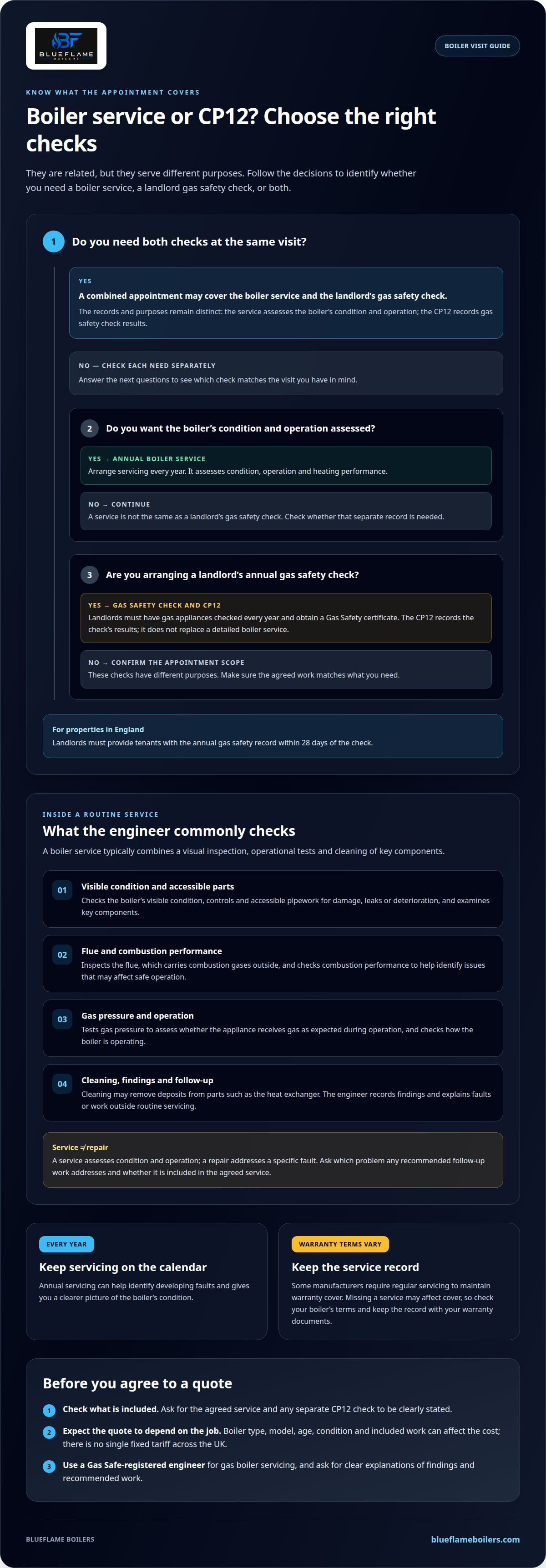
It’s understandable to want a clear answer on what an engineer will check and whether a landlord’s CP12 gas safety check is the same as a boiler service. They’re related, but they have different purposes. A service focuses on the boiler’s condition and operation; a CP12 records the results of gas safety checks.
This guide explains why annual servicing matters, what checks are commonly included and how warranty conditions can apply. It also looks at the factors that shape boiler service and CP12 costs, so you can understand what a quoted price covers and what to expect from a professional visit. Clear information helps you plan routine maintenance with confidence and know when a separate repair may be needed.
Key Takeaways
- Arrange a boiler service every year and review your warranty terms, as missed servicing can affect cover.
- Understand the difference between a boiler service, which assesses the boiler’s condition, and a CP12 gas safety record.
- Find out which visual checks, flue inspections, pressure tests and cleaning are commonly part of a service.
- Use a Gas Safe-registered engineer for gas boiler servicing, and look for a clear explanation of any recommended repair work.
- See which factors can affect the cost of a service or a combined CP12 check, and what to clarify in a quote.
Why should you get a boiler service?
Arrange an annual boiler service to assess its condition, operation and heating performance. There’s no single fixed tariff across the UK: the quote depends on the boiler and the work included.
Benefits of annual servicing
A yearly inspection gives an engineer the chance to spot developing faults before they disrupt heating or hot water. It also provides a clearer picture of the boiler’s condition, helping you understand whether it needs attention beyond routine maintenance. Boilers typically last 10 to 15 years with proper maintenance, so regular servicing can support informed decisions as the system ages.
Note how the boiler performs between services. Changes to heating or hot water are useful context for the engineer, alongside the boiler’s make, model and service history. Sharing these details helps focus the inspection and gives you a practical record of the boiler’s condition.
Servicing and boiler warranties
Annual servicing can matter to your warranty as well as your boiler’s condition. Some manufacturers require regular servicing to keep warranty cover valid, and missing a service may affect that cover. Terms vary, so check the servicing conditions for your boiler rather than assuming every warranty works the same way.
Keep the service record with your warranty documents. If you make a claim later, it can show when the boiler was serviced. Note the date, findings and any recommended work, then follow the manufacturer’s requirements for future servicing.
A service plan is another way to organise annual maintenance. Payments may be spread out, but cover varies: one plan may include only the annual service, while another may also cover repairs or replacement parts. Compare the service frequency, exclusions and repair cover to decide whether a plan suits your household. It isn’t automatically the same as a one-off fixed-price appointment.
Boiler cover is different from routine servicing. Cover plans commonly combine an annual service with repairs and replacement parts, but the terms determine what’s included. Check whether the plan covers only the boiler or other heating equipment too, and whether limits apply to parts or repairs. These details matter more than the monthly payment alone.
For a one-off appointment, the fixed quote should clearly state the agreed service. Boiler type, model, age and condition can affect the work required. If the inspection identifies a fault, the engineer can explain whether it needs a separate repair: servicing and repair are different tasks. Knowing the distinction helps you understand what the appointment covers and what any further work involves.
Checks included in a boiler service
A boiler service typically combines a visual inspection, operational tests and cleaning of key components. The engineer records the findings and explains any faults requiring separate attention.
Boiler inspection checks
The engineer examines the boiler’s visible condition, controls and accessible pipework for damage, leaks or deterioration. They also inspect the flue, which carries combustion gases outside, and check that the boiler’s key components are in suitable condition. Cleaning may be needed to remove deposits from parts such as the heat exchanger.
These checks help show how the appliance is operating. The engineer records the findings and identifies any work outside the scope of routine servicing.
Fault diagnosis and safety checks
A service can uncover faults that aren’t obvious in everyday use. The engineer assesses the boiler’s operation, checks for leaks and looks for signs of wear or damage to its components. If the heating has been unreliable, explain the symptoms and when they occur. This context can help direct fault diagnosis.
Routine servicing and repair are different: a service assesses condition and operation, while a repair addresses a specific fault. Ask for a clear explanation of any recommended follow-up work, including which problem it addresses and whether it’s part of the original service.
Gas pressure and flue gas checks
Gas pressure tests help assess whether the appliance receives gas as expected during operation. The engineer also inspects the flue and checks combustion performance to help identify issues that may affect safe operation. These are technical checks, not simply a visual inspection of the boiler casing.
The engineer can explain test results and record relevant findings. If a result points to a fault, the next step is to understand its cause and the work needed to address it.
A boiler service is not the same as a landlord gas safety check. In the United Kingdom, landlords must have gas appliances checked every year and obtain a Gas Safety certificate. A CP12 records the results of the gas safety check; it does not replace a detailed boiler service.
In England, landlords must provide tenants with the annual gas safety record within 28 days of the check, according to the UK Government. Tenants can ask when the latest check took place and whether a record is available. A combined appointment may cover the boiler service and the landlord’s gas safety check, but the records and purposes remain distinct.
Clear findings make it easier to decide what happens next. If you need to arrange an inspection or discuss a fault, make an enquiry about the boiler work required.
Boiler servicing and manufacturer warranties
Warranty terms can make annual servicing an important part of maintaining boiler cover. Requirements vary by manufacturer and the wording of the warranty.
Warranty servicing requirements
Major boiler manufacturers require annual servicing by a Gas Safe-registered engineer to maintain extended warranty cover. Missing a service may affect the warranty, even if the boiler continues to provide heating. Keep the service record with the warranty and installation documents as evidence of when the work was done.
Workmanship and parts warranties
A manufacturer’s boiler warranty, a parts warranty and a guarantee for repair workmanship refer to different types of cover. The manufacturer’s terms explain what applies to the boiler; parts or workmanship documents relate to specific replacement work or repairs. Read the wording carefully to identify what’s covered, which work it refers to and any conditions.
Start with the warranty booklet or registration documents supplied with your heating system. Check the required service interval, who must carry out the work and how to record it. Annual servicing is a common condition, but the written terms apply to your particular boiler. Don’t assume one manufacturer’s requirements apply to every model.
Keep a simple record after every appointment. Note the service date, boiler model, engineer’s findings and any follow-up repairs. If a later claim concerns a component, these details can help establish the appliance’s maintenance history. Store invoices and service reports together rather than relying on a calendar reminder alone.
Parts cover and repair workmanship can have separate conditions. One document might cover a replacement component, while another describes work done to diagnose or repair a fault. Check whether the paperwork names the part or repair, describes the covered work and states any limitations. Don’t assume a boiler warranty covers every repair or replacement.
Gas safety and warranty cover are related, but they’re not interchangeable. A gas safety record documents the outcome of a safety check; a manufacturer’s warranty sets out the appliance cover under its terms. Keep each document with the relevant service or repair record so you can identify what work was done and why.
If servicing has lapsed or a fault appears, read the warranty conditions before arranging repairs. This helps you understand the required service history and the claims process. A trusted engineer can explain the inspection findings and distinguish routine servicing from repairs, helping you choose your next step.
Gas Safe registration and avoiding overcharging
Gas boiler work must be carried out by an engineer with the appropriate Gas Safe registration. Registration is a legal requirement for gas boiler engineers, whether the job is a routine service, repair or replacement. Confirm that the engineer doing the work is registered for the gas work involved.
Gas Safe registration applies to gas work, not every heating task. A qualification alone doesn’t replace Gas Safe registration. For a boiler breakdown, make sure the person attending is registered to work on gas appliances.
Before agreeing to a fixed-price boiler service, establish exactly what the quote covers. It should distinguish routine servicing from fault diagnosis, repairs and replacement parts. If the engineer finds a faulty component during the service, ask what the fault is and what work is proposed before agreeing to any additional cost.
Ask for the service scope in plain language. It should identify the boiler being serviced and explain whether the appointment covers routine checks only. If the quote includes a separate repair, the engineer should describe what has failed and why the repair is needed. This makes it easier to distinguish the agreed service from extra work.
Be alert to unclear changes to the agreed work. If the engineer recommends replacement parts, ask which component needs replacing and how it relates to the reported fault. A breakdown may require repairs beyond a standard service, but that doesn’t make every additional item necessary. A specific explanation helps you decide whether to authorise the work.
The quote depends on the case, including the boiler type, model, age and condition, and whether repairs or parts are needed. Check that the quoted factors match the work described, rather than treating a service quote as cover for unrelated faults. A fixed quote is most useful when its scope and exclusions are clear.
Keep the quote, invoice and service record together. They show what was agreed, what work was done and whether a repair followed. If the charge changes during the appointment, compare the new work with the original scope and ask why before approving it. Clear records help resolve misunderstandings about servicing or repairs.
A registered engineer should explain inspection findings without pressuring you into an immediate replacement. If the boiler can be repaired, the fault and proposed repair should be clear. If replacement is recommended, the explanation should relate to the appliance’s condition. This distinction helps you make a considered decision after a breakdown or routine visit.
Boiler service and CP12 prices
The cost depends on what the appointment covers: a boiler service, a CP12 gas safety check, or both. For a quote, the price depends on the case and is given after a quote request; relevant factors include the boiler type, model, age, condition, number of gas appliances and whether you need a combined appointment.
A standard boiler service focuses on the appliance’s condition and operation. A CP12 gas safety check records checks on gas appliances in a rented property. Since the work has different purposes, a combined appointment should make clear which checks and records are included, rather than treating the two as interchangeable.
For landlords, the number and types of gas appliances matter. For example, if a property has a boiler and gas hob, the quote should identify which appliances the gas safety check covers. A boiler service concerns the boiler itself, so ask for the scope to distinguish it from checks on other appliances.
A fixed-price quote is useful when it explains what happens if the engineer finds a fault. Routine servicing assesses the boiler; it doesn’t automatically include repairs or replacement parts. If an issue needs a separate boiler repair, the engineer should explain the fault and proposed work before you decide whether to proceed.
Compare quotes by scope, not just by the headline amount. Look for clear details on:
- Whether the appointment covers a boiler service, a CP12 check or both.
- Which gas appliances are included in the safety check.
- Whether the service includes cleaning or only inspection and testing.
- How faults, parts and any additional repair work are handled.
- Which records you receive after the checks are completed.
These details explain why quotes may differ. A quote covering several appliances and a gas safety record has a different scope from a boiler-only service. The boiler’s age and condition can also affect whether the appointment stays routine or identifies further work. The written quote should separate the agreed service from additional work.
Landlords in England must provide tenants with the annual gas safety record within 28 days of the check, according to the UK Government. That record matters alongside the price: make sure the quote covers the required appliances and explains what documentation follows. Gas safety checks must be carried out by appropriately registered engineers.
For a clear quote, describe the boiler and whether the property has other gas appliances. State whether you need a service, a CP12 check or both. This helps define the work before the appointment and makes it easier to understand what the quoted price covers.
Blueflame Boilers Ltd: Moling service for supply pipe
Blueflame Boilers Ltd can help when a heating issue points to a problem beyond the boiler itself. A boiler service checks the appliance, while a damaged mains water supply pipe is a separate issue that may need another solution.
The moling service for a supply pipe covers the route from the external stop cock in the road to the internal stop cock inside your property. It may be relevant to a supply pipe problem rather than a boiler fault. For a boiler fault, the next step may be a repair; if the boiler needs replacing, a new gas boiler installation may be appropriate.
If you’d like to discuss the right next step, contact Blueflame Boilers Ltd.
Choose the next step for your heating
Use what you’ve learned to decide what your boiler needs next. If it’s running normally, plan routine maintenance around your household’s heating needs. If you’ve noticed a fault, unusual operation or a loss of hot water, describe the symptoms clearly when arranging help. This gives the engineer a useful starting point.
A fixed-price boiler service is most useful when its scope matches the work you need. Blueflame Boilers Ltd also provides boiler repairs, gas boiler installation and emergency callouts, so the next step can match your needs, whether that’s maintenance, repair or replacement. You don’t need to decide which applies before explaining what’s happening.
If you know them, share the boiler’s make and model, along with any recent changes in its performance. A straightforward conversation can help you describe the issue and work towards a practical plan for your home.
Good heating starts with a clear plan. Take the next step when you’re ready.
Frequently Asked Questions
What’s not included?
A routine service doesn’t automatically include repairs, replacement parts or a landlord’s CP12 gas safety check. For example, if an engineer finds a faulty valve during an annual service, diagnosing or replacing it may be separate work. The agreed scope matters: read what the appointment covers, including any cleaning or records, and distinguish those tasks from additional work recommended after inspection.
Are the repair quotes fixed, or will I have to pay unexpected additional fees?
A repair quote applies to the work it describes; it doesn’t automatically cover a different fault found during the repair. If the engineer identifies another issue, ask about its cause, the proposed work and any revised cost before authorising it. For example, a quote to replace one failed component doesn’t mean you’ve agreed to replace other parts discovered during the visit.
What does a fixed-price boiler service include?
The checks depend on the agreed service, but a gas boiler service commonly includes visual inspection, flue checks, pressure tests, cleaning key components and a condition report. For example, the engineer may inspect accessible pipework and assess the boiler’s operation. Appointment details should clarify whether testing, cleaning and a report are included, rather than leaving the scope implicit.
Are parts and repairs included in a fixed-price boiler service?
Parts and repairs aren’t automatically included in routine servicing. A service assesses the boiler; a repair addresses a fault, and replacement parts may involve separate work. Boiler cover plans commonly include an annual service, repairs and replacement parts, but the terms define the actual scope. If the service identifies a failed component, get the repair explained separately before agreeing to it.
Do boiler service prices vary by boiler type, brand or location?
Yes. Quotes can vary with the boiler’s type, model, age and condition, as well as the work included and the property’s location. A straightforward combi boiler appointment may have a different scope from a service involving another appliance or a landlord’s gas safety check. Compare what each quote covers, not just the headline amount, to understand the difference.
How often should a gas boiler be serviced in the UK?
A gas boiler should be serviced once a year. Regular annual servicing can also matter for the manufacturer’s warranty, so keep the service record with the boiler documents. For landlords in England, gas appliances must be checked every year, with a gas safety record provided to tenants within 28 days of the check, according to the UK Government. A boiler service and the landlord’s safety record serve distinct purposes.
How can I find a Gas Safe registered engineer for a fixed-price boiler service?
Choose an engineer who is Gas Safe registered for gas boiler work. Registration is a legal requirement for gas boiler engineers. Before agreeing to the appointment, establish which boiler and tasks the quote covers, and ask how any separately recommended repair will be handled. For example, make sure a service quote doesn’t imply that fault repairs or replacement parts are included unless it says so.
What is the difference between a one-off boiler service and a boiler cover plan?
A one-off service is an appointment for routine boiler maintenance, while a boiler cover plan is an ongoing arrangement. Cover plans commonly include an annual service, repairs and replacement parts, but the policy terms define what’s covered. Compare whether repairs and parts are included, what exclusions apply and how the plan handles faults. Don’t assume every plan offers the same cover.


