
The right engineer needs more than a nearby postcode: they must be registered and qualified for the work you need. In the UK, according to the Health and Safety Executive, an engineer who isn’t on the Gas Safe Register isn’t qualified to work on gas appliances in a home. When choosing a certified gas engineer near me, check their Gas Safe ID card for their photo, expiry date and the jobs they’re qualified to carry out.
It’s sensible to check credentials before booking, especially if your boiler has stopped working or you need urgent help. The engineer’s ID card shows a unique seven-digit licence number, which you can use to check their registration and qualifications.
This guide explains how to match an engineer’s qualifications to your job, arrange a boiler service or repair, and respond to a gas or heating emergency. You’ll also learn how to search safely online and what to expect when booking, so you can take the next step with confidence.
Key Takeaways
- Match the engineer’s qualifications to the specific gas work you need before arranging a visit.
- Plan boiler servicing regularly, and describe the appliance and fault clearly when booking a repair.
- If you smell gas and suspect a leak, call the National Gas Service Emergency Line on 0800 111 999.
- Compare three quotes from Gas Safe registered engineers who cover your postcode.
- Choose the right next step for your home, whether that’s boiler servicing, a repair, emergency help or a new installation.
You’ve found a gas safe engineer, but are they qualified for your job?
In England, Scotland and Wales, landlords must arrange annual gas safety checks and give tenants a copy within 28 days, according to the UK Government. For any gas work at home, check that the engineer is registered and qualified for the specific appliance and task.
Engineer Qualifications and Registration
The Gas Safe Register is the UK’s official register of businesses permitted to carry out gas work. The Health and Safety Executive says an engineer who isn’t on the register isn’t qualified to work on gas appliances in a home. Registration alone doesn’t mean an engineer is qualified for every type of gas work.
Check that the work categories on the engineer’s ID card cover your task. Boiler repairs and gas safety checks, for example, require the relevant qualifications. Describe the appliance and job when arranging a visit, then compare those details with the categories on the card. This helps you confirm that the engineer’s registered work matches your needs.
Checking the Register and ID Card
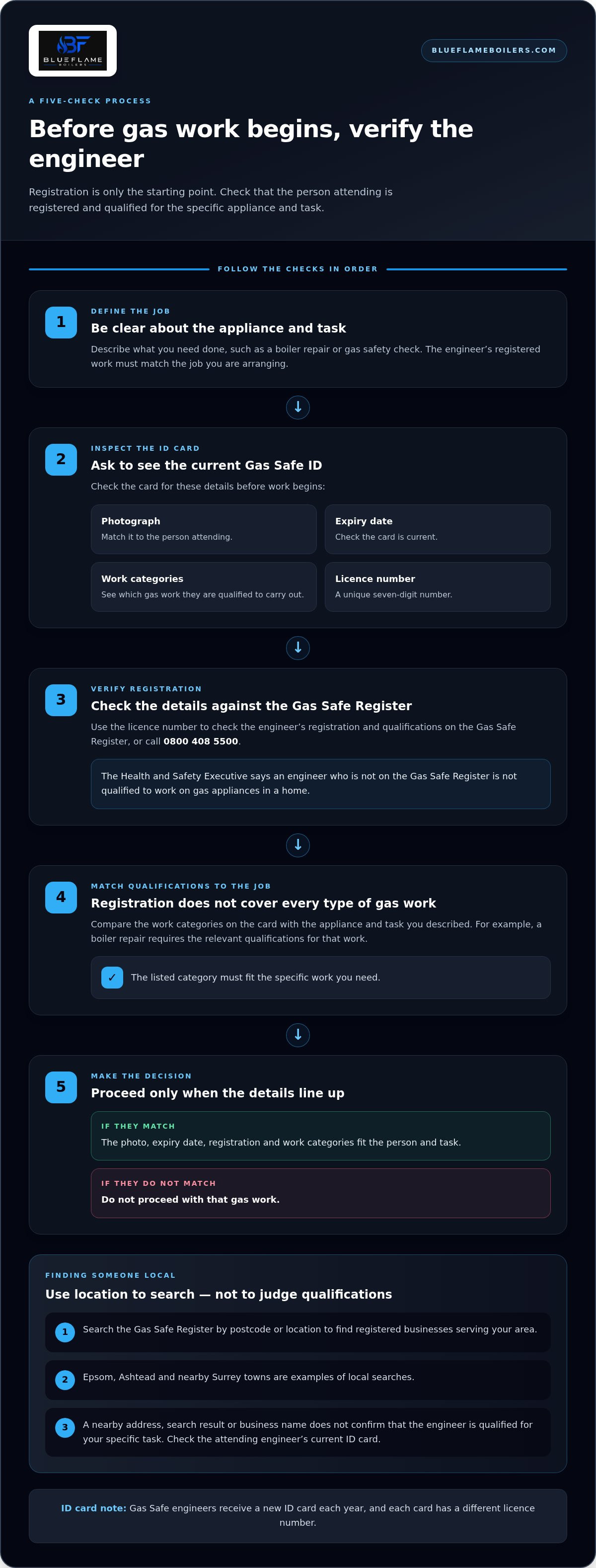
Ask to see the gas engineer’s current ID card before work begins. It shows their photograph, expiry date and the work they’re qualified to carry out, along with a unique seven-digit licence number. Gas Safe engineers receive a new ID card each year, and every card has a different licence number.
Use the licence number to check registration and qualifications on the Gas Safe Register, or call 0800 408 5500. Match the photograph to the person attending and check the expiry date. Then make sure the listed work fits your job. If the details don’t match, don’t proceed with that gas work.
Finding Registered Engineers Locally
To find registered engineers in Epsom, Ashtead or nearby Surrey towns, search the Gas Safe Register by postcode or location. This can help you identify registered businesses serving your area. Proximity is a useful starting point, but it doesn’t show whether an engineer is qualified for your specific task. Check the work categories on the engineer’s card before booking.
For example, if you’re arranging a boiler repair in Leatherhead, look for an engineer whose registration covers that work. Don’t rely only on a nearby address, search result or business name. Before work starts, check the attending engineer’s identity and current ID card. These steps help you assess whether a local, Gas Safe registered engineer is suitable for the job.
How do I book a service or a repair?
Before booking, describe the appliance, the problem and any error message, then ask what the visit includes. Request a written quote before authorising repair work, with the fault, proposed work and relevant cost factors clearly set out.
For a boiler service, share the make and model if you know them, along with any recent changes in performance. A service assesses the appliance’s condition and can identify issues that may need attention. An annual service is recommended, but it isn’t a legal requirement.
For a repair, note when the fault began and what happens when you use the controls. Tell the engineer if the boiler displays an error code, loses pressure or stops providing heating. Share these details when booking so they can understand the problem and plan the visit.
Before confirming an appointment, ask whether the engineer is qualified for the appliance and work involved, what the visit includes, and whether further work would need separate approval. For a written quote, ask for the proposed repair and its cost to be recorded before you agree to proceed. The price depends on the fault, parts and work required, and is given after a quote request.
Keep the appointment details and any quote together. If the engineer finds a different fault, ask how it changes the proposed work before authorising anything. This gives you a clear record of what you agreed to and what the repair is intended to address.
A suspected gas leak needs a different response from an ordinary boiler fault. If you smell gas and suspect a leak, treat it as an emergency rather than a routine boiler fault. Don’t treat a possible leak as a routine service booking; follow the emergency line’s instructions.
- For a service, describe the boiler and request routine maintenance.
- For a repair, share the symptoms and any error code.
- For a suspected gas leak, call the emergency line rather than booking routine work.
Once you’ve identified the job, you can enquire about a boiler service or repair and provide those details to help explain what you need.
Landlords in the UK need an annual gas safety certificate for their appliances. If you are booking on behalf of a landlord, raise the certificate when discussing the service and check what documentation the visit will provide. Keep the appointment details with the relevant records, and clarify whether the work being arranged is a service, a repair or a safety check before confirming.
For an emergency repair, ask for an estimate and what it covers before agreeing to work. Treat that figure as an average rather than a quote for your particular fault. Ask the engineer to explain any difference between the estimate and the proposed work, and wait for your approval before proceeding.
Emergency gas and heating callouts
A suspected gas leak needs a different response from a boiler breakdown. In the UK, if you smell gas and suspect a leak, call the National Gas Service Emergency Line on 0800 111 999. Don’t wait for a routine service appointment or treat the concern as an ordinary heating fault. Tell the operator clearly that you suspect a gas leak and give the property address.
For a heating emergency without a suspected gas leak, note what has stopped working before requesting help. Is the boiler showing an error code, or are the radiators cold while hot water still works? These details help describe the fault and distinguish a boiler problem from an issue elsewhere in the heating system. Report the symptoms you can observe rather than guessing at the cause.
When arranging an emergency callout, explain whether the problem affects heating, hot water or both. Share the boiler make and model if available, any error code, and when the fault began. Mention any recent installation or repair too. Clear details help the engineer understand the job and prepare to assess it.
An emergency doesn’t mean every fault has the same remedy. The engineer needs to identify the cause before deciding whether a repair is suitable. The fault may involve the boiler, its controls or another part of the heating system. Describe any changes you’ve noticed, such as repeated shutdowns or unusual sounds, without attempting to dismantle the appliance.
- Suspect a gas leak? Call 0800 111 999.
- No heating or hot water? Record the symptoms and any boiler error code.
- Recent installation or repair? Include that history when requesting help.
Keep the annual service record and any previous repair notes handy. They can provide useful context about the boiler’s maintenance history, but don’t replace an assessment of the current fault. If the appliance stopped working after an installation, explain what changed and when the problem appeared.
Once you’ve identified the immediate concern, make your next step specific: report a suspected gas leak to the appropriate emergency service, or request a heating callout for a boiler fault. Give the address, appliance details and symptoms clearly. This helps the person taking your call understand what assistance you need.
Finding an engineer online safely
Compare local engineers by checking relevant qualifications, customer reviews and insurance for the work. Reviews can describe communication and completed jobs, but they don’t establish an engineer’s qualifications. Gas Safe registration and the specific work category remain essential checks.
Online searches are convenient, but a result or advert isn’t proof of registration. The Gas Safe Register warns that illegal gas fitters are more likely to advertise online and in local papers than through other sources. Use online listings to find names, then check each engineer’s registration and job qualifications on the register.
For a fair comparison, get three quotes from different Gas Safe registered central heating engineers who cover your postcode. Give each the same details, such as your boiler make, the fault symptoms or the service you need. Comparable information makes it easier to assess what each quote covers.
- Qualifications: Does the engineer’s registration cover your specific gas work?
- Reviews: Do customers mention clear explanations, punctuality or the type of job you need?
- Insurance: Ask whether the engineer holds insurance relevant to the proposed work and what it covers.
Read reviews for useful details rather than relying on a star score alone. A review describing a boiler repair, for example, may be more relevant than one about another service. Look for clear descriptions of the work and how the customer’s questions were handled. Treat reviews as context, not proof of technical qualifications.
Ask for a written quote that identifies the proposed work and relevant cost factors before agreeing to proceed. If an engineer recommends something different from another, compare the reasons and scope, not just the final figure. A clear explanation helps you understand whether the engineers are addressing the same fault or proposing different work.
Keep your comparison focused on evidence. A professional-looking website, local address or positive review cannot replace registration checks. If a listing says an engineer serves your area, confirm that they cover your postcode and that their qualifications suit your boiler or appliance. Then review the quote and insurance information before choosing.
These checks help you assess local options without treating online advertising as a guarantee. Start with the Gas Safe Register, compare quotes for the same work, and consider reviews and insurance details as additional decision points. This gives you a practical way to assess whether an engineer is qualified and suitable for the job.
Find a Gas Safe registered engineer near me in the UK
Start with your postcode and the Gas Safe Register’s search tool to identify registered engineers and businesses relevant to your area. A postcode search is more useful than relying on a broad “near me” result, which may include businesses outside your local area. Search by town as well if your postcode is near a boundary.
Next, narrow the results to the job you need. A boiler service, a repair and work on another gas appliance can require different qualifications. If you’re looking for a certified gas engineer near me in Epsom, compare the engineer’s registered work categories with your job, not just their distance from home.
Use this simple process to make a local shortlist:
- Enter your postcode or town in the Gas Safe Register search.
- Note the registered business and engineer details shown in relevant results.
- Compare the listed qualifications with the appliance and work you need.
- Contact suitable options with a clear description of the job and your location.
Search results can show individual engineers as well as businesses. Check who is expected to attend, particularly if the business name differs from the engineer’s. Before booking, match the attending engineer’s details with their current ID card and registration record. This helps you identify who will carry out the gas work.
Consider property access as well as distance. If you’re in Ashtead, share your full postcode and mention practical details such as a controlled entry system. This helps establish whether the engineer covers your address and understand what the visit involves before arranging an appointment.
Once you have suitable local results, compare the work offered, appointment arrangements and quotes. Give each engineer the same description, whether you need a boiler repair or a gas safety check. If you’re a landlord arranging a check, explain that when you enquire so the visit matches your requirements.
A nearby address, map listing or positive review doesn’t show whether someone is qualified for your job. If you need a certified gas engineer near me in Cobham or Ewell, use the register to check the engineer’s details and relevant qualifications before work begins. Keep those details with your appointment information.
Before choosing, make sure the engineer’s location, your property postcode and the work you need all line up. A clear enquiry is a practical starting point for discussing the job and arranging the next step.
Blueflame Boilers: Gas Boiler Installation
Blueflame Boilers Ltd can help with a new gas boiler, a repair, routine servicing or an emergency callout. If your existing boiler needs replacing, a Gas Boiler Installation may be the right next step. For a fault or planned maintenance, the appropriate service depends on what your boiler is doing and the work required.
Explain the issue or installation you’re considering when you get in touch. Clear details help Blueflame Boilers Ltd understand whether you need installation, repair, servicing or urgent assistance. This is a straightforward next step after checking an engineer’s registration and matching their qualifications to your job.
Contact Blueflame Boilers Ltd to discuss the work you need.
Make your next step with confidence
Choosing a certified gas engineer near me is about finding the right person for the work, not simply the closest listing. Before arranging a visit, be clear about what needs attention and what information will help explain it. A concise description gives your enquiry a useful starting point and keeps the conversation focused on your home.
Take a moment to note whether you need a current problem resolved or are planning an upgrade. You can then discuss your requirements directly with Blueflame Boilers Ltd, without needing to have every technical detail worked out in advance.
Contact Blueflame Boilers Ltd today
With a clear idea of what you need, you’re ready to take the next step with confidence.
Frequently Asked Questions
I can smell gas, what should I do?
If you smell gas and suspect a leak, call the National Gas Service Emergency Line on 0800 111 999. Give the operator your location and follow their instructions. Don’t use an online booking form for a suspected leak; a routine appointment isn’t the right first step. After the emergency response, note when you first noticed the smell and share that detail with anyone handling follow-up work.
Need Help with a Heating Emergency?
If your heating stops but you don’t suspect a gas leak, note whether the problem affects radiators, hot water or both. Record any boiler error code and when the fault began. These details help explain the situation when you request urgent help. If just one radiator is cold while the others work, mention that difference, as it gives a clearer picture than simply saying the heating has failed.
How can I check a gas engineer's Gas Safe ID card and registration?
Compare the engineer who arrives with the details on their Gas Safe ID card, then check that their registration covers the work they’re due to carry out. The card includes a photo, expiry date, job qualifications and a unique seven-digit licence number. If someone else attends, check that person’s own card and registration before gas work begins.
What types of gas work can a Gas Safe engineer legally carry out?
A Gas Safe engineer can carry out gas work only when their registration and qualifications cover the specific job. This may include work on a boiler, cooker or another gas appliance, but registration alone doesn’t mean every engineer is qualified for every task. The Health and Safety Executive says an engineer who isn’t on the Gas Safe Register isn’t qualified to work on gas appliances in a home.
How can I find an emergency Gas Safe engineer nearby, and what are typical emergency call-out fees?
Search the Gas Safe Register by postcode, then check that a suitable engineer covers your area and the work you need. For a heating fault without a suspected gas leak, describe the symptoms when requesting help. Ask what the callout covers and whether diagnosis or parts are separate. Request a written quote for repair costs before agreeing to proceed.


