
It is 3 AM in Epsom, and instead of enjoying a peaceful night, you are staring at the ceiling because your heating system sounds like a percussion band trapped in a tumble dryer. You are likely lying there wondering, "why is my boiler making noise?" whilst worrying if a massive repair bill or a safety risk is lurking behind the kitchen cupboard. We completely understand that those sudden clanks and eerie whistles can feel incredibly stressful, especially during a cost-of-living crisis when every penny counts.
The good news is that your boiler is actually trying to talk to you, and we are here to help you translate its language. In this guide, you will discover exactly why your boiler is clanking, whistling, or gurgling, and learn how to restore peace and quiet to your Surrey home today. We will walk you through the five most common sounds, provide easy fixes you can try yourself, and explain the vital difference between a minor annoyance and a situation that requires a friendly, local Epsom engineer to keep your family safe and warm.
Key Takeaways
- Decode the "Boiler Symphony" to distinguish between harmless hums and the warning signs of a system in distress.
- Get the definitive answer to why is my boiler making noise and find out if it's a simple air bubble or a "kettling" crisis.
- Take control with easy DIY steps like bleeding radiators to banish gurgling sounds without spending a penny.
- Learn why professional power flushing is the ultimate secret weapon for removing sludge and keeping your Surrey home whisper-quiet.
- Find out when to bring in a friendly Epsom pro to protect your wallet and ensure your gas appliance is operating safely.
The Boiler Symphony: Identifying the Weird and Wonderful Sounds
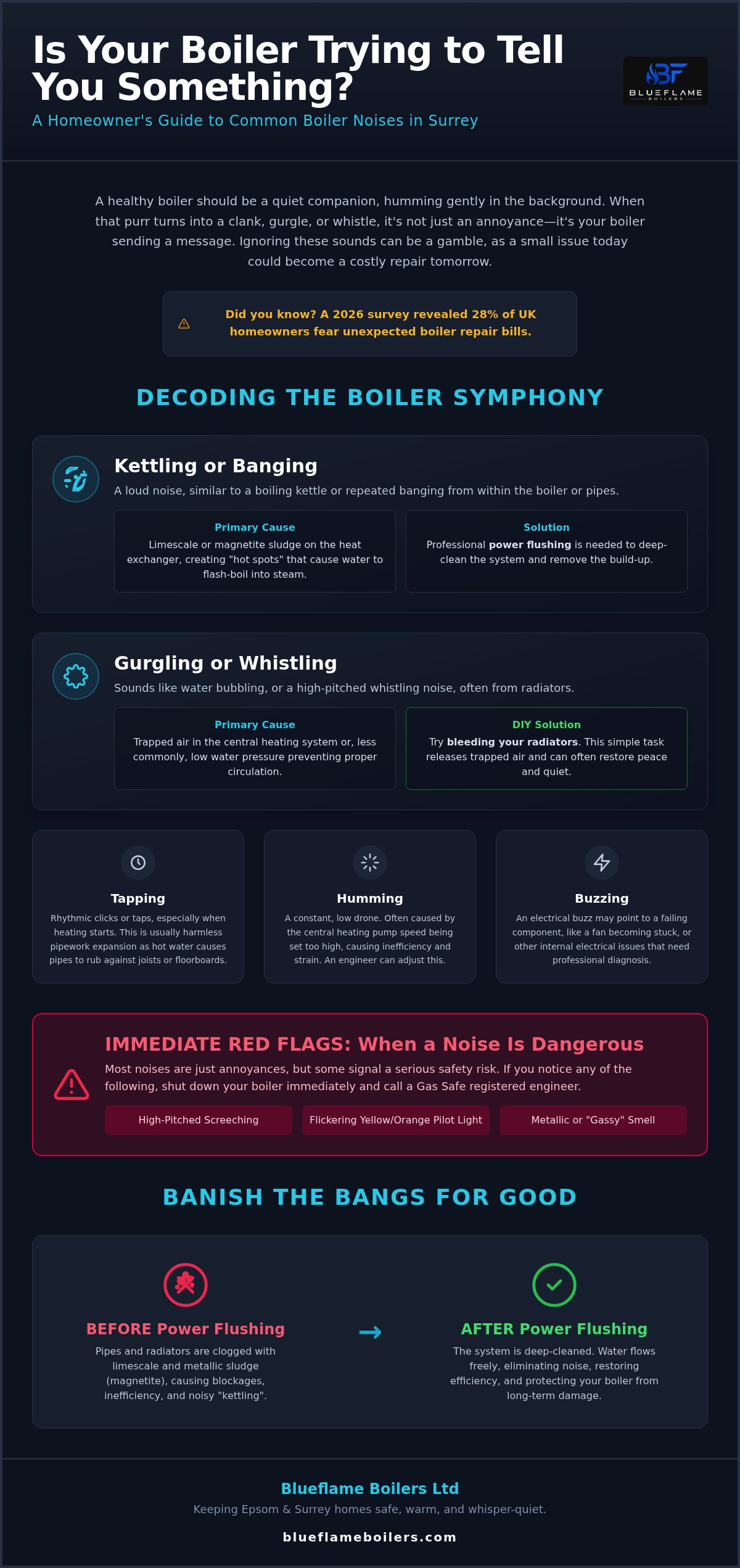
Your boiler isn't just a metal box; it's a hard-working piece of machinery that keeps your Surrey home cosy. A healthy unit should produce a gentle, consistent hum. Think of it like a purring cat. However, when that purr turns into a growl or a whistle, you are right to ask, "why is my boiler making noise?" A 2026 survey showed that 28% of UK homeowners specifically fear unforeseen boiler repairs, and for good reason. Ignoring these small sounds is a gamble. A tiny rattle today could easily transform into a major repair bill next month if a component finally snaps. One of the most frequent culprits we see in Epsom is "kettling." This happens when limescale deposits build up on the heat exchanger, restricting water flow and causing the water to overheat and steam, just like a kitchen kettle.
Is a Noisy Boiler Dangerous?
Most of the time, a noisy boiler is just an annoyance, but some sounds are definite red flags. If your boiler is making a loud banging noise, it might be simple thermal expansion as pipes warm up and rub against floorboards. However, if you hear a high-pitched screeching, your internal pump might be on its last legs. Always check your pilot light whilst the boiler is running. A healthy flame is crisp and blue. If it's flickering yellow or orange, or if you smell something metallic or "gassy," shut it down and call a Gas Safe engineer immediately. Understanding how a boiler works helps you realise that these systems handle high pressures and temperatures, so safety is always the priority for your family.
Common Sounds and Their Secret Meanings
Identifying the specific type of noise is the first step toward a fix. If you can categorise the sound, you can often narrow down the problem before an engineer even arrives at your door in Ewell or Banstead. Here is what your boiler might be trying to tell you:
- Tapping: This is often "pipework expansion." As hot water rushes through, pipes expand and rub against floorboards or joists. It's usually harmless but can be annoying if it's right under your bedroom.
- Humming: If the noise sounds like a constant drone, your central heating pump speed might be set too high. It's like driving a car in second gear on the motorway; it's inefficient and puts unnecessary strain on the system.
- Buzzing: This often points to electrical issues or a fan that's becoming stuck with debris. If you hear a buzz, it's worth investigating "why is my boiler making noise" before the part fails completely and leaves you without hot water.
Kettling and Banging: Is Your Boiler Acting Like a Teapot?
If you have ever heard your heating system sound exactly like a whistling kettle just before it hits a rolling boil, you are experiencing a phenomenon called "kettling." This is a frequent answer to the frustrating question: why is my boiler making noise? Kettling occurs when the water flow through your boiler's heat exchanger is restricted. Limescale or debris settles on the internal surfaces, creating "hot spots." When water hits these super-heated areas, it flashes into steam bubbles. As those bubbles move into cooler water and burst, they create the distinctive whistling or banging sounds that echo through your pipes.
The Limescale Problem in Epsom and Surrey
Living in Surrey means dealing with some of the hardest water in the United Kingdom. Homeowners amongst us in Epsom and Leatherhead often struggle with mineral build-up because our local water supply is rich in calcium and magnesium. Over time, these minerals form a stubborn crust inside your boiler. Ignoring these hot spots is a risky move. It doesn't just cause annoying clanks; it places immense thermal stress on the heat exchanger, which can eventually lead to a cracked component and an expensive replacement. Installing a simple scale reducer can help prevent this, but once the noise starts, you usually need a specialist to intervene. Always remember that HSE gas safety guidance requires all repairs involving gas-carrying parts to be handled by a Gas Safe registered engineer.
Banish the Bangs with Power Flushing
Sometimes the culprit isn't just limescale. It's "magnetite," a thick, black metallic sludge that forms when iron components in your radiators corrode. This sludge travels through your system, creating internal blockages that force your boiler to work much harder than it should. An expert power flushing Surrey service acts like a deep-clean for your entire central heating network. We use specialised equipment to flush out the magnetite and debris, ensuring your system returns to being whisper-quiet and highly efficient. A clean system can significantly lower your energy bills whilst providing the peace of mind that your boiler won't suddenly quit. If your radiators have cold spots and you're wondering why is my boiler making noise, it might be time to check if your system needs a professional detox to restore its health.
Gurgling and Whistling: When Air and Sludge Take Over
If your heating system sounds like a babbling brook or a stomach growling after a heavy meal, you have likely got air trapped in the works. Gurgling is the most common sign that air has invaded your central heating. It often happens when your system pressure drops too low. When the pressure gauge falls below the recommended 1.5 bar, the pump can end up sucking in air instead of water. This creates a chaotic racket that echoes through your Epsom home. It's a frustrating answer to the question: why is my boiler making noise? Whilst air is the usual suspect for gurgling, a high-pitched whistling might point toward a faulty internal fan or a partially blocked pipe that is struggling to cope with the flow.
There is a direct relationship between a noisy boiler and those annoying cold spots on your radiators. If the top of your radiator is cold but the bottom is warm, air is the culprit. If the bottom is cold whilst the top is hot, you are dealing with heavy sludge build-up. This sludge forces the boiler to run for longer periods, increasing your energy bills and putting unnecessary strain on every internal component. Identifying these symptoms early is the best way to prevent a total system breakdown during a Surrey winter.
Air in the System: The Silent Efficiency Killer
Air bubbles might sound harmless, but they are actually silent efficiency killers. They prevent hot water from circulating properly, which means your pump has to work twice as hard to push heat around your house. You might notice a constant "drone" sound coming from the boiler cupboard. This is often the sound of a pump struggling to push through air pockets. Over time, trapped air leads to internal corrosion. This creates the very sludge that eventually clogs up your favourite radiators and leads to those alarming bangs we discussed earlier. Keeping the air out is the simplest way to ensure a whisper-quiet home.
Is Your Radiator Cold at the Bottom?
When sludge settles at the bottom of a radiator, it acts like a thick blanket, stopping the heat from reaching the room. If your system is old and plagued by constant noises and cold spots, a simple repair might not be enough. Sometimes, a professional radiator installation in Surrey is the most cost-effective way to refresh your home's warmth and silence the system for good. A noisy boiler is often just the messenger, telling you that your radiator network is dirty and inefficient. By upgrading old, rusted radiators, you allow your boiler to breathe easily and operate at its peak A-rated efficiency.
Before you start worrying about a massive repair bill, there are a few simple checks you can perform yourself. Often, the reason why is my boiler making noise comes down to a minor maintenance task rather than a mechanical catastrophe. By following this DIY checklist, you might just save yourself an unnecessary call-out fee and get your Epsom home back to its quiet, cosy self in minutes. Identifying the source of the racket is key. If you are still scratching your head and asking why is my boiler making noise after checking the basics, it might be an internal component issue.
- Check the Pressure Gauge: Look at the front of your boiler. Is the needle sitting in the green zone, usually between 1.0 and 1.5 bar? If it's too low, the system struggles to circulate water, causing those gurgling sounds we discussed earlier.
- Listen for the Source: Walk around your house. Is the noise coming directly from the white box in the kitchen, or is it actually a pipe vibrating against a floorboard in the hallway? Localising the sound helps an engineer diagnose the problem faster.
- Inspect Your Thermostat: Sometimes a system makes a racket simply because it's being pushed too hard. Ensure your settings haven't been accidentally cranked up to the maximum, forcing the boiler to run at full tilt constantly.
How to Safely Bleed Your Radiators
If you have identified gurgling as the main issue, bleeding your radiators is your first line of defence. It's a quick process, but you must have a cloth ready to catch any drips and protect your favourite carpets. First, switch off the heating completely. Never bleed a radiator whilst the pump is running; you don't want to draw more air into the system. Second, insert your radiator key and turn it slowly anti-clockwise. You'll hear a hissing sound as the trapped air escapes. Finally, as soon as water starts to trickle out, tighten the valve. If the water that emerges is a dark, inky colour, this is a clear sign of sludge. Whilst you've solved the air problem, you likely need a professional flush to protect your boiler's long-term health.
When to Step Away and Call the Pros
We love a bit of DIY spirit, but gas appliances require a steady, professional hand. Our "Golden Rule" is simple: if you have to take the boiler cover off, stop immediately. Only a Gas Safe Registered engineer is legally allowed to work on the internal components of your boiler. Fiddling with the gas valve or internal fan isn't just dangerous; it will instantly void your manufacturer warranty and could put your family at risk. If those clanks and bangs persist after you've checked the pressure and bled the radiators, it's time to book a friendly boiler repair specialist to diagnose the fault safely and efficiently.
When you are staring at the ceiling at 2 AM asking why is my boiler making noise, you don't need a lecture on thermodynamics; you need a local hero with a toolkit! At Blueflame Boilers Ltd, we have become the favourite choice for silence-seekers in Epsom and Ewell because we cut through the jargon. Our "No-Nonsense" approach means we diagnose those clanks, whistles, and groans quickly and efficiently, getting your home back to its peaceful self without the fuss. We treat every system like it's in our own home, ensuring that every bolt is tight and every air bubble is banished.
Prevention is always more exciting than a breakdown, and it's certainly kinder to your bank balance. Booking an annual boiler service in Epsom is the absolute best way to stop noises before they even start. During a service, we don't just tick boxes; we deep-clean the components that cause kettling and check that your pump isn't overworking. We also love integrating modern tech to keep things smooth. By installing smart thermostats, we can help your system run more intelligently, preventing the constant "on-off" cycling that often leads to those annoying expansion noises in your pipes.
Fast Emergency Support Across Surrey
We know that some noises are more than just a nuisance; they can be downright scary. That's why we provide rapid emergency boiler repair across Leatherhead, Banstead, Weybridge, and the surrounding areas. When you call us, you aren't getting a faceless call centre. You are getting a friendly, local Gas Safe engineer who knows Surrey's hard water challenges inside out. You can expect a professional who arrives with a smile, respects your carpets, and explains exactly why is my boiler making noise in plain English. Our mission is simple: to keep Surrey homes warm, safe, and blissfully quiet, no matter the time of day.
Ready for a Silent Night?
Waiting until your heating completely gives up is the most expensive way to manage your home. Those small rattles and gurgles are your boiler's way of asking for a little TLC. By acting now, you avoid the stress of a total breakdown during a cold snap and keep your energy efficiency at its peak. Why spend another night wondering if that "thump" was the boiler or a ghost? It's time to take control and restore the peace you deserve. Don't let a noisy system ruin your comfort for another minute. Book your boiler health check with Blueflame Boilers Ltd today! and enjoy the sound of silence.
Restore the Peace to Your Surrey Home Today
Now you can finally stop wondering "why is my boiler making noise" and take the first step toward a whisper-quiet home. You have learned how to decode those mysterious gurgles and identify when hard-water limescale is turning your unit into a whistling teapot. By performing simple DIY checks like bleeding radiators and monitoring your pressure gauge, you are already ahead of the game. Your boiler is the hardest-working appliance in your house, and a little attention now prevents a major headache during the winter months.
If the clanking persists, don't let it stress you out for another second. Our team of Gas Safe Registered engineers has been serving Epsom and Surrey for years, earning a 5-star local reputation for friendly, top-notch service. We are your local experts, dedicated to keeping your family warm whilst ensuring your heating bills stay as low as possible. Let us handle the technical bits whilst you get back to enjoying a silent night.
Stop the noise and book your expert boiler repair in Epsom now!
We can't wait to help you get your heating system back in tip-top shape. Peace, quiet, and a cosy home are just a click away!
Frequently Asked Questions
Is it normal for my boiler to make a humming noise?
A gentle, consistent hum is perfectly normal as it indicates the internal pump and fan are working correctly. However, if the hum becomes a loud drone, it often suggests the central heating pump speed is set too high or a component has vibrated loose. A quick adjustment by a professional can usually silence this without needing expensive replacement parts.
Can a noisy boiler explode if left unrepaired?
It is incredibly unlikely for a modern boiler to explode because they are fitted with multiple safety valves and sensors that shut the system down if pressure or temperature gets too high. However, unusual noises are your system's way of warning you about a fault. You should always have a Gas Safe engineer investigate any new or alarming sounds to ensure those safety features are still operating correctly.
How much does it cost to fix a noisy boiler in Surrey?
The cost depends entirely on the underlying fault, but industry data for 2026 suggests a typical boiler repair in the UK averages around £300. Minor fixes like bleeding radiators or adjusting pressure might only cost a standard call-out fee. For more complex issues involving internal parts, prices generally range from £120 to £750 depending on whether you need a simple sensor or a new heat exchanger.
Why does my boiler make a loud bang when it starts up?
A loud bang during startup is often caused by "delayed ignition," where gas builds up slightly before the spark ignites it. This can be due to dirty burners or a faulty spark electrode. Because this involves the combustion process, it is a job that requires an expert to clean and recalibrate the system. Addressing this early prevents damage to the internal casing and ensures your boiler starts up smoothly every time.
Will bleeding my radiators stop my boiler from gurgling?
Yes, bleeding your radiators is the most effective way to stop gurgling sounds caused by trapped air. When air pockets move through the pipes, they create a splashing noise that echoes back to the boiler. If gurgling persists after you have released the air, it might indicate your system pressure is too low or your pump is starting to fail. This is a common reason why is my boiler making noise during the colder months.
Is boiler kettling dangerous for my family?
Boiler kettling isn't usually an immediate danger to your family, but it is a serious threat to your boiler's lifespan. The banging occurs when limescale causes water to overheat and turn to steam. If left alone, this thermal stress can crack the heat exchanger, leading to water leaks and a complete system failure. It's best to address it with a professional flush before it becomes a safety risk or leads to a total breakdown.
How often should I have my boiler serviced to avoid noises?
You should have your boiler serviced once every 12 months by a Gas Safe Registered engineer to keep it running quietly and efficiently. Regular maintenance is the best way to prevent the build-up of sludge and limescale that causes most noises. This annual check is also a legal requirement for landlords and a condition for maintaining most manufacturer warranties in the UK, helping you avoid asking why is my boiler making noise in the first place.
What should I do if my boiler is making a high-pitched whistling sound?
If your boiler is making a high-pitched whistling sound, you should first check your system pressure and ensure no radiators are completely turned off. This "kettling" sound is often a sign of limescale build-up. If the whistling is constant and coming from the top of the unit, it might be a bearings issue in the internal fan. Switch the system off and call a local engineer to prevent the fan from seizing completely.


