

It is a frosty Tuesday morning in Epsom, and whilst waiting for the kettle to boil, you notice the needle on your boiler gauge looking a bit sluggish. You are likely asking yourself, what should boiler pressure be when heating is off, and whether that resting dial is a warning sign of a looming breakdown. It is perfectly normal to feel a spark of "pressure anxiety" when those technical manuals look like they are written in another language, especially when you just want a warm home without any scary noises or expensive repair bills.
We completely understand that your boiler is the heart of your home, and keeping it happy shouldn't be a guessing game. This 2026 guide reveals the exact "sweet spot" for your system when it is cold, ensuring your heating stays in peak condition all year round. We will walk you through reading those dials with confidence, explaining the difference between a minor dip and a genuine emergency. By the end, you will know exactly how to keep your system perfectly tuned, giving you the peace of mind that your home will stay cosy no matter how low the temperature drops outside.
Key Takeaways
- Discover exactly what should boiler pressure be when heating is off to ensure your system stays in the 1.0 to 1.5 bar "sweet spot" whilst resting.
- Learn why it is perfectly normal for your pressure gauge to rise when the heating is running and how much of a jump is considered safe.
- Get the confidence to safely top up your boiler if the needle drops below 1.0 bar, preventing those stressful winter morning breakdowns.
- Identify the common reasons for high-pressure headaches and how to tell if a simple mistake with your filling loop is causing the needle to creep into the red.
- Understand why a professional annual health check from local Surrey experts is the best way to keep your heating system running perfectly all year round.
Your Boiler’s Favourite Number: The Ideal Pressure When Resting
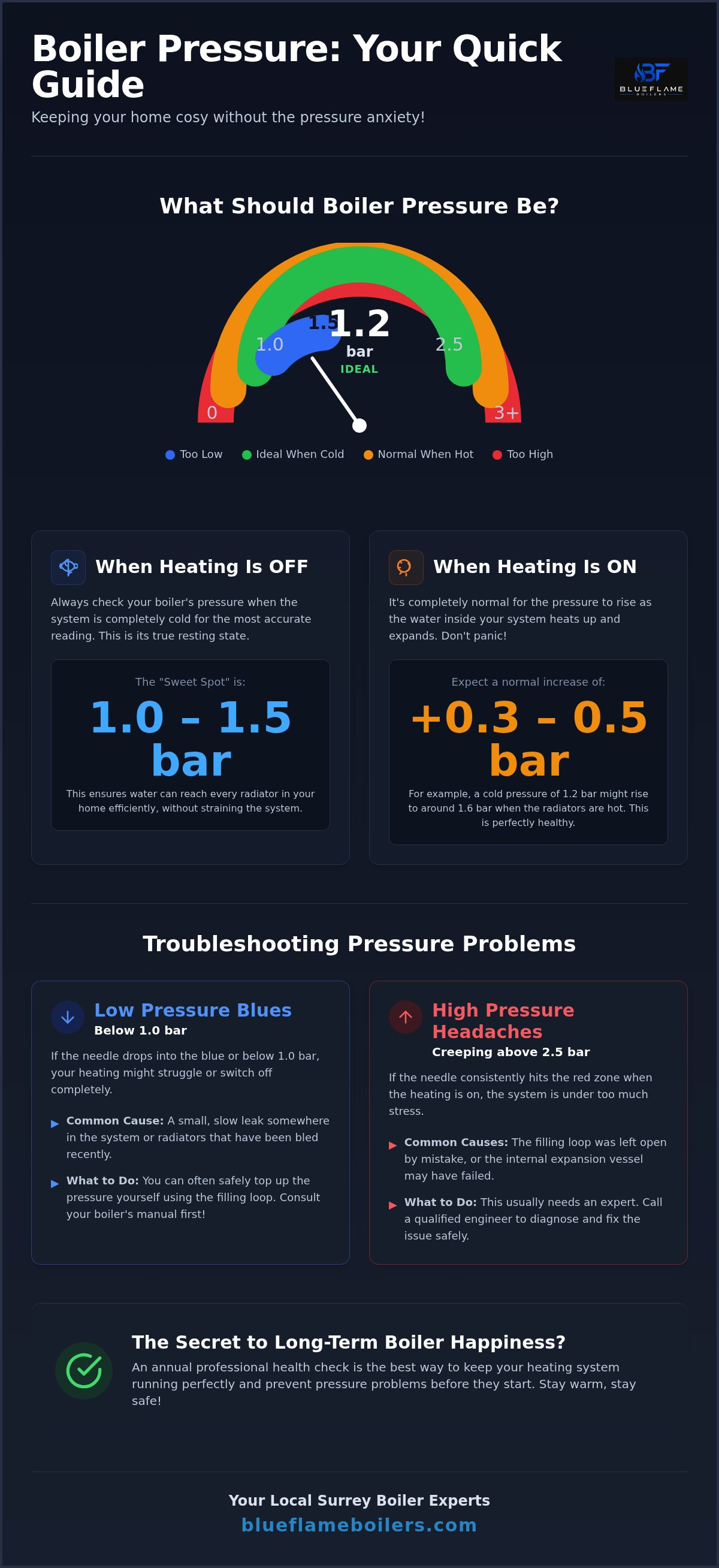
Think of your boiler’s pressure gauge like a heart rate monitor. When your system is resting and stone cold, it should be steady, calm, and predictable. If you are wondering what should boiler pressure be when heating is off, the standard answer across the UK is between 1.0 and 1.5 bar. In our world, a "bar" is simply the unit of measurement we use to track the force of water and steam pressure within your central heating pipes. Most modern boilers make this easy for you by featuring a clear green zone on the dial, which highlights this exact sweet spot. It is the perfect resting state for a healthy, efficient system.
Where to Find Your Boiler Pressure Gauge
Most boilers display their pressure clearly on the front casing. It is usually a circular dial with a physical needle, though many newer models now use a digital display that glows when you press a button. You shouldn't confuse this with the temperature reading, which fluctuates constantly based on how hard the boiler is working. If you don't see a dial immediately, don't panic. Check for a small flap or a removable panel at the bottom of the unit; manufacturers often hide the technical bits away to keep the boiler looking sleek in your kitchen or utility room. Once you find it, you can check your system's health in seconds.
Why 1.0 to 1.5 Bar is the Magic Range
This specific range provides just the right amount of "push" to ensure hot water reaches every corner of your home. Whether you are in a terrace in Epsom or a larger detached house in Leatherhead, that pressure is what gets the heat to your furthest radiator. Maintaining this level prevents unnecessary strain on internal seals and helps your expansion tank do its job effectively by absorbing the changes in water volume.
If your needle sits at 0.9 bar, it isn't a reason to call for emergency help just yet, but it is a signal to keep a close eye on things. A reading below 1.0 bar means the system is losing its "oomph," whilst anything over 1.5 bar whilst cold suggests there might be too much water in the loop. Staying within this magic range keeps your boiler running quietly and ensures your home stays warm without putting your pipes under undue stress.
The Big Expansion: Why Your Gauge Moves When the Heating Kicks In
Science is absolutely brilliant, isn't it? When you turn your heating on, the water inside your pipes and radiators gets hot and physically expands. Because your heating system is a sealed loop, that extra volume of water needs somewhere to go, which naturally causes the needle on your gauge to climb. It is totally normal and expected for your pressure to jump up by 0.3 to 0.5 bar whilst the central heating is running. If your resting pressure is 1.2 bar, seeing it hit 1.6 bar during a chilly Surrey winter evening is absolutely perfect. To manage this safely, your boiler contains an internal expansion vessel. Think of it as a clever shock absorber that soaks up this extra pressure like a sponge, keeping the whole system stable and secure.
The Difference Between Cold and Hot Pressure
To get a reliable reading of your system’s health, you should always check the "true" pressure when the radiators are stone cold. Whilst you now know what should boiler pressure be when heating is off, checking it after the system has been resting for at least an hour gives you the most accurate baseline. If you use a smart thermostat like Nest or Hive, you can often monitor your home's heating behaviour more closely through your smartphone, which is great for spotting patterns. For those who prefer a more manual approach, a handy tip is to mark the "cold" position on your gauge with a tiny bit of tape. This makes it incredibly easy to see exactly how much the needle moves when the heat is on. For more details on the basics, you can read about how to check and set boiler pressure to ensure you are interpreting the dial correctly.
When the Rise is Too High
Sometimes the needle doesn't stop at a healthy level. If your gauge shoots into the red zone, typically anywhere above 2.5 bar, every time the heat is on, your system is feeling the squeeze. This is a major warning sign that your expansion vessel might need a professional re-charge or has failed entirely. When this internal cushion loses its air, the expanding water has nowhere to go, often leading to drips from the small copper overflow pipe on your external wall. If you notice the needle creeping too high or see water dripping outside, our team at Blueflame Boilers can perform a quick health check to get your system back into the green zone before it causes a breakdown.
Low Boiler Pressure Blues: How to Safely Top Up Your System
Finding your boiler gauge sitting below 1.0 bar, or even worse, at zero, can be a bit of a shock on a cold morning. Don't panic. If your system has lost its "push," your boiler might simply refuse to start as a safety precaution. Re-pressurising your heating system is just like topping up the air in your car tyres; it's a routine task that most Surrey homeowners can handle with a bit of confidence. Before you reach for the filling loop, take a quick walk through your house. Check for any tell-tale damp patches or visible leaks around your radiator valves, as adding water to a leaking system is only a temporary fix.
Understanding the basics is key to maintaining a healthy home. For a deeper dive into the mechanics of your system, you can find Everything You Need To Know About Boiler Pressure to help you feel more comfortable with the process. If everything looks dry and you've confirmed what should boiler pressure be when heating is off, you can proceed with the top-up to get your heating back on track.
Step-by-Step: Using the Filling Loop Like a Pro
First, locate the silver braided hose, known as the filling loop, which is usually found directly underneath your boiler casing. You will typically see two small black handles or valves. Slowly turn these handles until you hear the satisfying hiss of water entering the system. Keep your eyes on the gauge like a hawk. Once the needle hits that perfect 1.2 bar mark, close both valves tightly. It is vital to ensure they are fully shut, as leaving them even slightly open will cause the pressure to keep climbing into the danger zone.
Why Does the Pressure Keep Dropping?
If you find yourself topping up the system every few weeks, there is a mystery to solve. A tiny leak, perhaps just a damp patch under a radiator in Leatherhead, can cause a slow but steady drop in pressure. Interestingly, bleeding your radiators to remove trapped air will also lower your system pressure, so always check the gauge after you've finished. When a simple top-up isn't solving the problem, or if the needle drops back to zero overnight, it's time to call in the experts for a professional boiler repair in Surrey. We can track down those hidden leaks and get your system back to its best.
High Pressure Headaches: Why the Needle is Creeping into the Red
While we spent the last section talking about the "blues" of low pressure, the opposite can be just as stressful for your home's heating. If your gauge needle is hovering stubbornly above the 2.5 bar mark whilst the system is cold, your pipes and internal seals are feeling the squeeze. It is the first question people ask us: what should boiler pressure be when heating is off, and the answer is always that steady 1.0 to 1.5 range. Anything pushing into the red zone is a clear signal that the system is over-pressurised. The most common "oops" moment we encounter across Surrey is a homeowner accidentally leaving the filling loop valves slightly open after a routine top-up. This allows mains water to continuously trickle into your system, slowly but surely pushing that needle higher. If the pressure reaches a critical point, your boiler will likely trigger a "lockout" safety precaution to prevent damage. Sometimes, internal debris can cause these spikes too, in which case a power flush in Surrey is the ultimate way to clear blockages and restore a healthy flow.
How to Gently Lower Your Boiler Pressure
If you've accidentally overfilled your system, you can often fix it yourself without needing a heavy toolkit. We call this the "Radiator Trick." Grab a radiator bleed key and a thick towel to protect your favourite carpet. Find the radiator furthest away from your boiler and slowly open the bleed valve. Instead of just letting air out, allow a small amount of water to drain into a container or onto your towel. You must watch the pressure gauge like a hawk during this process. We recommend checking the dial every 10 seconds of bleeding to ensure you don't overdo it. Once that needle settles back into the green zone at roughly 1.2 bar, tighten the valve securely and give yourself a pat on the back for a job well done.
When It’s a Mechanical Fault
Sometimes, the needle keeps creeping up no matter how much water you drain. This usually points to a mechanical fault that needs a professional eye. A failing Pressure Relief Valve (PRV) is a common culprit; if you notice a constant drip from the small copper pipe on your external wall, the valve is likely worn out. You might also have a faulty filling loop that is letting water "creep" past the seals even when it feels tightly shut. In rarer cases, an internal leak in the heat exchanger could be the cause. These technical issues are strictly for Gas Safe registered experts to handle. If your boiler is acting up and the pressure won't stay stable, you should book a boiler health check with our local team to get things sorted quickly and safely.
Long-Term Boiler Happiness: Expert Care in Surrey
The best way to stop losing sleep over your pressure gauge is to let a professional handle the heavy lifting. Whilst you now know exactly what should boiler pressure be when heating is off, a yearly service ensures that needle stays where it belongs without you needing to lift a finger. Keeping your pressure stable isn't just about avoiding stressful breakdowns; it actually helps your system run more efficiently. When the water pressure is correct, your boiler pump doesn't have to work nearly as hard to circulate heat, which saves you a tidy sum on your energy bills amongst other benefits. We love serving our local community from Epsom to Woking with a smile and top-notch expertise, making sure every home we visit stays toasty and safe throughout the year.
The Benefits of a Blueflame Health Check
Our Gas Safe registered engineers don't just glance at the dial and move on. We perform a deep dive into the "health" of your entire system to catch small issues before they become expensive disasters. This includes cleaning out any nasty sludge or metallic debris that causes those annoying noisy pipes and erratic pressure fluctuations. We also take the time to test your expansion vessel, ensuring the air cushion is fully charged and ready for the busy winter rush. Most importantly, a professional annual service is a requirement for validating your manufacturer’s warranty. Without that official stamp in your service book, you could be left footing the bill for a major repair that would have otherwise been covered. It is a simple step that keeps you protected for years to come.
Ready for a Stress-Free Winter?
Our local Surrey team makes booking your annual check-up incredibly simple. We understand that you lead a busy life, so we've made our process as easy as a quick phone call to our friendly office. We are also the favourite choice for local landlords needing CP12 Gas Safety Checks in Epsom and Leatherhead, providing reliable documentation and total peace of mind for both owners and tenants. Our goal is to ensure your heating system is a silent, reliable partner in your home, not a source of technical worry. Why wait for a sudden cold snap to find out your system is struggling? Book your friendly boiler service with Blueflame Boilers today! and enjoy the comfort of a perfectly pressurised home all winter long.
Keep Your Home Toasty and Your Boiler Happy
Mastering your heating system doesn't have to be a chore. Now that you know exactly what should boiler pressure be when heating is off, you can check your gauge with total confidence. Remember that the 1.0 to 1.5 bar range is your system's favourite resting place. This ensures there is enough push to reach every radiator in your Surrey home. Whilst a little bit of expansion is perfectly normal when the heat is on, keeping that needle away from the red zone will prevent unnecessary strain and those dreaded winter repairs.
As a local, family-run business, we are here to ensure you never have to face a cold morning alone. Our Gas Safe Registered experts are always ready to help with everything from routine health checks to emergency 24/7 support. Don't let a dodgy dial dampen your spirits or your home's warmth. We pride ourselves on providing clear, honest advice to our community in Epsom and beyond.
Get your boiler back in the green with Blueflame Boilers Ltd!
Stay warm, stay safe, and enjoy the peace of mind that comes with a perfectly balanced heating system. Your boiler will certainly thank you for it.
Frequently Asked Questions
Is it dangerous if my boiler pressure is too high?
It isn't typically dangerous to your physical safety, but it is certainly harmful to your heating system's health. Modern boilers feature a Pressure Relief Valve that vents excess water through an external pipe to prevent the unit from failing. However, if the needle stays in the red zone, it can lead to internal leaks or a complete system lockout. You should drain some water via a radiator to bring it back to a safe level.
Can I still use my hot water if the boiler pressure is low?
Most modern boilers will automatically shut down if the pressure drops too low as a built-in safety precaution. This means you likely won't have any hot water or heating until the system is topped up. If you're unsure what should boiler pressure be when heating is off, aim for that 1.2 bar sweet spot to get things moving again. If it keeps dropping, you might have a hidden leak.
How often should I have to top up my boiler pressure?
You should only need to top up your boiler once or twice a year. Central heating is a sealed system, so it shouldn't lose water regularly under normal conditions. If you find yourself reaching for the filling loop every few weeks, it is a clear sign of a leak or a failing expansion vessel. Frequent topping up can also introduce fresh oxygen, which might lead to internal radiator corrosion.
What happens if I leave the filling loop open by mistake?
Leaving the filling loop open will cause your boiler pressure to rise until it matches your home's mains water pressure. This usually pushes the needle deep into the red zone and triggers the Pressure Relief Valve to dump water outside. You might notice a steady stream of water from the copper pipe on your external wall. Always double-check that both black handles are turned fully off after you finish re-pressurising.
Why does my boiler pressure drop every time I bleed the radiators?
Bleeding your radiators releases trapped air and a small amount of water, which naturally reduces the overall volume and pressure in the system. It is a very common occurrence for the needle to dip during this process. After you have finished bleeding all your radiators to get them heating up properly, you will almost always need to use the filling loop to bring the pressure back up to 1.2 bar.
Does a smart thermostat help with boiler pressure issues?
A smart thermostat like Nest or Hive won't physically fix a pressure leak, but it is a fantastic tool for monitoring your system’s behaviour. Some advanced models can even send an alert to your phone if they detect that your boiler has stopped working due to low pressure. This helps you catch issues early, especially if you are away from home, preventing a freezing house when you return to Surrey.
What should I do if my boiler pressure gauge is stuck and won’t move?
If your needle doesn't move when the heating is on or off, the gauge itself might be blocked with sludge or mechanically faulty. This is a job for a Gas Safe engineer to investigate immediately. A stuck gauge is risky because you won't know if your system is over-pressurised or dangerously low. Our team can quickly replace the part to ensure you are getting an accurate reading again.
How much does it cost for a professional to fix a pressure leak in Surrey?
The cost to fix a pressure leak depends entirely on where the water is escaping. A simple leaking radiator valve is often a quick fix, whilst a hidden leak under floorboards or a failed internal component requires more time and parts. As a local Surrey family-run business, we focus on providing transparent and honest estimates once we have diagnosed the exact cause of your boiler's pressure drop.


