

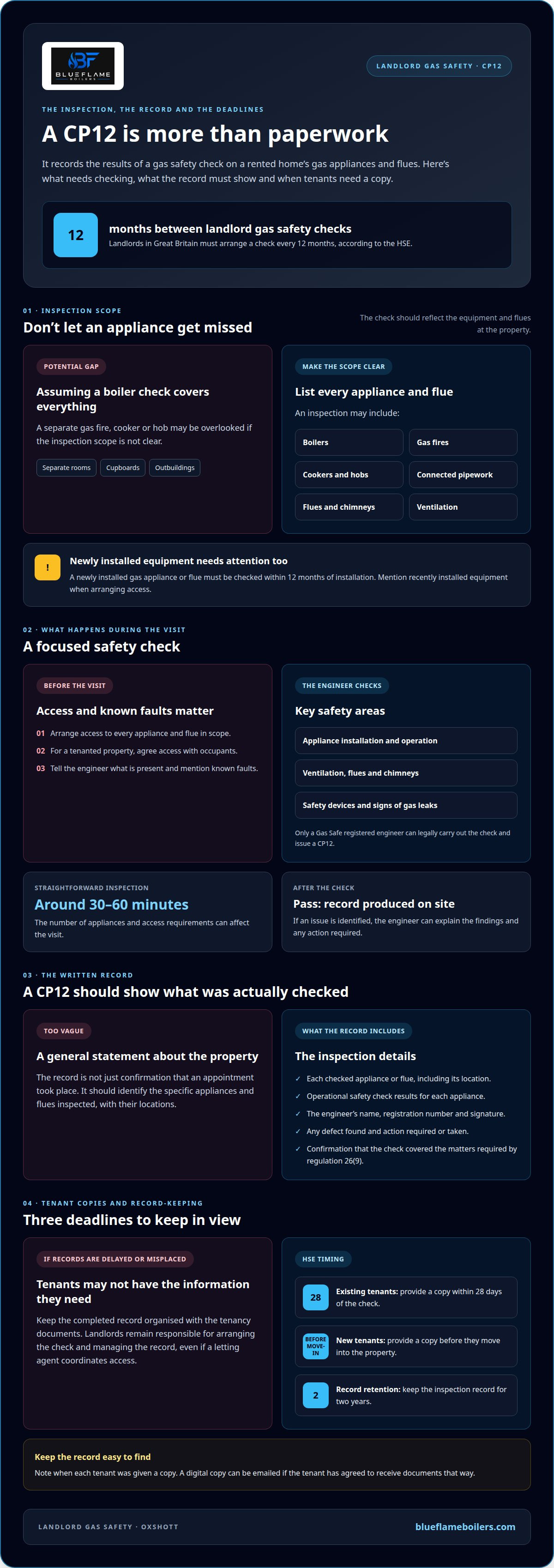
A CP12 is more than paperwork: it records the results of a gas safety check on a rented home’s gas appliances and flues. For landlords, a CP12 certificate in Oxshott needs renewing every 12 months, according to the Health and Safety Executive (HSE).
It’s understandable to want clear answers before arranging an inspection. The record must be shared with existing tenants within 28 days of the check, given to new tenants before they move in, and kept for two years, according to the HSE. Knowing what’s covered and what happens next can make the process much more straightforward.
This guide explains what an inspection checks, which details the gas safety record must include, and when tenants should receive a copy. It also covers how long to retain the record and the factors that affect the cost, so you can plan the next check with confidence.
Key Takeaways
- Understand which gas appliances, flues and safety checks a landlord gas safety record covers.
- Know what information the record should contain, including inspection results and any defects found.
- Plan when to give tenants their copy and how long to retain the inspection record.
- See what can affect the cost of a check, from the appliances included to their accessibility.
- Learn when Blueflame Boilers Ltd’s landlord gas safety checks can help you arrange a CP12 inspection.
What is a Gas Safety Certificate?
A gas safety certificate, often called a CP12, records a professional check of gas appliances and flues in a rental property. A CP12 certificate Oxshott landlords arrange helps document whether the inspected equipment is operating safely.
A straightforward inspection typically takes around 30-60 minutes, and the certificate is produced on site if the appliances pass.
Inspection coverage
An inspection may cover boilers, gas fires, cookers and hobs, plus connected gas pipework, flues and ventilation. When arranging a CP12 certificate Oxshott landlords should identify each appliance at the property, rather than assuming a boiler check includes a separate gas fire or hob.
New installations also need attention. According to the Health and Safety Executive, a newly installed gas appliance or flue must be checked within 12 months of installation. Mention recently installed equipment when arranging access, so the engineer can include it in the inspection scope.
Checks by a Gas Safe engineer
Only a Gas Safe registered engineer can legally carry out a gas safety check and issue a CP12. The engineer assesses appliance installation and operation, ventilation, flues and chimneys, safety devices, and signs of gas leaks. Together, these checks help establish whether the inspected equipment can operate safely.
Before the visit, arrange access to every appliance and flue, including equipment in cupboards or separate rooms. Tell the engineer which appliances are present and mention any known faults. Between inspections, respond promptly to faults or safety concerns. The next scheduled check is not a substitute for dealing with them.
For a local inspection provider, look for a Gas Safe registered engineer and clarify which appliances and flues are included. Discussing the property’s equipment and access arrangements before the appointment helps avoid overlooking a cooker, fire or outbuilding appliance.
Inspection and certificate timing
A straightforward UK gas safety inspection typically takes around 30-60 minutes, although the number of appliances and access requirements affect the visit. If the appliances pass, the gas safety certificate is produced on site. If the engineer identifies an issue, they can explain the findings and any action required.
Arrange access to every appliance and flue included in the inspection. For a tenanted property, agree access with occupants before the appointment. Between checks, arrange professional attention for appliance faults or changes in operation rather than waiting for the next inspection.
Information required on a landlord gas safety record
A CP12, also called a Landlord Gas Safety Certificate, is the written record of a landlord’s gas safety check. It documents the appliances inspected, the results and any issues requiring attention.
Information recorded on a CP12
The record must identify each checked appliance or flue and its location. For example, it should distinguish a kitchen boiler from a gas fire in a living room. It must also include the engineer’s name, registration number and signature, along with the results of operational safety checks for each appliance.
Where an inspection finds a defect, the record must describe it and any action required or taken to repair it. It must also confirm that the check covered the matters required by regulation 26(9). These details give landlords and tenants a clear account of what was inspected and what the engineer found.
UK legislation identifies the Gas Safety (Installation and Use) Regulations 1998 as the legal basis for landlords’ gas safety duties. CP12 is the familiar name for this landlord gas safety record. The information should relate to the actual appliances and flues checked at the rental property, rather than being treated as a general statement about the whole building.
Landlord record-keeping and tenant copies
According to the Health and Safety Executive, landlords in Oxshott must give existing tenants a copy of the gas safety record within 28 days of the inspection. New tenants must receive a copy before moving into the property. These deadlines make it important to keep the completed record available after the engineer’s visit.
The Health and Safety Executive also states that Oxshott landlords must keep the inspection record for two years. Keep it organised with the property’s tenancy documents, so the relevant copy can be located when tenants change or a later inspection takes place. A digital copy can be emailed if the tenant has agreed to receive documents that way.
Landlords remain responsible for arranging the check and managing the record, even when a letting agent coordinates access. Keep the completed record, provide each tenant with a copy on time and note when it was shared. The document should reflect any defect and repair action, not merely confirm that an appointment took place.
If you’re arranging a landlord gas safety check, enquire about an inspection and the record you’ll receive.
Is a CP12 a Legal Requirement?
Yes. In Great Britain, landlords must arrange a gas safety check every 12 months, according to the Health and Safety Executive. The duty applies to rented properties with gas appliances. A CP12 is the written record of that check, rather than a substitute for having the inspection carried out.
The Gas Safety (Installation and Use) Regulations 1998 set out landlord gas safety duties. Landlords are responsible for arranging the inspection and ensuring it covers the gas appliances and flues for which they are responsible. The check must be completed before letting a property, as well as kept up to date during a tenancy.
Timing matters: there is no grace period after the deadline for completing the annual check in Great Britain. Arrange the next inspection before the current record expires and allow time to organise access. A late appointment does not remove the duty to complete the check.
A newly installed appliance or flue also needs attention within 12 months of installation, as explained by the Health and Safety Executive. This applies even if the property’s other gas appliances have already been checked. Include the new equipment in the arrangements rather than assuming an earlier inspection automatically covers it.
The engineer carrying out the gas safety inspection must be Gas Safe registered. Registration matters because the check involves assessing gas appliances and flues, not simply completing a landlord form. A general tradesperson or an engineer without the relevant registration cannot legally perform the check and issue the CP12.
In Oxshott, a provider can confirm the engineer’s Gas Safe registration by identifying the engineer who will attend and providing their registration details. Ask to see the engineer’s Gas Safe ID card when they arrive, and ensure the person attending is the registered engineer named for the inspection.
Before booking, describe the property’s gas appliances and flues, including any boiler, gas fire or cooker. This helps define the inspection scope and plan access with tenants. Keep the appointment details and completed gas safety record together to make the next annual check easier to manage.
A gas safety check is separate from routine boiler servicing. Landlords have a legal duty to arrange the inspection, while a service is a distinct maintenance task. Treating one as the other can leave the landlord without the required inspection record. Compliance means arranging the correct check with a Gas Safe registered engineer and keeping the record current.
Tenant certificate deadlines and record retention
After the annual gas safety check, landlords must manage both tenant copies and the inspection record. The deadlines apply alongside the need to keep the property’s gas safety information organised.
Tenant certificate delivery deadlines
Existing tenants in Oxshott must receive a copy within 28 days of the inspection, according to the Health and Safety Executive. New tenants must receive the current gas safety record before moving into the property. These deadlines make prompt delivery part of completing the inspection process, not an administrative task to leave indefinitely.
After the engineer completes the check, send the record using a method the tenant can access. You can email a digital copy if the tenant has agreed to receive documents that way. Note when and how you sent it, especially when several tenants occupy the same rental property.
For example, if a boiler and gas fire are checked at the same visit, give tenants the record covering both appliances. When a new tenancy begins, provide the incoming tenant with the current record before they move in, rather than relying on the previous tenant’s copy. This keeps the property’s gas safety paperwork relevant to its current occupants.
Required details in a CP12 record
The CP12 should identify each appliance or flue checked and its location, such as a boiler in a kitchen or a fire in a living room. It must record the operational safety check results and include the engineer’s name, registration number and signature. These details connect the findings to the equipment inspected and the person who carried out the work.
If the engineer finds a defect, the record should state what was found and what repair action is required or has been completed. Keep the document with the property’s inspection history so you can track the next annual check against earlier findings. A record that identifies a fault also helps you follow up on the appliance involved.
The Health and Safety Executive says Oxshott landlords must retain the gas safety inspection record for two years. Keep it accessible alongside tenancy documents, rather than relying on an email inbox or a tenant’s copy as the only record. Where the regulation 36A early-renewal flexibility is used in Great Britain, retain the relevant record until two further gas safety checks have been carried out.
A simple record-keeping routine is to save the completed CP12, note when each tenant received their copy, and retain the document for the required period. This creates a clear timeline for the property, from the inspection and any reported defects to tenant delivery and the next check.
Typical UK CP12 prices and appliance add-ons
There is no fixed national price for a landlord gas safety inspection. The cost depends on the property, the number of gas appliances, their accessibility and location. Checking one accessible boiler involves a different scope from inspecting several appliances with restricted access or separate flues. For an Oxshott rental, describe the equipment when requesting a quote so the inspection scope is clear.
Ask what the quoted inspection includes. A CP12 check may cover boilers, gas fires, cookers and hobs, along with gas pipework, flues and ventilation. An additional appliance can affect the total because it needs to be included in the inspection. A boiler and a separate gas hob, for example, are distinct items to identify when discussing the visit.
It’s also useful to separate a gas safety check from a boiler service. The safety check records whether the relevant gas appliances and flues meet safety requirements. A boiler service is a separate maintenance task, so combining the two changes the work being requested. Make sure the scope clearly states whether the price covers the CP12 check alone or additional maintenance.
Landlords are responsible for maintaining gas pipework, appliances and flues safely in rental properties. If a tenant owns an appliance, the landlord remains responsible for the connected gas pipework, but not the tenant-owned appliance itself. Clarify ownership and responsibilities before the inspection, particularly if a tenant has supplied a cooker or another gas appliance.
Access can also affect inspection arrangements. A boiler in an accessible cupboard may require different preparation from equipment behind stored items or in a separate part of the property. Provide an accurate appliance list and arrange access to the relevant areas so the engineer understands the scope. Confirm which appliances, pipework and flues are included before the appointment.
Breaching gas safety regulations can have serious consequences. In England, a breach can result in an unlimited fine and up to six months in prison following summary conviction in a magistrates’ court. The most serious offences tried in the Crown Court can carry up to two years in prison. Keeping inspections and records current helps landlords meet their compliance duties.
The price for a CP12 inspection depends on the appliances included, access and location, and is provided after a quote request.
Blueflame Boilers Ltd: Landlords Gas Safety Checks - CP12
Blueflame Boilers Ltd provides Landlords Gas Safety Checks - CP12 for landlords arranging a gas safety inspection in Oxshott. It’s a practical next step when a certificate is due, before a new tenancy, or after a gas appliance installation. The engineer checks the relevant gas appliances and records the findings.
If the inspection identifies a boiler fault, separate boiler repair support is available. A safety check and a repair are different tasks, and the inspection record can help clarify what needs attention.
To arrange a landlord gas safety check, contact Blueflame Boilers Ltd.
Make your next inspection part of a smoother letting routine
Use the next CP12 certificate in Oxshott as a clear point to keep your property’s gas safety arrangements organised. Once you have the inspection record, keep its findings in view when planning any follow-up work. This helps you make informed decisions about the property’s heating and communicate clearly with tenants.
For landlords, a clear route from inspection to any necessary heating work can make property maintenance easier to manage. If the inspection points to further work, Blueflame Boilers Ltd offers gas boiler installation, boiler repair and emergency callouts. The right next step depends on the property’s needs, so there is no need to arrange unrelated work just because an inspection is due.
Whether you’re planning an upcoming check or deciding what to do after an inspection, a straightforward conversation can help you take the next step with confidence.
A well-organised inspection is one practical way to manage your rental property with confidence.
Frequently Asked Questions
What is a CP12 Certificate?
A CP12 certificate is the landlord’s record of a gas safety inspection. The name comes from “CORGI Proforma 12”, the original term associated with a Landlord Gas Safety Certificate. It links the inspection findings to the appliances and flues checked at a rental property. Landlords use the record to document the inspection and share its results with tenants, rather than as a general certificate for every part of the building.
How Much Does a Gas Safety Check Cost?
There is no single national price for a gas safety inspection. The cost depends on the number of appliances, their accessibility, the property’s location and whether the booking includes additional work, such as a boiler service. An inspection of one boiler has a different scope from a visit covering several appliances. To understand a quote, check which appliances and flues the inspection includes.
How long is a CP12 valid?
A landlord gas safety certificate is valid for 12 months from the inspection date. The Health and Safety Executive says landlords in Great Britain must complete a gas safety check every 12 months. Keep the inspection date visible in your property records so you can plan the next appointment before the existing certificate expires. A change of tenant doesn’t replace the need to keep the inspection schedule current.
What Does a CP12 Not Include?
A CP12 covers gas appliances, pipework and flues, not the fixed electrical installation. An Electrical Installation Condition Report (EICR) relates to that separate electrical system. A CP12 also isn’t a boiler service: servicing is a separate maintenance task, and repairs aren’t automatically included just because an inspection identifies a fault. For example, a boiler may pass its safety checks but still need maintenance for another issue.
How often should gas appliances be inspected and serviced?
For a rented property in Great Britain, the gas safety check must be completed every 12 months, according to the Health and Safety Executive. Boiler servicing is separate, with annual servicing recommended to support safe, efficient operation. For example, arranging servicing alongside the property’s regular maintenance planning can help distinguish routine boiler care from the inspection record landlords need for gas safety compliance.
What do 'Immediately Dangerous' and 'At Risk' mean?
“Immediately Dangerous” (ID) and “At Risk” (AR) are classifications used in current gas-industry unsafe-situation procedures. They describe different levels of concern identified during an inspection. If an engineer records either classification, read the findings and follow the specific safety advice given for the appliance or installation. The appropriate action depends on what the engineer found, so the written record should identify the issue and required response.
What is a CP12 gas safety certificate and who needs one in Oxshott?
A CP12 certificate records a gas safety inspection at a rental property. Landlords in Oxshott who let homes with gas appliances need to arrange the required checks and keep the property’s record current. This applies whether the home has a boiler, cooker, gas fire or several appliances. For a property with multiple gas appliances, ensure the inspection covers each relevant item, rather than treating one appliance’s check as the full property record.
How much does a CP12 certificate cost in Oxshott?
There’s no fixed national price for a CP12 inspection in Oxshott. The total depends on the number and type of gas appliances, access to equipment, flues and ventilation, and whether extra work is included. A property with a boiler and separate gas fire, for instance, has a different inspection scope from one with a boiler alone. A clear quote should set out which appliances and work it covers.


