

What changes when a boiler moves across the hall instead of to another floor? The cost to move a boiler to a different room is typically around £1,000 for a short-distance move on the UK market, but a longer route can raise the bill as pipework and labour increase.
It’s understandable to focus on the distance between the boiler’s old and new positions. But the route is only part of the picture: relocating the flue, adapting gas and water pipes, and making good the wall or floor can also affect the work involved.
This guide explains how distance, labour and extra work affect the cost to move a boiler to a different room, and when combining a relocation with a replacement may make sense. You’ll also learn why the proposed position, access and condition of the existing system matter when planning the job.
Key Takeaways
- The distance and route between the boiler’s current and proposed positions can affect the work involved and the overall cost.
- Flue changes, scaffolding or a condensate pump may add extra work when the new position creates access or drainage challenges.
- Moving a boiler can be a chance to consider replacement, particularly if the existing unit is older or no longer suits your needs.
- Different locations around the home bring different practical considerations, including pipe routes, flue placement and maintenance access.
- Wall and floor repairs, electrical adjustments, labour and additional pipework can all influence the final estimate.
Are there additional costs to moving a boiler?
Moving a boiler can involve more than disconnecting it and reconnecting it elsewhere. The new position may require extra pipework, flue changes, access equipment or finishing work.
How boiler type and destination affect costs
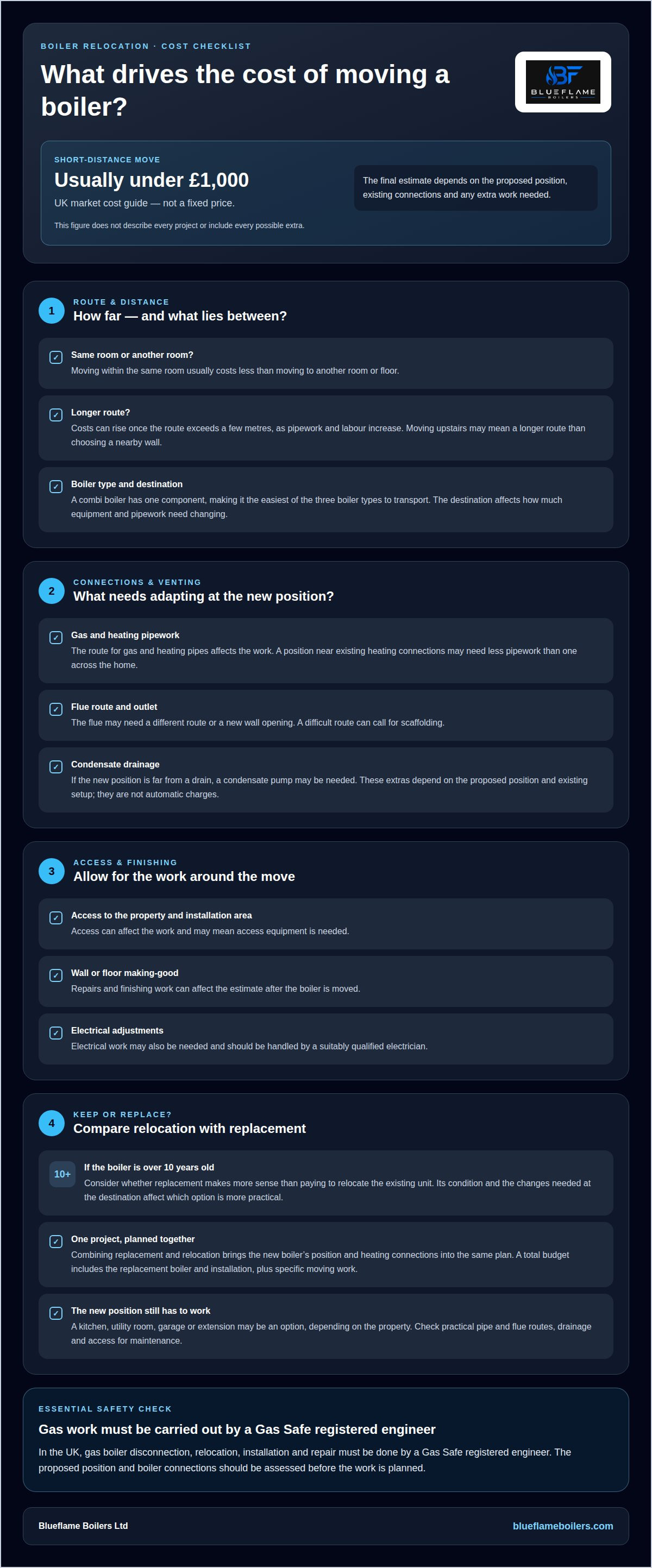
Boiler type affects how straightforward the move is, while the destination determines how much equipment and pipework need changing. A combi boiler has one component, making it the easiest of the three boiler types to transport. Moving a boiler within the same room usually costs less than moving it to another room or floor. Costs can rise once the route exceeds a few metres.
Factors shaping relocation costs
The work depends on what’s needed to connect the boiler safely and make its new position practical. The route for gas and heating pipes, the flue outlet, access to the property and drainage all matter. For example, a position far from a drain may require a condensate pump, while a difficult flue route may call for scaffolding.
Some possible extras have separate costs. They are not automatic charges: whether they apply depends on the proposed position and the existing setup.
Changes to pipework can add to the work, particularly when dealing with complex water supply lines or unexpected drainage faults—work that plumbing specialists such as SOS Plombiers often address when upgrading domestic pipe systems. Depending on the new position, the flue may also need a different route or a new wall opening.
An older boiler can change the decision as well as the estimate. If it’s over 10 years old, consider whether replacement makes more sense than paying to relocate the existing unit. A move may still involve adapting old connections and pipework, whereas replacement brings the new boiler and installation into the same project. The condition of the current boiler and the changes needed at the destination affect which option is more practical.
For a short-distance move, UK market costs are usually less than £1,000. That figure doesn’t describe every project or include every possible extra. A total budget for a new boiler and relocation combines the replacement boiler and installation with the specific moving work, such as new flue arrangements, pipework and access equipment. The destination and scope of work shape the final estimate.
Is it worth combining with a boiler replacement?
Combining a move with a replacement may make sense if the boiler is ageing, unreliable or poorly positioned for your household. It lets you plan the new boiler’s position and its connections with the heating system together, rather than adapting an older unit and revisiting the layout later.
Relocating a boiler can free cupboard space, reduce noise near living areas or make room for a kitchen or bathroom renovation. Moving it from a kitchen cupboard to a utility room, for example, may suit your plans if the new position allows practical pipe and flue routes and access for maintenance.
Risks include an unsuitable flue position, awkward pipe routes and faults caused by poor disconnection or reconnection. Relocation may also reveal problems with existing connections that need further work. In the UK, gas boiler disconnection, relocation, installation and repair must be carried out by a Gas Safe registered engineer.
The decision between moving your existing boiler and installing a new one depends partly on its age and condition. If an older boiler is over 10 years old, replacement may be worth considering alongside relocation. A newer boiler may be more efficient, but the new position still needs to suit its flue, pipework and servicing requirements.
Combining both jobs can bring the installation planning together: the engineer can consider the boiler model, destination and heating connections as one project. A replacement may also avoid spending on relocation work for a boiler that is nearing the point where it needs replacing. For a semi-detached household, upgrading to an efficient boiler can save up to £320 per year on heating bills.
There is no single relocation price for every room or floor. Moving a boiler within the same room is generally less involved than moving it elsewhere in the property. Longer routes can increase the work if pipework or flue arrangements need changing. Moving it upstairs, for example, may require a longer route than placing it on a nearby wall.
A qualified heating engineer should assess the proposed position and the boiler’s connections. Electrical work may also be needed, and should be handled by a suitably qualified electrician. Gas boiler installation, disconnection, relocation and repair must be carried out by a Gas Safe registered engineer, because the work involves the gas supply as well as heating, flue and condensate connections.
If you’re weighing up a move against replacement, you can discuss the relocation and replacement options as part of planning the work.
How much does it cost to move a boiler?
The destination and existing system determine the work, so there is no single relocation cost for every home. To prepare a useful quote, the proposed position, connection routes and details of the heating system all matter.
Choosing a suitable new location
A suitable position must allow the boiler to connect to the heating system and vent safely, while remaining accessible. A kitchen, utility room or garage may be an option, depending on the property. Moving a boiler into a utility room, for example, may free kitchen cupboard space, but the pipework and flue still need a suitable route.
Consider how each possible position affects daily use and installation. A boiler close to existing heating connections may require less pipework than one across the home. An extension may offer another location, but its distance from the heating system, hot water outlets and suitable flue outlet can affect the work. The preferred room is only one part of the decision.
Location suitability and access
A suitable position must meet installation requirements and allow access for maintenance. Building regulations cover matters such as distances from windows and doors, ventilation, flue and waste-pipe connections, and maintenance access. A proposed kitchen or garage location needs to be assessed against these requirements, not chosen on appearance alone.
Access matters after installation, too. The engineer needs to reach the boiler for servicing and repairs, so a cramped cupboard filled with shelving may not be practical. An outside position needs weather-resistant, adequately insulated housing to help prevent freezing and maintain efficient operation. For a garage, consider the connection routes and proposed flue position as well; similar principles of clearance and practical accessibility are outlined by heating and cooling specialists at happyhomehvacsolutions.com.
Getting accurate relocation quotes
For an accurate quote, explain where the boiler is now and which room you’re considering. The assessment needs to account for the route between the two positions, gas and heating pipework, flue position, drainage and access. These details help distinguish a straightforward move to a nearby utility room from a more involved relocation between floors.
The price depends on the case and is given after a quote request; the main factors include distance, pipework changes, flue work, drainage and access. A useful estimate should make clear which work is included, such as adapting connections or making an opening for the flue. Request a boiler relocation quote with the proposed destination and existing setup in mind.
Compare the proposed position with the current one rather than judging by room name alone. Moving a boiler to another kitchen wall may require fewer changes than placing it in a nearby garage if that means longer connections or a different flue route. An extension may also require extra pipework. The location and installation details need to be considered together.
Effects of walls, floors, electrics and making good
A boiler move can involve more than making new connections. Removing the old unit may leave holes, fixings or pipe openings, while the new position may require drilling through a wall or floor. These changes affect both the installation and the finish of the room.
Wall work depends on the chosen pipe and flue routes. Moving a combi boiler from a kitchen cupboard to a bathroom, for example, may mean closing old pipe openings and creating new access points. The route must also suit the flue and waste-pipe connections. Building regulations cover ventilation, these connections and access for maintenance.
Floors may need attention if pipework passes between storeys or through flooring. Lifting boards can provide access, but the surface may need repair afterwards. Moving a boiler from an upstairs cupboard to a downstairs room could leave visible gaps or marks at its former position. The making-good work depends on the materials affected and the finish required.
Making good may involve filling small holes or touching up a wall, rather than renovating the whole room. Removing a boiler from a tiled bathroom, for instance, can leave marks or openings that need a different finish from those on a painted kitchen wall.
Electrical work may be needed to adapt wiring or a connection point to the boiler’s new position. A move across one room may require less adjustment than moving the boiler to another floor. Electrical work is separate from gas and heating pipework, so it should be clearly included in the project scope if required.
Plan the finish as well as the move. A useful estimate separates disconnection and reconnection from wall and floor repairs, electrical changes and redecoration. This clarifies whether the old cupboard will be ready for storage or still needs carpentry and decorating. New openings for pipework may also need finishing.
Making-good work depends on the surfaces affected and the route between the old and new positions. A few fixing holes in a painted wall are different from tiled walls, flooring that needs lifting or openings across several rooms. Asking for these items to be described separately helps distinguish boiler relocation from repairs to the rest of the home.
Labour, parts and distance affecting cost
Labour covers disconnecting, relocating and reconnecting the boiler, then testing its operation. The time required depends on the route, access and connections. Moving a boiler between floors, for example, can involve more work than shifting it along one wall.
A boiler relocation in the UK usually takes between 1 and 2 days. This is a typical timeframe, not a fixed schedule for every home. A longer route may require additional pipework, while a change of flue position can involve new openings or access work. These details affect how the engineer plans the job and how much labour it needs.
The parts required depend on the new route. The engineer assesses the boiler’s position and flue route to determine whether components need changing.
Distance can affect the route pipework takes through the property. A direct route may be straightforward, while obstacles, walls and changes in floor level can make the work more involved. An airing cupboard on another floor, for example, may require pipes to pass between levels. Route length and access affect both the parts needed and the time required to fit them.
In an older home, the existing gas pipe may be too narrow for the boiler in its new position. Whether an upgrade is needed depends on the pipe’s condition and the proposed location. This is separate from the labour involved in moving and reconnecting the boiler.
Relocating a gas boiler is complex work. In the UK, gas boiler disconnection, relocation, installation and repair must be carried out by a Gas Safe registered engineer. A clear estimate should identify labour, flue components, pipework changes and access requirements separately, so you can see how the distance and route affect the work.
For a useful assessment, share the boiler’s current position and intended destination, including any floors between them. Details such as an airing cupboard, nearby walls and the proposed flue outlet help explain the route. The engineer can then assess how these factors affect the labour and parts required.
Blueflame Boilers
Blueflame Boilers Ltd can help you consider the boiler work involved when planning a change of position or replacement. If the existing boiler’s age or condition is part of your decision, servicing or repairs can help address its current needs. If you’re replacing it, gas boiler installation may be the relevant next step.
Share the boiler’s current position, your preferred room and any planned changes to the heating system. These details help focus the discussion on your home and the work you’re considering, rather than treating every move as the same project.
If you’d like to discuss your boiler plans, contact Blueflame Boilers Ltd.
Plan your boiler’s next position
Before choosing a new position, consider how it will work for your household over time. A boiler tucked away in a cupboard may free up living space, but it still needs to be accessible for servicing. Think about how the room is used, where the heating connections run and whether the position will remain convenient after renovations.
The cost to move a boiler to a different room is only one part of the decision. Planning the move alongside home improvements can help coordinate access, pipe routes and finishing work. Blueflame Boilers Ltd provides gas boiler installation, boiler repairs and emergency callouts in Epsom and surrounding Surrey areas.
Share your preferred position and what you hope to change with Blueflame Boilers Ltd to discuss the next steps.
A clear plan is a good starting point for making your home work better for you.
Frequently Asked Questions
What rules and regulations apply when moving a boiler?
A boiler relocation in the UK must account for building regulations covering flue position, ventilation, pipe connections and access for maintenance. Moving a boiler beside a window, for example, may affect where the flue can exit. The new position also needs suitable gas, heating and waste connections. A location that looks convenient may not be suitable once its connections and flue route are assessed.
What about the flue?
The flue carries combustion gases outside, so its route and outlet position are central to planning a move. A boiler shifted to an external wall may need a different arrangement from one positioned deeper inside the home. The outlet’s position relative to windows and doors matters. A new flue route, for example, may need to avoid an opening that could affect how gases disperse.
How much does it cost to relocate a boiler to another room in the UK?
The cost to move a boiler to a different room depends on the property and the work required, so one figure cannot represent every relocation. Moving it to an adjacent room may require a shorter route than moving it upstairs. A quote should reflect the proposed position, pipe and flue routes, access, drainage and making-good work. Ask for relocation to be distinguished from unrelated repairs or redecoration.
What factors affect the cost of moving a boiler?
The main factors are the distance to the new position, the route through the home and the changes needed to connect the boiler. Routing pipes through a finished ceiling, for instance, can involve different access and repair work from using exposed pipework in a utility space. Flue requirements, drainage, electrical adjustments and the condition of existing connections can also affect the scope.
How much does it cost to extend or reroute boiler pipes and flue?
Pipe and flue work depends on length, materials, route and installation access. A direct run along an accessible wall differs from pipework routed through cupboards or between floors. Flue work also depends on the boiler’s new position and a suitable outlet. A clear quote should identify the planned routes and any extra access or finishing work, rather than grouping every change into a vague allowance.
Does moving a boiler require a new flue or ventilation?
A relocation does not always require a completely new flue, but the existing arrangement must suit the boiler’s new position. A longer route or different external wall may require changes. Ventilation must also be considered. Moving a boiler into a cupboard, for example, changes its immediate surroundings, so ventilation and maintenance access need to be assessed together.
What UK building regulations and Gas Safe requirements apply when relocating a boiler?
Building regulations cover details such as flue and waste-pipe connections, ventilation and maintenance access. Gas boiler disconnection, relocation, installation and repair must be carried out by a Gas Safe registered engineer. These requirements apply whether the boiler moves across a room or to another floor. Electrical connections may require separate work, so the heating and electrical parts of the project should be considered distinctly.
How long does it take to move a boiler to another room?
A boiler move in the UK usually takes between 1 and 2 days. The actual schedule depends on the destination and the work involved, including how the pipes and flue need to be rerouted. A nearby position with straightforward access differs from a move requiring work through walls or floors. Making good the old location may also happen separately from the boiler installation, depending on the project.


