
A boiler error code can be a helpful clue, but it isn’t the full diagnosis. A boiler fault-finding expert in Ewell will consider the code alongside the boiler’s symptoms and pressure; most models should show a cold water pressure between 1.0 and 1.5 bar. Putting those clues together helps pinpoint the cause before choosing a repair.
It’s frustrating when the heating stops or the hot water runs cold, especially when the display flashes a message you don’t recognise. This guide shows how an engineer investigates the signs, what pressure readings can reveal and what to do if you need an emergency repair.
From the first checks to a clear repair plan, here’s what to expect from a methodical boiler fault-finding visit in Ewell. Knowing what information to share can make the next step clearer.
Key Takeaways
- Read an error code as a clue, then consider it alongside the boiler’s symptoms and pressure reading.
- Most boiler models should have a cold water pressure between 1.0 and 1.5 bar; the right interpretation depends on the model and its condition.
- UK gas work must comply with the Gas Safety (Installation and Use) Regulations 1998, according to The National Archives.
- A systematic diagnosis helps identify whether the fault needs a repair, further investigation or a different next step.
- Blueflame Boilers Ltd offers boiler repair and emergency callouts when a boiler fault needs professional attention.
Why Choose Local Boiler Experts in Ewell, Stoneleigh, KT17?
A boiler fault finding expert in Ewell should identify the cause before recommending a repair or replacement. That means considering the symptoms alongside the boiler’s make, model, controls and operating history, rather than treating one warning light as a complete diagnosis.
Heating engineers in Ewell investigate faults affecting heating, hot water or both. These can include ignition problems, leaks, unusual pressure changes, circulation issues or unresponsive controls. The checks depend on the symptoms and the boiler model.
The manufacturer’s instructions are a useful starting point. Worcester Bosch boilers, for example, can display diagnostic codes that indicate a particular fault area. A code helps guide the investigation, but the engineer still needs to assess the appliance and connected heating system before deciding what has failed.
When booking, share details that can help the engineer prepare: the boiler’s make and model, any displayed code, whether heating or hot water is affected, when the problem began, and any leaks or unusual noises. A photo of the display can help capture the code accurately.
A systematic visit can follow these steps:
- Record the symptoms. The engineer establishes whether the fault affects heating, hot water or both, and whether it happens continuously or intermittently.
- Check the appliance display. They note any fault code and interpret it using the manufacturer’s guidance for that model.
- Assess relevant readings and controls. They compare what the boiler shows with its behaviour, then check components linked to the reported symptoms.
- Investigate the wider system. If radiators stay cold while hot water works, for example, the engineer considers heating-side causes rather than assuming the whole boiler has failed.
- Explain the finding. The engineer describes the fault, the repair required and whether replacement is a more suitable option.
Boiler warranties and home-emergency plans may cover diagnosis or repairs, depending on their terms. Check the policy’s exclusions, maintenance requirements, excesses and limits to understand what may be covered.
Regular servicing can help identify developing issues before they become breakdowns. Gas boilers should be serviced once a year. A service assesses the appliance’s condition, while fault diagnosis focuses on a specific problem that has already appeared.
For residents in Ewell, Stoneleigh and KT17, a clear diagnosis makes the next decision easier: repair the fault, investigate further or consider replacement. Keep the boiler model and symptom details close at hand when arranging an assessment.
Emergency boiler repair availability
If your boiler suddenly stops, describe what has happened when you get in touch. In Ewell, explain whether it has stopped completely, whether heating or hot water still works, and whether you’ve noticed a leak, unusual noise or warning light. These details help clarify the problem.
Suspect a gas leak? Switch off the boiler, open windows and call the National Gas Emergency Service on 0800 111 999. Don’t investigate the appliance yourself. A smell of gas needs a different response from an ordinary breakdown, so treat it seriously and act promptly.
If a warning appears, note the exact message or take a clear photo. Record when it started and whether it followed a power interruption or change in operation. Avoid repeatedly resetting the boiler, as the display may give the engineer a useful clue.
Worcester Bosch and other manufacturers’ models can show different symptoms, even when the heating problem looks similar. A domestic boiler with cold radiators but working hot water gives different clues from one where both have stopped. An engineer assesses the symptoms before deciding which repair is needed.
Repair costs depend on the fault, parts required, work involved and whether the visit is an emergency callout. The price is given after a quote request. Call-out fees and what they cover also depend on the terms for the visit, so ask for the cost breakdown before agreeing to work. Every breakdown has its own details.
Repair may be suitable when the fault is isolated, the required parts are available and the boiler remains appropriate to use. Replacement may make more sense if the diagnosis identifies extensive work or recurring faults. The findings, scope of repair and boiler condition all inform the decision.
Sometimes the problem is outside the boiler. One cold radiator may point to a local radiator or circulation issue, while several cold radiators can suggest a wider heating-system fault. An engineer can assess whether the issue involves the appliance, a radiator or system operation before recommending a next step.
Ready to arrange help? Have the address, boiler make and model, displayed code, affected functions and any leak details handy. Those useful details give the call handler a clearer starting point. You can send an enquiry with your boiler fault details for support in Ewell.
Gas Safe registered engineers
Gas boiler diagnosis involves work on an appliance that burns fuel, so registration matters. UK gas work must comply with the Gas Safety (Installation and Use) Regulations 1998, according to The National Archives. A registered engineer can assess gas-related faults and carry out work within their competence.
Before gas work begins, check the engineer’s credentials on the Gas Safe Register. Match the registration details to the person attending and confirm they cover the work required. Registration is personal, so a company name alone doesn’t establish an individual engineer’s status.
Experience matters too, but it complements registration rather than replacing it. An engineer familiar with a boiler’s make and model can use the symptoms to guide relevant checks instead of guessing. Ask for a clear explanation of the diagnosis, proposed work and any safety checks completed.
Gas work and general plumbing can overlap around a heating system, but they require different skills. A dripping water pipe near a boiler may need plumbing investigation; a fault involving the gas supply or combustion requires an appropriately registered gas engineer. Clear descriptions help direct the right checks.
During an assessment, the engineer considers the boiler’s operation, visible condition and reported symptoms. Repeated shutdowns, for example, may lead to checks of the controls and relevant components. The precise tests depend on the fault and appliance. A diagnostic code is useful evidence, not a reason to bypass safety procedures.
Safety checks are also relevant beyond breakdown visits. Landlords have responsibility for arranging annual gas safety checks for rented properties. A CP12 record documents the outcome of a landlord gas safety check; it doesn’t replace fault diagnosis when a boiler develops a separate problem.
Use this simple sequence before the visit:
- Check the attending engineer’s details on the Gas Safe Register.
- Describe the boiler symptoms, display message and affected functions.
- Ask what the proposed checks cover and what the findings mean.
- Keep the diagnosis or safety record with the appliance documents.
For Ewell households, checking registration and describing the symptoms clearly can help establish whether the issue concerns gas work, plumbing or another heating-system component. A useful explanation connects the engineer’s checks to the fault and the recommended next step.
Boiler error codes and pressure gauges
A boiler display can offer useful diagnostic clues, but an error code doesn’t identify every failed part. Vaillant and Worcester Bosch models use instructions specific to each appliance, so similar symptoms may call for different checks. Note the exact code, boiler model and when the warning appeared. This helps connect the display to the boiler’s behaviour.
Pressure adds another piece of evidence. Most boiler models should have a cold water pressure between 1.0 and 1.5 bar. Compare the gauge reading with the guidance for your own model, and note whether the system is cold or has recently been heating. A reading outside the expected range can help direct investigation, but it doesn’t prove a particular component has failed.
Changes in pressure can provide further clues. If the gauge repeatedly falls after pressure has been restored, an engineer may investigate a leak or another system issue. A noticeable rise in pressure during heating can also guide checks. Record what you observe and when it happens. Don’t open the boiler casing or treat a gauge reading as a diagnosis.
Use this practical sequence when a code or pressure warning appears:
- Write down the displayed code exactly, including letters and symbols.
- Photograph the display and gauge, if they’re easy to see safely.
- Check the manufacturer’s user instructions for that model’s explanation.
- Record whether heating, hot water or both are affected.
Manufacturer instructions matter during installation, servicing and fault diagnosis because controls and display meanings vary between models. Interpret a Vaillant code using the instructions for that boiler, not a list for another appliance. The engineer can then compare the code with the gauge reading, reported symptoms and checks of relevant components.
Annual boiler servicing is separate from investigating a current fault. A service records the appliance’s condition, while a diagnostic visit focuses on a specific problem, such as repeated shutdowns or a pressure warning. Keeping the records together may help show whether a reading or symptom has changed since the previous visit.
Don’t repeatedly reset the boiler just to clear a code. The display may provide useful evidence, and a reset doesn’t explain why the warning appeared. Follow only safe user checks described in the manufacturer’s instructions. Leave internal inspection and repair to an appropriately qualified engineer.
For a clearer diagnosis, give the engineer the boiler’s make and model, the exact error code, the pressure reading and the conditions when the warning appeared. Together, these observations can help distinguish a temporary display warning from a fault that needs repair.
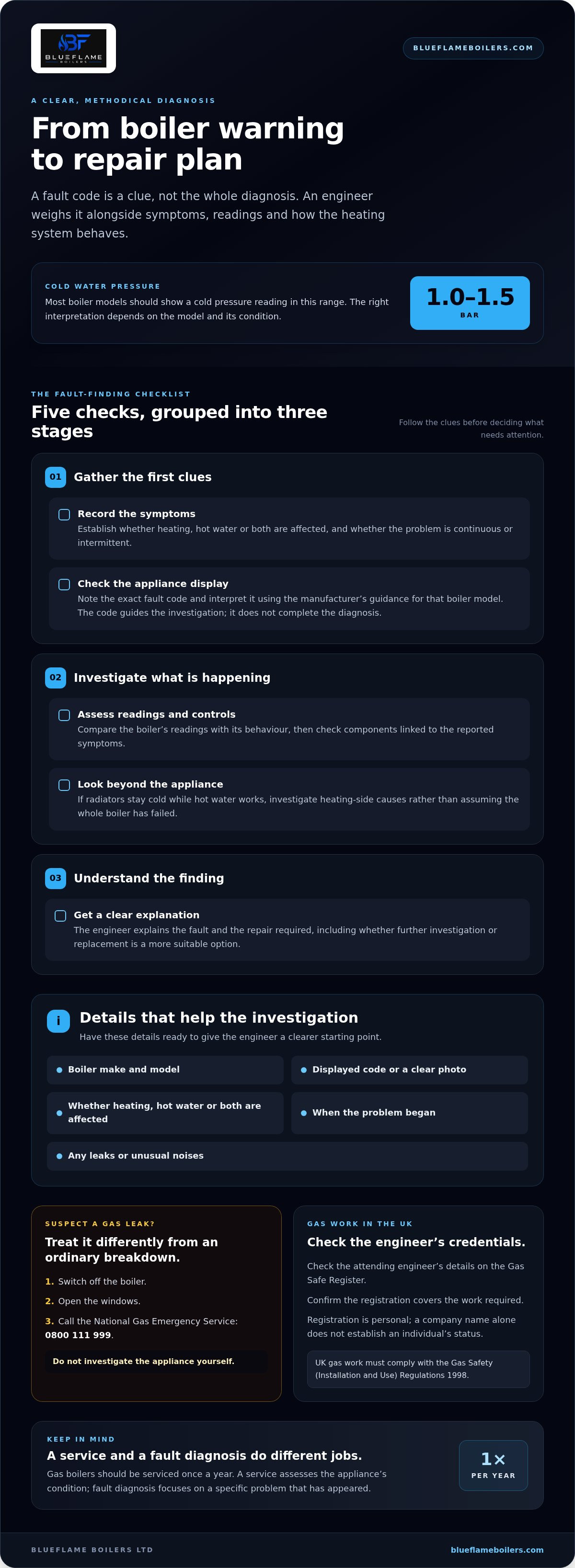
Logical boiler fault-finding process
A reliable diagnosis follows evidence in a clear order. The engineer starts with your account of the fault, then considers the boiler’s display, controls and behaviour. Heating that fails while hot water still works, for example, gives different clues from a boiler that stops both functions.
Next, a Gas Safe registered engineer identifies the appliance and consults the relevant manufacturer guidance. The make, model and installation details help determine which diagnostic steps apply. A code on one boiler may mean something different on another, so using the correct instructions matters.
The investigation should test likely causes rather than jump straight to replacement. A pressure change, repeated shutdown or unusual noise can guide further checks, but each is evidence, not a diagnosis. The engineer compares observations and narrows down the possible causes before recommending work.
A logical fault-finding visit can move through these stages:
- Define the fault. Establish which functions are affected, when the problem began and whether it happens consistently.
- Review the evidence. Record the display message, pressure reading and any recent changes to the heating system.
- Follow model-specific guidance. Use the relevant manufacturers’ instructions to select appropriate checks for that appliance.
- Test the likely cause. Assess the relevant controls and components, then compare results with the reported symptoms.
- Explain the outcome. Set out the cause, the proposed repair and any further action needed.
This process can also help distinguish a boiler fault from a wider system issue. If several radiators are cold but the boiler appears to operate, the engineer can consider circulation or controls rather than assume the appliance has failed. If only hot water is affected, checks can focus on the parts and settings relevant to that function.
Annual servicing has a different purpose from fault diagnosis. It offers a planned opportunity to assess the boiler’s condition, while a fault visit investigates a specific problem. Service records can provide useful context, especially when a current symptom differs from an earlier inspection.
Before the engineer arrives, prepare the boiler’s make and model, a brief timeline, the functions affected and any display details. This gives the investigation a useful starting point. A clear explanation of each check and finding can also help you understand why a repair is recommended or further assessment is needed.
Arrange a boiler fault assessment with the relevant details ready.
Blueflame Boilers Ltd: Gas Boiler Installation
Blueflame Boilers Ltd can help diagnose and repair boiler faults. If an engineer finds that replacement is the more suitable next step, the company also provides gas boiler installation. The right option depends on the diagnosed fault and the boiler’s condition.
If your boiler has stopped working, Blueflame Boilers Ltd provides emergency callouts for repair support. The company also offers regular boiler servicing, keeping planned maintenance distinct from urgent fault-finding. Share the boiler model, any display code and which functions are affected to make your enquiry more informative.
To discuss a boiler repair, installation or service, contact Blueflame Boilers Ltd through an online enquiry or visit blueflameboilers.com.
Take the next step towards a clear diagnosis
Uncertainty about a boiler fault can make it difficult to decide what to do next. A professional assessment gives you a practical basis for weighing repair against replacement, rather than making a decision from a warning code alone. For households in Ewell, sharing the symptoms and boiler details is a helpful first step.
Blueflame Boilers Ltd offers boiler repair and emergency callouts when a fault needs attention, as well as gas boiler installation when replacement is the appropriate route. If you’re looking for a boiler fault-finding expert in Ewell, explain what you’ve noticed and what outcome you need. That gives the enquiry a useful focus from the outset.
A calm, informed next step can make a difficult boiler problem feel more manageable. Help is within reach.
Frequently Asked Questions
Which Gas Safe registered boiler fault-finding engineers serve Ewell, Surrey?
Blueflame Boilers Ltd provides gas boiler repairs and emergency callouts in Ewell. Its engineers are Gas Safe registered and can investigate gas boiler faults. When arranging a visit, explain whether the problem affects heating, hot water or both, and share the boiler’s make and model. This helps focus the enquiry on the fault and the work you need.
What is the typical cost of boiler fault finding in Ewell?
There isn’t one cost that applies to every fault-finding visit. The price depends on the symptoms, diagnostic work required, repair complexity, parts needed and whether the request is urgent. Ask for a quote based on the fault before agreeing to work, and clarify whether the quote covers diagnosis alone or also includes repair labour and parts. No industry average gives a reliable price for your specific boiler problem.
Do Ewell boiler engineers charge call-out fees, and what do they include?
Before booking, ask for a clear explanation of the work included in the quote, including whether it covers diagnosis, repair labour or parts. A boiler that displays a warning but still runs may need different investigation from one requiring repair. Understanding the proposed work helps you make an informed decision.
How quickly can a boiler repair engineer attend in Ewell, including emergency call-outs?
Attendance timing depends on urgency, engineer availability, travel and the details provided when you book. Emergency call-outs are intended for faults needing prompt attention, but an exact arrival time can’t be assumed. Explain whether the boiler has stopped completely, if there’s a leak, and whether the property has heating or hot water. Those details help the service assess urgency and plan the response.
How can I check a boiler engineer's Gas Safe registration and qualifications?
Use the Gas Safe Register to check the engineer’s name and registration details, then confirm that the registration covers the gas work required. Match the details to the person who arrives, rather than relying only on a company name or vehicle branding. You can also ask the engineer to explain the diagnostic findings and proposed work. Registration and relevant experience are separate considerations.
What are the common boiler fault codes and safe checks homeowners can try?
Codes vary between manufacturers and models, so there is no universal list of common codes. Read the display carefully, note the boiler’s make and model, and consult the manufacturer’s user instructions for that appliance. You can also record the pressure gauge reading and whether heating or hot water is affected. Follow only user checks described in the manual. Don’t remove the casing or attempt internal repairs.
What safety risks mean I should switch off my boiler and call an engineer immediately?
A suspected gas leak needs immediate action: switch off the boiler, open windows and call the National Gas Emergency Service on 0800 111 999. Carbon monoxide is colourless and odourless, and a faulty boiler can leak it. If you suspect carbon monoxide, treat the situation as urgent and seek emergency help. Don’t try to diagnose or repair a suspected gas or combustion fault yourself.


