
Imagine waking up on a chilly morning, heading to the kitchen for a coffee, and stepping into a cold puddle right beneath your boiler. It's a sinking feeling that immediately triggers thoughts of expensive repairs or, worse, a total system breakdown in the middle of winter. You're not alone in feeling that spike of anxiety. A dripping unit is one of the most common reasons homeowners in Surrey call us, and it's natural to worry about water damaging your floorboards or reaching sensitive electrical components.
If you're currently asking, "why is my boiler leaking water?" then this guide will help you stay calm and take control. You'll discover exactly why your boiler is dripping, how to safely identify the source of the leak, and when it's essential to call a Gas Safe engineer to protect your home. We'll walk through common culprits like corroded pipes or high pressure, explain how to understand potential repair costs, and ensure your family remains safe from hazards whilst you get your heating back on track.
Key Takeaways
- Learn the essential safety steps to take the moment you spot a drip, including how to isolate the electrical supply and mains water to prevent further damage.
- Understand the technical reasons why is my boiler leaking water, from high system pressure triggering the relief valve to internal corrosion caused by system sludge.
- Use our diagnostic guide to identify the source of the leak, helping you determine if the issue is a simple external valve fix or a more complex internal component failure.
- Recognise the hidden risks associated with boiler leaks, such as potential electrical hazards and long-term structural damage to your home’s flooring and joists.
- Discover when it is essential to stop troubleshooting and contact a Gas Safe registered engineer to ensure your family’s safety and the longevity of your heating system.
Immediate Steps to Take When You Spot a Boiler Leak
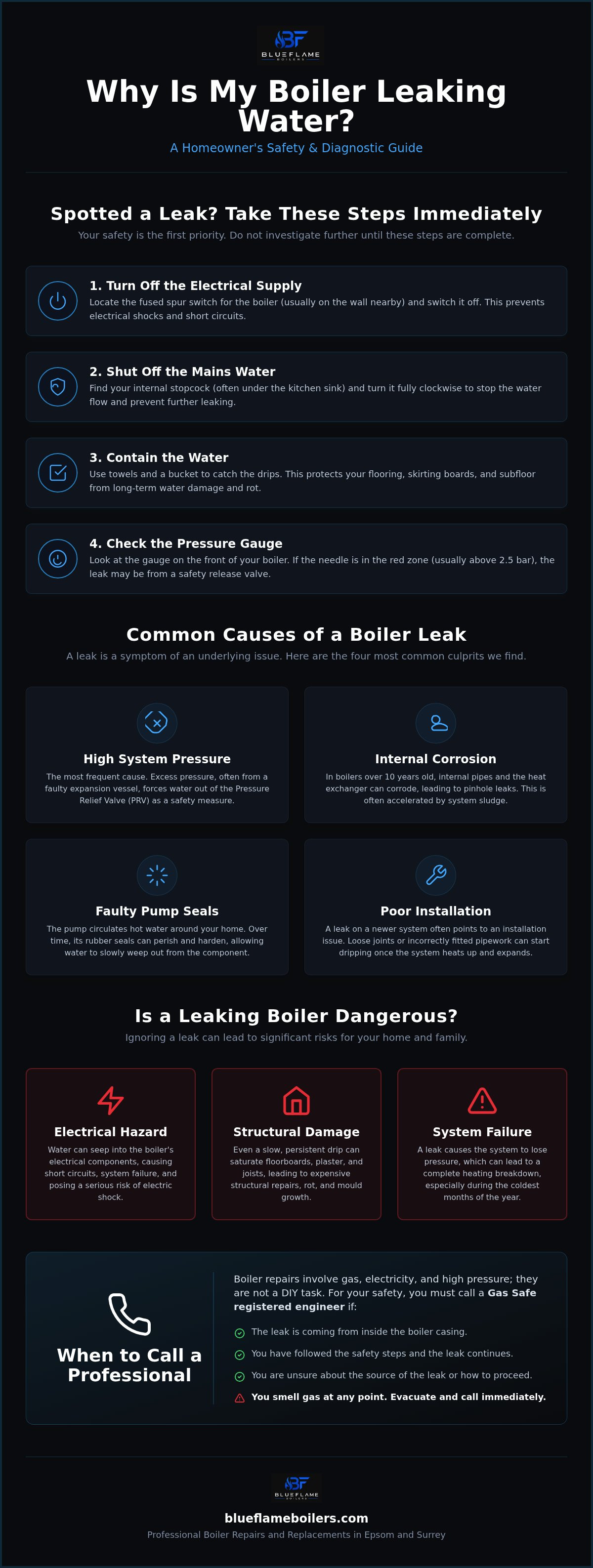
Discovering a pool of water under your heating unit is a stressful moment, but your first priority must be safety rather than diagnosis. Water and electricity are a dangerous combination. Before you start wondering why is my boiler leaking water, head to the fused spur (the wall switch near the unit) and turn off the power supply. This simple action prevents internal short-circuits and protects you from potential electrical shocks whilst you manage the situation.
Next, you need to stop the flow. Locate your mains water stopcock, usually found under the kitchen sink or in a hallway cupboard, and turn it clockwise until it's fully closed. This halts the pressure buildup and prevents more water from being forced through the leak. Whilst the system is cooling down, grab some old towels and a bucket. Don't just wipe up the mess; leave a container directly under the drip to protect your floorboards and skirting boards from warping or rot. Even a small amount of water can cause significant structural damage if it seeps into the subfloor.
Take a quick look at the pressure gauge on the front of the unit. If the needle is resting in the "red zone" (typically above 2.5 bar), the leak might actually be a safety feature in action. High pressure often forces water out through the pressure relief valve to prevent the system from failing. Understanding What is a Boiler? and how its internal pressure vessels work can help you see why these safety components are so vital for your home's protection.
Safely Isolating Your Heating System
Most modern units have small isolation valves on the pipework underneath. These look like small taps or screwdriver slots. If you can identify which pipe is leaking, turning the corresponding valve can stop the flow locally. However, you should never attempt to open the boiler casing yourself. This is a sealed unit; breaking the seal can lead to dangerous gas leaks or invalidate your manufacturer warranty. If you notice a faint smell of gas alongside the dripping water, open your windows immediately to ensure the area is well-ventilated and evacuate the room.
Identifying the Source of the Water
To help your engineer when they arrive, try to spot where the water is coming from without touching any internal parts. Is it a steady drip or a high-pressure spray? Check the external discharge pipe, often called the PRV pipe, which pokes through the outside wall of your house. If water is gushing from here, it's almost certainly a pressure issue rather than a burst pipe. Also, look for damp patches on the wall or ceiling; if the moisture originates from higher up or near the flue, it could be a roofing or chimney issue requiring the expertise of Atlas Roofing Solutions Ltd rather than a plumbing fault. Providing these details to a local specialist in Epsom or Surrey can speed up the repair process significantly.
To understand how professional contractors tackle these structural issues, you can learn more about ALG Roofing Limited and their expertise in comprehensive roof replacements.
Common Reasons Why Your Boiler Is Leaking Water
Understanding exactly why is my boiler leaking water requires looking at your heating system as a complete circuit. It is rarely a random event; usually, a drip is a symptom of internal stress, component fatigue, or chemical imbalances within the water itself. In our experience across Surrey, most leaks stem from four primary culprits that range from simple pressure issues to more serious internal decay.
High system pressure is the most frequent cause we encounter. When the water inside your system gets too hot or the expansion vessel fails, the pressure rises beyond safe limits. To prevent the unit from failing catastrophically, a safety valve releases the excess. Whilst this protects the machine, it leaves you with a puddle. On the other end of the scale, older units often suffer from corroded components. If your boiler is over a decade old, the internal copper pipework and the heat exchanger are vulnerable to pinhole leaks caused by years of chemical reactions. Ignoring these small drips can escalate the dangers of a leaking boiler, potentially leading to expensive electrical damage or even gas safety risks.
We also frequently see faulty pump seals. The internal pump is a hardworking mechanical part that circulates hot water around your radiators. Over time, the rubber seals that keep the water contained can harden and perish, allowing water to weep out. Finally, in newly installed systems, a leak often points to poor installation. A single loose joint or an incorrectly fitted pipe can manifest as a leak once the system reaches full operating temperature and the pipes expand.
The Role of the Pressure Relief Valve (PRV)
The PRV is your boiler's primary safety net. If the needle on your gauge climbs into the red zone, the PRV opens to vent water, usually through a pipe that leads outside your home. If you notice water dripping from this external pipe, it's a sign that your expansion vessel might have lost its air charge or that the PRV itself is stuck open by debris. A constantly dripping PRV is a clear signal that the internal pressure isn't being managed correctly.
Corrosion and System Sludge
In hard water areas like Epsom and Leatherhead, internal corrosion is a significant threat. When air enters the system, it reacts with the metal radiators to create a thick, black substance known as magnetite or "sludge." This grit is abrasive and acts like sandpaper, eating away at the delicate internal heat exchanger. This is why power flushing Surrey homes is such a vital preventative measure; it cleanses the system of these corrosive particles before they can cause a permanent leak.
Leaking from Underneath vs. Internal Dampness: A Diagnostic Guide
Pinpointing the exact exit point of a drip is the most effective way to understand why is my boiler leaking water. Identifying whether the moisture is originating from inside the white metal box or from the maze of pipework beneath it changes the diagnostic path entirely. When you call for help, being able to describe the location of the leak helps our engineers arrive with the correct spare parts, saving you time and reducing the stress of a cold home.
One specific diagnostic feature often overlooked is the tundish. If you have an unvented water cylinder, you'll likely see a small plastic funnel on the pipework nearby. This is designed to provide a visible gap so you can see if water is being safely discharged from a pressure or temperature relief valve. If water is splashing into the tundish, your system is telling you that its safety limits have been reached. This is a controlled discharge rather than a random burst, but it still requires professional attention to reset the system safely. Reporting this specific detail accurately is vital when booking an emergency boiler repair Surrey homeowners can rely on.
Water Dripping Directly from the Casing
If you see water seeping through the seams of the metal casing or dripping from the very bottom of the unit, the fault is likely internal. A rusted heat exchanger or a failed automatic air vent are common culprits. The primary danger here is that water can easily find its way onto the printed circuit board (PCB). This is the "brain" of your heating system. Even a few drops of moisture on these sensitive electronics can cause the unit to short-circuit, leading to a total "lock out" where the boiler refuses to ignite for safety reasons.
Leaks from the Pipework Below the Boiler
Sometimes the issue isn't the machine itself, but the connections that feed it. Check the filling loop, which is the silver braided hose used to top up your pressure. If the valves at either end haven't been closed tightly, they will weep. Similarly, the isolation valves that connect your radiators to the unit can develop loose compression joints over time. These "weeping" joints might only produce a few drops a day, but they are a warning sign. As the metal expands and contracts during heating cycles, these small leaks can suddenly become major bursts if left unaddressed.
Is a Leaking Boiler Dangerous? Assessing Risks to Your Home
Whilst a small drip might seem like a minor annoyance, the underlying reason why is my boiler leaking water often involves serious safety risks that extend far beyond a wet floor. The most immediate threat is the combination of water and electricity. Modern boilers are packed with sensitive electronic components. If water ingress reaches the internal wiring or the main control board, it can cause a short-circuit, lead to a fire hazard, or permanently fry the system's brain. If your unit is currently leaking, you should book a professional safety check immediately to prevent these hazards from escalating.
Structural damage is another significant concern that homeowners often underestimate. A persistent leak, even a slow one, can saturate floorboards, skirting boards, and even the timber joists beneath the unit. Over time, this moisture leads to wood rot and creates the perfect environment for black mould to thrive. Mould spores can spread through your home's air, posing respiratory health risks to your family. It's far better to address the leak today than to face a massive bill for floor replacement and damp remediation in six months.
Beyond the external damage, a leak puts the boiler itself at risk of a "dry fire." If the water level drops too low whilst the unit is still trying to fire up, the internal heat exchanger can overheat rapidly. Without water to absorb the heat, the metal can warp or crack. This turns a repairable fault into a total system failure, often requiring a complete boiler replacement. Protecting your home means acting before the pressure drops to zero.
Electrical Hazards and PCB Damage
Water ingress is the primary cause of death for expensive boiler electronics. The Printed Circuit Board (PCB) is the most costly part of the machine. A simple leak from a perished seal might only cost a small amount to fix if caught early. However, if that water drips onto the PCB, a repair scenario can quickly jump from £100 for a seal to over £500 for a new board and labour. Once a leak is fixed, a Gas Safe engineer must perform a professional "dry out" to ensure no residual moisture remains near the electrical terminals.
The Impact of Surrey’s Hard Water
Living in Surrey brings specific challenges for heating systems. Residents in Epsom and Leatherhead deal with some of the hardest water in the UK, which leads to rapid limescale buildup inside the unit. This limescale acts as an insulator, causing the heat exchanger to overheat and "kettle." This internal stress creates pressure spikes, which is a common answer to why is my boiler leaking water in the South East as the system tries to vent the excess pressure. Investing in a regular boiler service Epsom homeowners trust is the only way to descale these components and prevent pressure-related leaks before they start.
Professional Boiler Repairs and Replacements in Epsom and Surrey
Once you've identified a drip, the temptation to "tweak" a valve or tighten a nut yourself is often high. However, if the cause behind why is my boiler leaking water is internal, you must step back. It's a legal requirement in the UK to use a Gas Safe registered engineer for any work that involves opening the boiler casing or touching gas-carrying components. At Blueflame Boilers Ltd, we provide a transparent, methodical approach to every callout. We don't believe in aggressive sales techniques; we focus on getting your home warm and dry again as quickly as possible.
Deciding whether to patch up an old unit or invest in a new one is a common dilemma for Surrey homeowners. If your boiler is over 12 years old and the repair costs are mounting, it might be more cost-effective to upgrade. A modern, A-rated unit provides better efficiency and comes with a manufacturer warranty that protects you from future repair bills. We help you compare the long-term savings of a new unit against the immediate cost of a repair, ensuring you make the right choice for your family's budget.
Why Local Expertise Matters
Choosing a local family business over a faceless national energy company means you get engineers who actually know your area. We understand the specific challenges of Surrey’s infrastructure, from the high water mains pressure in Reigate to the hard water issues that often explain why is my boiler leaking water in towns like Epsom and Woking. Our proximity to the KT and RH postcode areas allows us to respond quickly to emergency callouts. Because we’re local, our warranties actually mean something. You won’t be stuck in a national call centre queue when you need us most.
Long-Term Solutions for a Leak-Free Home
The best way to handle a leak is to prevent it from ever happening. Annual servicing is the only reliable way to catch perishing seals or rising pressure before they turn into a kitchen-floor puddle. If your current unit is showing its age, a professional gas boiler installation Surrey homeowners can rely on will reset the clock on your home's reliability. Combined with a smart thermostat to monitor system health and prevent frozen pipes during a Surrey cold snap, you can enjoy a worry-free winter. To book an engineer in Epsom, Woking, or Reigate, simply get in touch with our friendly team at Blueflame Boilers Ltd today.
Take Control of Your Home's Heating
A dripping unit is more than just a nuisance; it's a call for attention from one of your home's most vital systems. We've explored the immediate safety protocols to protect your flooring, the technical triggers behind pressure spikes, and the specific hard water challenges that residents in Epsom and Leatherhead face. Understanding exactly why is my boiler leaking water empowers you to act quickly, preventing a minor drip from turning into a costly structural or electrical emergency.
Our team of Gas Safe Registered Engineers at Blueflame Boilers Ltd has spent years serving the local community across Surrey. We specialise in expert diagnostics for all major boiler brands, providing clear answers and honest advice on whether a repair or a modern replacement is your best path forward. You don't have to face a cold house or a damaged floor alone.
Book your emergency boiler repair in Surrey with Blueflame Boilers Ltd today and let our local experts restore your peace of mind. Your home's safety and comfort are our top priorities, and we're ready to help you get your heating system back to its best.
Frequently Asked Questions
Can I still use my heating if the boiler is leaking?
No, you should turn off your heating system immediately if you notice a leak. Even a small drip can travel along internal pipework and reach the printed circuit board (PCB) or other sensitive electrical components. Using the boiler whilst it's leaking significantly increases the risk of a permanent electrical short-circuit or a fire hazard. It's best to keep the system isolated until a Gas Safe engineer has confirmed it's safe to operate.
Is a leaking boiler an emergency that requires an immediate callout?
Yes, a leaking boiler is considered an emergency because it involves water in close proximity to gas and electrical systems. Beyond the safety risks, water can quickly cause structural damage to your floorboards and ceilings. If you cannot stop the leak by isolating the water supply, you should book an emergency callout to prevent a minor fault from escalating into a total system failure or costly home repairs.
How much does it typically cost to fix a leaking boiler in the UK?
Minor leak repairs, such as replacing a perished seal or tightening a joint, typically cost between £150 and £250. If the leak is more complex, the average cost for a standard boiler repair in the UK is approximately £300, with typical ranges falling between £100 and £500. Emergency callouts are more expensive, usually costing between £225 and £675 depending on the parts required and the time of the visit.
Why is my boiler leaking water from the bottom only when the heating is on?
This usually happens because of thermal expansion or high system pressure. When your heating is on, the water inside the system expands and the pressure rises; if your expansion vessel is faulty, this pressure has nowhere to go and escapes through the pressure relief valve. If you're asking why is my boiler leaking water specifically when it's hot, it could also be a perishing seal that only gaps when the metal pipework expands due to the heat.
Will a leaking boiler eventually explode or cause a gas leak?
Modern boilers have multiple safety valves designed to prevent explosions by venting excess pressure, so a catastrophic failure is extremely rare. However, a persistent leak caused by corrosion can eventually weaken the heat exchanger, which may lead to a gas leak. The more immediate danger is usually an electrical fire caused by water dripping onto internal wiring, which is why you must never ignore a damp unit.
How do I top up my boiler pressure if it has dropped due to a leak?
You can top up the pressure using the filling loop, which is usually a silver braided hose underneath the unit. You'll need to open the two small valves at either end of the hose until the needle on your pressure gauge sits between 1.0 and 1.5 bar. Don't do this whilst the boiler is actively leaking; you must fix the source of the leak first, or the pressure will simply drop again and continue to cause water damage.
Can hard water in Surrey cause my boiler to leak more frequently?
Yes, the hard water found in Epsom, Leatherhead, and across Surrey significantly increases the risk of leaks. Limescale builds up inside the heat exchanger, causing "kettling" and localised hotspots that stress the metal and internal seals. Over time, this mineral buildup leads to pinhole leaks and pressure spikes. This is a common technical reason why is my boiler leaking water in the South East, making regular descaling and servicing essential.
Does home insurance usually cover boiler leaks and subsequent water damage?
Standard home insurance typically covers the "trace and access" costs to find the leak and the repair of any resulting water damage to your floors or walls. However, the actual repair or replacement of the boiler itself is often excluded unless you have a specific "Home Emergency" add-on or a dedicated boiler cover plan. You should check your policy details to see if mechanical breakdown is included or if the cover is limited to the damage caused by the water.


