

Gas safety certificate renewal is an annual requirement for landlords in England. According to the Health and Safety Executive, relevant landlord-provided gas appliances and flues must be checked within 12 months of the previous check. A qualifying check can be arranged up to two months before the deadline whilst keeping the original annual deadline.
An expiry date can seem like a simple diary reminder, but an inspection may uncover problems that need attention before the paperwork is complete. Understanding what the record covers, when to book and what happens if remedial work is needed makes gas safety certificate renewal easier to plan.
This guide explains what a Gas Safety Certificate covers, how early renewal works and what can affect the cost of an inspection, without quoting a service price. It also explains what to expect if a fault is found and how remedial work relates to the safety record, so you can plan ahead and understand the next steps.
Key Takeaways
- A landlord gas safety record is valid for 12 months from the inspection date, and arranging a check early can help you plan ahead.
- The cost of a check depends on what needs inspecting, including the gas appliances in the property.
- Learn what the certificate records and when landlords need to give tenants a copy.
- Understand why an expired certificate has no grace period and what to do if a deadline has passed.
- If an inspection identifies a fault, remedial work may be needed before the record can show the installation is safe.
Can a landlord wait until the certificate expires before arranging another check?
No. Landlords should arrange the next check before the current record expires, rather than leave it until the last day. Booking early gives you time to arrange access and address any issues identified during the inspection.
Annual renewal for landlords
Annual renewal means arranging a new gas safety check each year for relevant landlord-provided gas appliances and flues. According to the Health and Safety Executive, landlords in England generally must have them checked by a Gas Safe registered engineer within 12 months of the previous check.
The timing matters because the certificate records the inspection outcome, it does not automatically extend the deadline. Add the next appointment to your property calendar as soon as the current check is complete. For a rented home with several appliances, arrange access to each one during the visit.
Certificate validity and renewal timing
According to the Health and Safety Executive, a landlord gas safety certificate in the UK is valid for 12 months from the inspection date. The expiry date is therefore tied to the inspection, so use the date on the current record when planning the next check.
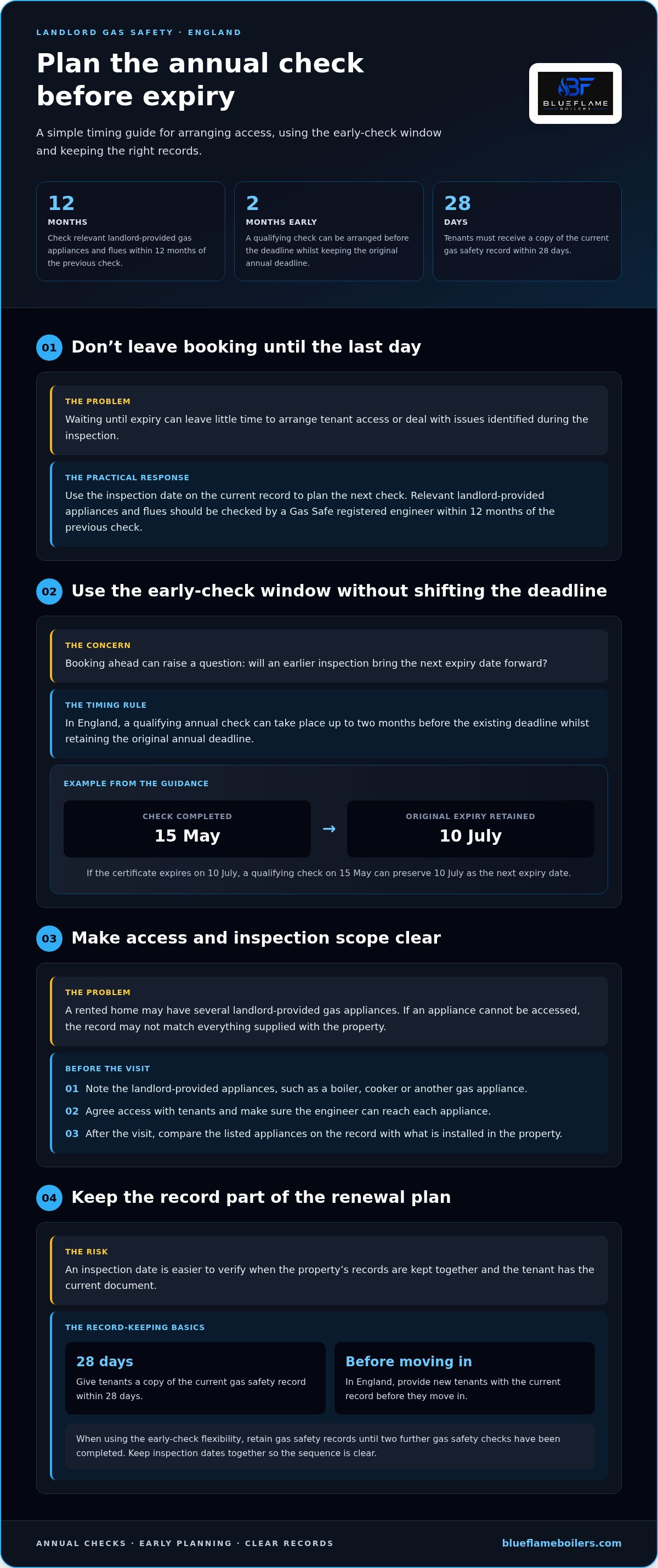
In England, the Health and Safety Executive allows a qualifying annual check up to two months before the existing deadline while retaining the original annual deadline. This gives landlords more time to arrange access without bringing forward the next expiry date.
For example, if a certificate expires on 10 July, a check on 15 May can preserve 10 July as the next expiry date. Booking before the deadline can help avoid a gap caused by scheduling or tenant access. The key step is to request an appointment early enough to complete the inspection within the current certificate period.
Keep the inspection and expiry dates visible in your records. Set a calendar reminder ahead of the deadline, then agree access with tenants before booking the visit. If a tenant cannot attend the first proposed appointment, offer another suitable time instead of leaving arrangements until expiry.
When using the early-check flexibility, retain gas safety records until two further gas safety checks have been completed. Keep each record with the property’s inspection dates so the sequence is clear if you need to show when checks took place. A simple reminder system can help landlords manage annual renewals across several properties.
Gas safety check costs
The cost of a rental-property gas safety inspection depends on the appliances included and the work requested. The number and type of landlord-owned gas appliances affect the scope of the visit. Combining a boiler service with a safety check means arranging both tasks. The quote depends on the circumstances, including the appliance count, access and requested service.
The inspection can cover gas appliances provided by the landlord. These may include a boiler, cooker or other gas appliance supplied with the rental property. The record should reflect the appliances checked, so compare it with what is installed. If there are several appliances, make sure the engineer can access each one during the appointment.
Tenants can check the current gas safety record for the property and compare its inspection date and listed appliances with the rental home. If the record is missing or the appliances do not match, ask the landlord for the current document and explain what needs clarification.
A boiler service and a gas safety check have different purposes, even when arranged during one visit. The safety check assesses the landlord’s gas appliances and produces the required record; servicing is maintenance for the boiler. Ask for both tasks to be clearly identified in the booking and paperwork, so the documents show what the engineer completed. A combined appointment may be convenient, but the cost depends on the work requested and appliances involved.
For landlords arranging an appointment, the two-month early-check flexibility can help with tenant access and the existing expiry date. A qualifying check during this period can retain the original deadline. This allows time to organise the inspection before expiry, particularly when the engineer needs access to several appliances or appointments must be coordinated across properties.
Before arranging the visit, note the appliances supplied with the property and make access arrangements with tenants. Tell the engineer whether you’re requesting a safety check alone or a boiler service as well. This makes the scope clearer and helps the written record reflect the work completed. If you need to arrange a landlord gas safety check, provide the property details and explain which appliances are present.
You cannot compare costs accurately by looking only at the phrase “gas safety check”. One property may need a check covering a boiler; another may include a boiler and cooker. The requested service matters too. A clear appointment brief helps landlords understand what the quoted work covers and what documentation to expect after the inspection.
What is a Gas Safety Certificate?
A Gas Safety Certificate, also called a gas safety record, documents checks on landlord-provided gas appliances and flues. It gives landlords and tenants a written account of the inspection and any issues identified.
Providing certificates and retaining records
Landlords must give tenants the current gas safety record and keep records of completed checks. According to the Health and Safety Executive, tenants must receive a copy within 28 days. In England, new tenants must receive the current record before moving in.
Keep the record with the property’s inspection history. In England, gas safety check records normally need to be retained for at least two years. Electronic records are permitted if they can be reproduced when required, are protected against loss or interference, and identify the engineer who carried out the check.
Responsibility for gas installations
Landlords are responsible for gas appliances, fittings and flues they provide for tenants. The Gas Safety (Installation and Use) Regulations 1998 established these duties, and checks must be carried out by a Gas Safe registered engineer.
The inspection record should relate to the rental property and its landlord-provided equipment. For example, if the landlord supplies a boiler and cooker, both should be included in the inspection arrangements. A tenant’s own appliance is separate from equipment supplied by the landlord.
Compliance evidence and legal responsibilities
A clear compliance trail brings together the gas safety record, inspection dates and evidence that tenants received the document. This helps landlords show what was checked and when, rather than relying on memory or scattered messages.
According to The National Archives (legislation.gov.uk), a gas safety record more than 12 months old puts a landlord in breach of regulation 36 of the Gas Safety (Installation and Use) Regulations 1998. Keep the latest record accessible, alongside earlier documents and evidence of delivery to tenants.
For each property, keep a simple file with the current and previous records, along with dated correspondence about sending copies or arranging access. Match every record to the property address and listed appliances. If you use an electronic system, retain a version that can be reproduced and identifies the inspecting engineer.
These documents serve different purposes: the inspection record documents the check, while delivery evidence shows that tenants received it. Keeping both makes it easier to respond to a tenant’s request or demonstrate the inspection history. An organised file also helps landlords spot an approaching expiry date and plan the next check without searching through old emails.
Whether an expired gas safety certificate has a grace period
No. There is no grace period after a UK gas safety certificate expires. To renew it, arrange a safety check with a Gas Safe registered engineer, provide access to the landlord’s gas appliances, then keep the new record and give tenants a copy.
Expired certificates and compliance penalties
An expired record leaves a gap in the landlord’s gas safety paperwork, so the annual legal requirement still needs attention. A landlord who forgets to renew could face a fine of up to £6,000 and up to six months in prison. These consequences make it important to act as soon as the expiry is noticed, rather than wait for another reminder.
Keep the previous record, note its expiry date and record when the replacement inspection is arranged. The paperwork should make the sequence clear: the earlier check, the missed deadline and the new inspection. This evidence helps explain the steps taken after expiry.
Actions after a record expires
Arrange a new check promptly and give the registered engineer access to every landlord-provided gas appliance and flue. Once the inspection is complete, keep the resulting record and provide tenants with a copy. If access is delayed, document reasonable attempts, including notices and offers of flexible appointment times.
- Find the expired record and note its expiry date.
- Arrange a new check with a Gas Safe registered engineer.
- Coordinate access with tenants and record attempts if access is unavailable.
- Keep the new record and provide a copy to tenants.
Landlords can avoid a future gap by arranging the next qualifying check before the deadline. In England, the Health and Safety Executive allows a qualifying check up to two months early while preserving the original annual deadline. This flexibility can help when tenant access or appointment scheduling makes a last-minute visit difficult.
For example, if access falls through on the planned day, contact the tenant again in writing and offer flexible appointment times. Keep copies of messages and appointment details with the property’s gas records. This creates a dated account of attempts to complete the check, rather than leaving the delay unexplained.
After a replacement inspection, update the property file with the new record and inspection date. Make sure the document identifies the appliances checked and the engineer who carried out the work. A clear record helps landlords track the next renewal and show tenants that the inspection is complete.
Remedial work and certificate reissue
A gas safety check may identify a defect that needs attention before an appliance can be treated as safe. The gas safety record should reflect the engineer’s findings, while records of remedial work and any later assessment clarify what happened next.
Keep the inspection and repair stages distinct. A recorded fault does not disappear just because a repair has been arranged. For example, if an engineer identifies a boiler problem, record the finding, the work completed and the outcome of any follow-up assessment. This gives landlords and tenants a practical record of the appliance’s status.
The next step depends on the issue found. The engineer can explain the defect, the work required and whether the appliance should remain in use until the issue is resolved. Do not treat a carbon monoxide concern as routine maintenance: follow the engineer’s instructions and arrange the necessary work.
After a repair, keep documentation showing what was done and whether the appliance was checked again. File it with the original gas safety record. A repair invoice can show that work took place, but it does not replace an inspection record or show the result of a later safety assessment.
A useful sequence for landlords is:
- Read the gas safety record and identify the appliance and defect noted.
- Arrange the specified remedial work and retain its written description.
- Have the relevant appliance assessed again where needed.
- File the updated record and repair documents together.
This distinction matters because a boiler repair and a gas safety check serve different purposes. Repair work addresses a fault; an inspection documents the condition assessed by the engineer. If work changes the installation or involves a component noted in the original report, keep the follow-up paperwork with that report so the sequence is easy to understand.
Ask for clear wording in the record: which appliance was checked, what issue was found, what work was completed and what the later assessment concluded. If the gas safety record still lists outstanding work, do not file it as though every issue has been resolved. The documents should tell a consistent story, from the first inspection through to the completed action.
For landlords, the key takeaway is simple: keep remedial work records with the inspection records. File the initial findings, repair details and any follow-up assessment together for the property. This makes it easier to explain the appliance’s status to tenants and track any remaining work.
Arrange a landlord gas safety check
Blueflame Boilers: Gas Boiler Installation
Blueflame Boilers Ltd can help with boiler faults through boiler repair, or with maintenance through boiler servicing. If an inspection identifies a boiler issue, repair may address the fault; if the appliance needs replacing, gas boiler installation is the relevant next step. Emergency callouts are available for urgent boiler problems.
Choose the service that matches the issue identified, and keep inspection and repair documents together in your property records. A new installation does not replace the need to address findings on an existing gas safety record, so follow the engineer's stated next steps.
To discuss the right boiler service for your property, contact Blueflame Boilers Ltd.
Plan the next step for your property
Treat the inspection record as a working document, not simply paperwork to file away. Read the engineer’s findings alongside any remedial-work documents, then note any action still outstanding. If a boiler fault needs attention, arrange repair or servicing; if the boiler needs replacing, consider a suitable installation. Clear tenant updates and organised records make maintenance decisions easier. Planned gas safety certificate renewal is also a useful point to review the property’s heating needs and keep its maintenance history together. Record the appliance involved, work completed and any required follow-up.
Blueflame Boilers offers Boiler Repair, Emergency Callouts and Gas Boiler Installation. These services can support landlords dealing with a boiler fault, an urgent boiler problem or a replacement. Let the inspection findings guide your next step.
Take the next step with a clear plan for your property’s heating. A little organisation now can help you move forward with confidence.
Frequently Asked Questions
Do I have to use a Gas Safety Engineer?
Yes. Landlords must arrange checks with a Gas Safe registered engineer, not a general handyman or unregistered contractor. The engineer should inspect the relevant landlord-provided gas appliances and flues and document the findings. Check that the record identifies the inspecting engineer, then file it against the correct property. This distinguishes the official gas safety inspection from other maintenance or repair visits.
What if the tenant will not allow access?
Keep dated records of reasonable attempts to arrange access, such as written notices and offers of flexible appointment times. If a tenant declines an appointment, propose another and keep copies of the messages. Record missed visits and the tenant’s responses alongside the property’s gas documents. This creates a clear account of your efforts and helps you continue arranging the inspection rather than treating one refusal as the end of the process.
Do I need one if the property has no gas?
No, a landlord does not need a gas safety certificate if the property has no gas supply and no gas appliances. For example, a home with electric heating and no gas-connected cooker or boiler falls into this category. Check the property, including appliances supplied to tenants, before relying on that distinction. If gas equipment is present, the relevant landlord gas safety duties apply to the equipment provided.
How long does a gas safety record last?
A landlord gas safety record is valid for 12 months from the inspection date, according to the Health and Safety Executive. Use the inspection date shown on the document to plan the next appointment. Keep the record with the property file, rather than relying on a separate reminder alone. If the property changes tenants, make sure the current record is easy to find and ready to share.
How often do you need to renew Gas Safe certificate?
Landlords need a new gas safety check annually for relevant landlord-provided appliances and flues. In England, the Health and Safety Executive allows a qualifying early check within the permitted window while preserving the original deadline. Plan gas safety certificate renewal around the recorded expiry date, rather than delaying until after it. Calendar reminders can help landlords coordinate access and appointments across several rental properties.
How quickly must the tenant receive the new record?
Give existing tenants a copy within 28 days, according to the Health and Safety Executive. For a new tenancy in England, provide the current record before the tenant moves in. Keep evidence of delivery, such as a dated email or written acknowledgement, with the property’s inspection documents. That makes it easier to show when the record was shared, particularly if a tenant later asks for another copy.
Need a gas safety check?
Blueflame Boilers offers CP12 certificates for landlords. This can suit landlords arranging checks in Epsom and nearby areas, including Ashtead, Leatherhead, Oxshot, Cobham, Weybridge, Ewell, Worcester Park, Cheam, Sutton, Carshalton, Banstead, Reigate, Tadworth, Woking, Bookham, Effingham, Horsley, Ripley and Kingswood, Surrey. Have the property details and appliance information ready when arranging the appointment, so the inspection can be planned around the rental home.
What is a gas safety certificate in the UK and who needs one?
It is the record of a gas safety inspection for landlord-provided gas appliances and flues. Landlords renting a property with gas appliances or a gas supply need to arrange the relevant checks and provide tenants with the record. For example, a landlord who supplies a gas boiler must include it in the inspection arrangements. The document records the findings and helps tenants understand which equipment was checked.


