
A combi conversion is more than a straightforward boiler swap. The cost of replacing an old boiler with a combi depends on the work required, particularly changes to pipework, the boiler’s position and removal of a hot-water cylinder or storage tank.
If you’re considering the change, look beyond the installation itself. A combi heats water on demand from the mains and can free up space by removing the need to store hot water. However, it may not suit every home, especially where several bathrooms are used at once.
This guide explains what affects conversion costs, when a combi may suit your household and how efficiency and boiler lifespan relate to potential savings. The price depends on the property and the work involved, so you’ll need a tailored quote. You’ll also learn how converting from a conventional or system boiler differs from replacing an existing combi.
Key Takeaways
- Separate the boiler’s purchase cost from installation work, then consider what the conversion itself adds to the project.
- Think about how your household uses hot water: a combi can suit smaller homes, while stored hot water may better support several simultaneous demands.
- Compare potential energy savings with the installation cost, remembering that efficiency and actual household use affect the payback period.
- Factor in the boiler’s expected lifespan when weighing the long-term value of replacing an older system.
- Understand how changing from a conventional or system boiler can involve extra pipework and removal of tanks or cylinders.
Energy efficiency and potential bill savings
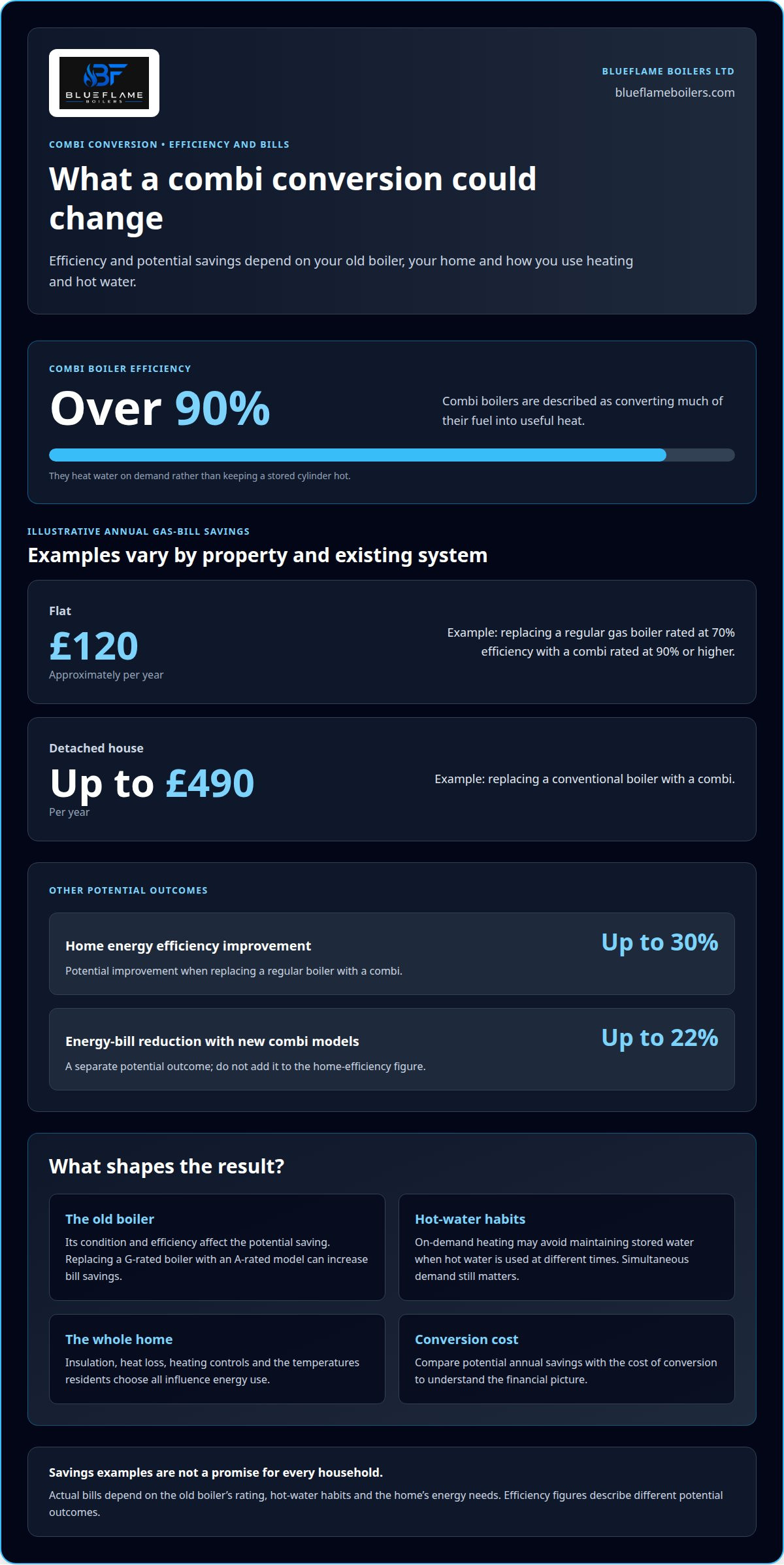
Combi boilers are described as achieving over 90% efficiency. This means they convert much of their fuel into useful heat. They heat water as it is needed, rather than keeping a stored cylinder hot. That operating difference can affect energy use, particularly in homes previously heating stored water. However, boiler efficiency alone doesn’t determine the household’s final bills. How the home uses heating and hot water matters too.
The potential saving depends partly on the old boiler’s condition and efficiency. For example, replacing a 70%-efficient regular gas boiler with a combi rated at 90% or higher could save approximately £120 a year on gas bills in a flat. In a detached house, replacing a conventional boiler with a combi could save up to £490 a year. These examples show why savings vary with the property and existing system.
Efficiency improvements can also be expressed as a change in the home’s energy performance. Replacing a regular boiler with a combi can improve home energy efficiency by up to 30%. New combi models could cut energy bills by up to 22%. These figures describe different potential outcomes, so they shouldn’t be added together. A home’s starting point matters: replacing a G-rated boiler with an A-rated model can increase bill savings.
Hot-water use is another factor. A combi heats mains water when you open a tap, rather than drawing from a hot-water store. If your household uses hot water at different times, this on-demand setup avoids maintaining stored water. If several people need hot water simultaneously, however, the pattern of demand matters. A boiler’s energy efficiency doesn’t change that practical consideration.
A home’s energy efficiency affects how much heat it needs. For example, a well-insulated home may lose less warmth than a draughty one, changing how often the heating runs. The same boiler can therefore lead to different bills in different homes. Heating controls and the temperatures residents choose also affect energy use. When considering likely savings, look at the whole home, not just the boiler’s efficiency rating.
Compare the potential annual saving with the conversion cost to understand the financial picture. A saving of £120 a year in one flat differs from the potential £490 a year in a detached home. The figures are examples, not a promise of what every household will save. The old boiler’s rating, hot-water habits and the home’s energy needs all influence the outcome.
Why switch to a combi boiler?
A combi conversion changes how your home stores and receives hot water. Whether it suits you depends on available space, the mains water supply and how your household uses heating and hot water.
Removing tanks and cylinders
That change also removes stored hot water from the system. Consider where the existing cylinder and tanks are located, and how your household uses hot water. For example, if several people regularly shower at once, you may value stored hot water more than the extra cupboard space.
Combi capacity varies by model. Some models can meet the hot-water demand of a home with 2 bathrooms, while combis generally suit smaller or medium homes with one or two bathrooms. The number of bathrooms alone doesn’t show whether simultaneous use will feel comfortable.
Water pressure suitability
A combi draws water directly from the mains, so the incoming supply affects flow at taps and showers. Water pressure and flow rate are related but different: pressure describes the force of the water, while flow describes how much water arrives over time.
For example, run a shower while opening a kitchen tap to see whether the supply meets your household’s needs. A combi doesn’t store hot water, so weak incoming flow can affect hot-water performance. Suitability depends on the mains supply and your home’s expected demand.
In the UK, gas boilers must be installed by a Gas Safe Registered engineer. For rented homes, a CP12 is a landlord’s Gas Safety Check; it is distinct from the boiler installation itself.
Grant support depends on the scheme and the household or property’s eligibility. No automatic payment applies to every UK boiler conversion, so don’t rely on grant funding until you know the relevant criteria.
Switching risks and disadvantages
The main trade-off is losing stored hot water. A conventional boiler’s cylinder can supply several showers at once, whereas a combi heats water on demand. If people in your home often use hot water simultaneously, consider that pattern before switching.
A combi also relies on the incoming mains supply, making water pressure and flow important. If the supply can’t meet demand, taps or showers may be less effective during simultaneous use. Conversion can also involve removing tanks and changing pipework, adding work beyond a straightforward boiler swap.
For an accurate quote, describe your existing boiler and its location, where the tanks and cylinder are, and how your household uses hot water. A clear assessment should account for removal, pipework changes and the proposed combi location. All installations must be carried out by Gas Safe Registered engineers.
If you’re considering a conversion, you can enquire about your boiler conversion with details of your current setup.
Additional costs for changing boiler type or location
A like-for-like replacement keeps the boiler type and position broadly unchanged. Converting to a combi or moving the appliance changes the work involved. The installer may need to alter pipework, remove redundant equipment or prepare a new position. For example, moving a boiler from a kitchen to a utility room means routing connections to the new location. These tasks affect the project’s scope and the time and materials required.
Pipework is a key consideration when changing boiler type. Many older UK boilers run on 15mm gas pipes, while most modern combis need a 22mm pipe to function efficiently. If the existing pipework doesn’t meet the new boiler’s requirements, it may need upgrading. The route, access and condition of the pipes influence how involved that work is. A conversion assessment should account for the actual pipework, not assume the old connections can simply be reused.
Changing the boiler’s position can add work. A new site may need longer heating and water connections, a different route through the property, or adjustments around cupboards and walls. Moving the boiler to another room, for example, can involve more pipework than replacing it in its existing position. Access and the distance to existing connections help shape the installation plan.
Changing from a conventional boiler can involve removing the hot-water cylinder and cold-water tank, as well as reconfiguring pipework. This differs from a straightforward replacement because the old system’s layout must be adapted to suit a combi. A regular-to-combi conversion typically takes 1.5-2 days. A system-to-combi conversion often takes up to 3 days. The extra time reflects the different work each property needs.
The type of boiler affects what needs to change around it. A combi supplies hot water differently from a conventional or system boiler, so the existing cylinder, tanks and connections all matter. For example, a home with a cylinder in an airing cupboard may need that equipment removed and the associated pipework altered. Moving the boiler at the same time can mean further changes. Together, these details determine the work required.
The price depends on the boiler’s new position, the existing pipework, the system being replaced and any tank or cylinder removal. The exact figure is given in a quote for your case. Sharing details about the current boiler and intended location helps describe the project clearly. You can enquire about your boiler installation with those details.
Boiler lifespan and savings payback
A good-quality new boiler should last around 10-15 years. That gives you a useful period for considering the value of a conversion, rather than looking only at the installation day. The boiler’s expected working life and the time needed for energy savings to offset its cost are related, but they’re not the same measure. A boiler can remain useful even if the initial outlay has not yet been recovered through lower bills.
The payback period depends on the installation price and the amount saved on energy bills. A simple estimate compares the project cost with the expected annual saving. For example, a home making modest savings each year will take longer to recover its conversion cost than one making larger annual savings. This comparison is a guide, not a full forecast of future energy spending.
Start with your home’s actual energy demand. A household that heats every room regularly and uses hot water throughout the day may have a different bill pattern from a smaller household that heats less often. The old boiler’s efficiency matters too: replacing a poorly performing unit presents a different savings opportunity from replacing a more efficient one. The same combi model can therefore produce different outcomes in different homes.
Boiler models differ in efficiency and suitability, so your choice affects the payback calculation. A model suited to your property’s heating and hot-water demand can avoid paying for capacity your household doesn’t use. A boiler that struggles to meet demand, on the other hand, may not provide the expected comfort. Consider your household’s usage alongside the energy rating, rather than judging a model on efficiency alone.
Maintenance is another part of the long-term picture. An annual service can help keep a boiler operating as intended and identify developing faults. Dedicated heating and gas specialists such as Plumbing & Boilers London provide routine servicing and maintenance to help protect your investment. Over a 10-15-year lifespan, regular care gives you a clearer record of the boiler’s condition. Repair needs, changes in household demand and energy prices can all affect the value you experience over time.
Compare like with like when weighing replacement against continued use. List the current boiler’s repair history, heating performance across the home and household energy use. Then compare these details with the expected performance of a suitable new model. A conversion may be more compelling when repeated faults or poor heating coincide with potential energy savings, but the calculation still depends on the project cost.
Think of payback as one part of a wider decision. The expected lifespan, annual energy savings, boiler condition and household demand all influence the result. A longer payback period doesn’t automatically mean a new boiler is unsuitable, especially if reliability or hot-water needs are central concerns. Review the likely savings against the boiler’s expected 10-15 years of service, and consider how your needs may change during that time—whether those annual utility savings simply lower everyday outgoings or are redirected towards bucket-list pursuits like climbing Mount Kilimanjaro with Kilimanjaro Select.
Combi boiler conversion from a conventional or system boiler
Converting a conventional or system boiler involves more than replacing the appliance. A regular-to-combi conversion typically takes 1.5-2 days, while a system-to-combi conversion often takes up to 3 days.
Converting a conventional system can involve removing the cold-water feed tank and hot-water cylinder, adapting pipework and connecting the combi. A system boiler conversion also replaces the cylinder-based arrangement with on-demand hot water. The precise tasks depend on the existing layout, the new boiler’s position and the property’s heating requirements.
Conventional and system boilers store hot water differently from a combi. A conventional boiler works with a cold-water tank and hot-water cylinder, while a system boiler uses a cylinder without the same loft-tank arrangement. A combi heats water as needed, so conversion changes both hot-water delivery and the surrounding connections. It requires a planned system change, not simply fitting a new boiler to the old setup.
Pipework is an important part of the conversion. Existing connections were arranged for the old boiler and stored-water system, so they may need reconfiguring for a combi. Gas pipework may also need upgrading to meet the new boiler’s requirements. The route, accessibility and condition of the pipes influence the amount of work. A new boiler position can require further changes to connect it to the heating system.
Radiators remain part of your home’s central heating system, but the installer must connect them to the new boiler arrangement. Your property’s heating demand and hot-water use help determine whether a combi is suitable. A household with several bathrooms or frequent simultaneous hot-water use needs careful consideration, because a combi doesn’t draw from a stored cylinder. The conversion should account for both taps and radiators.
The process typically starts with an assessment of the existing boiler, cylinder, tanks, pipework and proposed appliance position. The old equipment is then removed where required, connections are altered, and the new combi is installed and tested. For example, converting a regular boiler may require removing loft equipment as well as the airing-cupboard cylinder. A system conversion can involve different removal work, affecting the project’s timeframe.
The key is to assess the whole heating layout, not just the boiler. Pipework changes, equipment removal, boiler position and household demand all shape the scope of a conversion. These details also explain why converting from a conventional or system boiler differs from a like-for-like replacement.
Blueflame Boilers Ltd
Blueflame Boilers Ltd can assess whether a combi conversion suits your home and explain the work involved. Its gas boiler installation service covers replacement projects. An assessment of your existing setup can clarify factors such as boiler position, pipework and household heating needs.
If your current boiler has developed a fault, boiler repair may be the right next step. Boiler servicing can help maintain a working system. The right option depends on whether you’re planning a conversion or addressing a problem with your existing boiler.
Share details of your current boiler and the changes you’re considering to discuss the work involved. For help with your next step, contact Blueflame Boilers Ltd.
Make your next boiler decision with confidence
Turn the information into a clear plan for your home. Note what matters most: freeing up storage space, meeting your household’s hot-water needs or addressing an ageing system. The cost of replacing an old boiler with a combi depends on the work your property requires, so a tailored assessment can clarify the options and installation scope.
Blueflame Boilers Ltd provides gas boiler installation, boiler repair and emergency callouts. Whether you’re planning a conversion or dealing with a boiler fault, discuss your situation and the practical next step with the team.
A well-considered decision starts with your home’s needs. Take the next step when you’re ready.
Frequently Asked Questions
How long does it take to recoup the costs of a new boiler?
Payback depends on the installation outlay and the savings your household makes on energy bills. Estimate it by comparing the full project cost with the likely annual saving, using your home’s previous energy use as a guide. For example, a household with modest heating demand may save less than one replacing a poorly performing boiler in a larger property. Changes in energy use can affect the estimate over time.
How much does a new boiler cost?
A new boiler’s price depends on the model, its output and the installation work involved. The appliance price is only part of the total if fitting requires new connections, changes to existing pipework or removal of redundant equipment. For a useful comparison, separate the boiler supply from the work needed to install it. The figure for your home depends on its requirements and is provided in a quote.
Why are some boilers more expensive?
Boiler prices vary according to the model’s output, efficiency, features and manufacturer. A higher-output model may suit a home with greater heating or hot-water demand, while a smaller property may need less capacity. Installation also affects the total: replacing a boiler in the same position differs from changing the system layout. New connections or relocating the appliance, for example, add work beyond supplying the boiler.
How much does it cost to replace an old boiler with a combi boiler in the UK?
The cost of replacing an old boiler with a combi in the UK depends on the existing system and the conversion work required. A like-for-like replacement differs from changing a regular or system boiler, which may involve altering pipework and removing stored-water equipment. The boiler’s location and the home’s heating layout also affect the scope. Your property’s exact figure is provided in a quote based on these requirements.
What is the average cost of a combi boiler in the UK by size and brand?
There isn’t one useful average for every size and brand because both the model and installation scope affect the total. The boiler’s output should suit the home’s heating and hot-water demand; choosing by brand alone won’t establish suitability. For example, a larger home with more radiators may need a different output from a compact flat. Compare suitable models by specification and include any installation changes in your budget.
How much does combi boiler installation cost, including labour and materials?
The installed total depends on labour, materials and the work needed to connect the new boiler to your home’s system. Reusing existing pipework creates a different scope from a project requiring new routes or connections. Access to the installation area can also affect the work. For a clear budget, distinguish the appliance from fitting and associated materials. A quote gives the figure for your specific setup.
What extra costs apply when converting a system or regular boiler to a combi boiler?
Conversion work can include adapting pipework, removing a hot-water cylinder or tanks, and preparing the combi’s chosen position. The precise tasks differ between regular and system boilers because their existing layouts aren’t identical. For instance, a new boiler position may require longer pipe routes as well as equipment removal. Include these details in the conversion scope rather than treating it as a simple appliance swap.
How much does it cost to remove and dispose of an old boiler and hot-water cylinder?
Removal and disposal costs depend on the equipment that needs taking out, access to it and the conversion plan. Removing a boiler alone is different from a project that also removes a cylinder and redundant tanks. For example, equipment in a tight airing cupboard may require a different approach from items with clear access. Ask for removal and disposal to be identified in the project quote so the scope is clear.


