
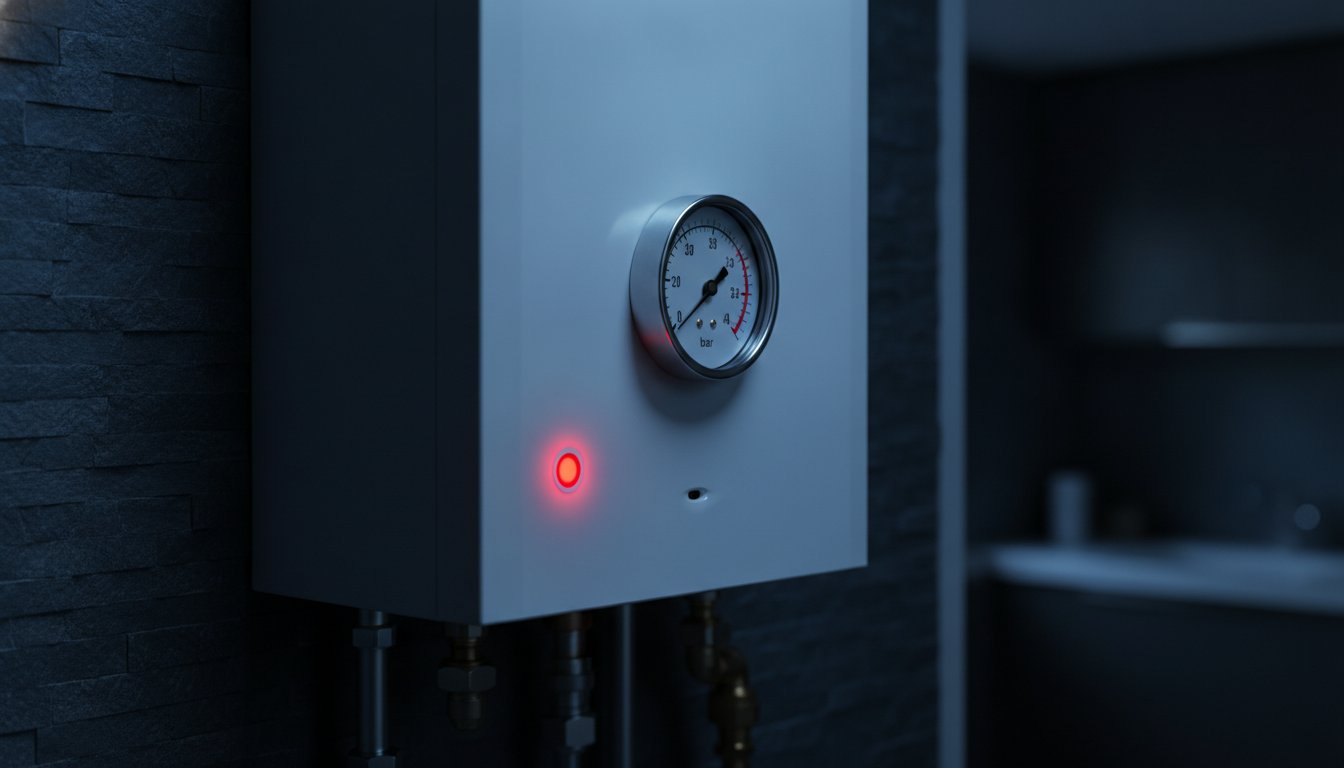
Imagine waking up on a chilly morning in Epsom to find your radiators stone cold and your boiler displaying a flashing red warning light. It’s a common source of anxiety to find your boiler pressure too high, especially when you’re worried about the safety of your home or the potential for a hefty emergency callout fee. You likely just want your heating back on without the stress of a complicated or expensive repair.
We understand how frustrating a lockout can be; however, high pressure is often a symptom of simple user error or local water conditions rather than a total mechanical failure. This 2026 guide will show you exactly how to identify the ideal pressure setting for your Surrey home and how to safely return your system to the green zone. We will walk you through the common causes of pressure spikes, provide clear steps for DIY fixes, and explain the specific signs that indicate you need a Gas Safe registered engineer to step in.
Key Takeaways
- The ideal boiler pressure for most modern UK systems is between 1.0 and 1.5 bar when the water is cold.
- If you discover your boiler pressure too high, the most common culprit is a filling loop that hasn't been fully closed after topping up.
- You can often safely lower the pressure yourself by bleeding your radiators, provided you let the system cool down completely first.
- Persistent pressure spikes or a dripping copper pipe on your external wall usually indicate a faulty Pressure Relief Valve or expansion vessel failure.
- Annual servicing by a Gas Safe engineer is essential to identify early signs of component wear and to keep your manufacturer’s warranty valid.
What Is Boiler Water Pressure and How Does It Work?
Most modern boilers in the UK operate as a "sealed system". This means the water that heats your radiators is kept in a closed loop, completely separate from the water that comes out of your kitchen or bathroom taps. It's a precise balance. When your boiler fires up, the water inside gets hot and naturally expands. Since there's nowhere for that extra volume to go in a rigid pipe network, the pressure on the gauge rises.
To prevent this expansion from damaging your pipes or joints, every sealed system includes an expansion vessel. This is essentially a small tank with a rubber diaphragm inside. On one side of the diaphragm is the system water; on the other is compressed air. As the water expands, it pushes against the diaphragm, compressing the air and safely absorbing the extra pressure. If this vessel fails or the air charge is lost over time, you'll likely find your boiler pressure too high because the expanding water has nowhere to go.
A small rise on your gauge of about 0.3 to 0.5 bar whilst the heating is active is perfectly normal. However, if the needle hits the red zone, which is usually anything above 2.5 or 3.0 bar, the system is at risk. Most modern units will trigger a safety lockout to prevent internal components from bursting under the strain.
The Difference Between Water Flow and Water Pressure
It's easy to confuse these two terms. Water flow is the volume of water moving through your pipes to reach your taps. Pressure, however, is the force that pushes that water. In a central heating context, we talk about "static pressure" when the boiler is off and "dynamic pressure" when the pump is running. Understanding how central heating systems manage pressure is vital because high pressure is almost always an internal "closed loop" issue. It isn't caused by high pressure from the water mains outside your Epsom or Weybridge home. Instead, it's a clear signal that the balance of water and air inside your boiler has been disrupted.
Digital vs Analogue Pressure Gauges
You'll usually see one of two types of displays on your boiler. Traditional analogue gauges use a physical needle. The green section indicates the safe operating range, whilst the red section warns of a fault. Modern boilers, like those from Worcester Bosch or Ideal, often use digital displays. These are very precise but can be confusing if they show error codes instead of numbers. Common codes like F22 (Vaillant) or E1 (Baxi) often trigger when the system detects the boiler pressure too high or too low. Be aware that digital sensors can sometimes give "ghost" readings. This happens if heavy sludge or debris from old radiators blocks the sensor, making it think the pressure is higher than it actually is.
What Is the Ideal Boiler Pressure for a Modern Heating System?
Getting your heating system to run efficiently starts with the right balance of water and air. The industry standard for most UK households is a range of 1.0 to 1.5 bar. The ideal boiler pressure for a modern heating system is between 1.0 and 1.5 bar when the system is cold. If your gauge is sitting within this window before you turn your heating on for the evening, your system has enough water to circulate effectively without putting undue stress on the internal seals and valves.
Checking this gauge should become a monthly habit, much like checking the oil in a car. By monitoring the needle or digital readout regularly, you can spot trends before they become emergencies. For instance, a slow, steady rise over several weeks often hints at a weeping filling loop, whilst a sudden jump every time the heating fires up suggests an expansion vessel that needs attention. Catching these signs early prevents the frustration of a total lockout when you need warmth the most.
Ideal Pressure: Cold vs Hot Readings
It is a common mistake to assume the needle should stay perfectly still. When your radiators are stone cold, aim for that 1.0 to 1.2 bar sweet spot. Once the boiler is under full load and the water begins to heat up, the physical expansion will naturally push that reading higher. An acceptable rise whilst the boiler is active can reach up to 2.0 bar. This is simply physics in action.
However, if the pressure exceeds 2.5 bar during operation, you are entering the "surge" zone. At this point, the safety mechanisms, specifically the Pressure Relief Valve (PRV), may trigger to vent excess water and protect the unit. While domestic boilers are designed with multiple safety layers to prevent the hazards of pressure vessel rupture, a constant surge will eventually wear out these safety components, leading to leaks and expensive repairs.
Manufacturer Variations
While the 1.0 to 1.5 bar rule is a reliable baseline, some brands have specific preferences. Worcester Bosch models often feature a clear green band on the analogue gauge that extends exactly to 1.5 bar, whereas Vaillant digital displays are often programmed to be "happiest" at 1.2 bar. If you have a larger property in Surrey with an unvented water cylinder, your system might be set slightly higher to ensure water reaches the top floor radiators with sufficient force.
Understanding these nuances is key to maintaining your warranty. For a deeper dive into brand-specific requirements, you can check the ultimate guide to boiler servicing in Epsom. If you find your boiler pressure too high every time you try to use the hot water, it might be time for a professional check. A quick boiler repair consultation with Blueflame Boilers Ltd can often resolve these calibration issues before they lead to a mid-winter breakdown.
Identifying Why Your Boiler Pressure Is Too High
Finding the needle on your pressure gauge nudging into the red zone can be unsettling. While modern units are built to high safety specifications, a reading above 2.5 bar suggests the system is struggling to regulate its internal environment. Identifying the root cause is essential because persistent over-pressurisation can strain joints and lead to leaks. Most instances of finding your boiler pressure too high stem from a few common mechanical or user-related issues.
In Surrey areas like Epsom and Weybridge, local water conditions play a significant role. The region is known for hard water, which contains high levels of calcium and magnesium. Over time, limescale can build up inside the Pressure Relief Valve (PRV). If a small piece of scale gets trapped in the valve's seat, it prevents the valve from closing fully. This allows water to continue entering or prevents the system from venting correctly, leading to a steady climb on the gauge.
The Filling Loop: A Simple Fix
The most frequent cause of high pressure is actually the simplest to resolve. The filling loop is the silver, braided flexible hose located underneath or near your boiler. It features two small tap-like valves used to top up the system with mains water. If these valves are left slightly open, or if they haven't been turned fully perpendicular to the pipe, water will continue to trickle into your heating circuit. Even a tiny, microscopic gap can cause the pressure to rise over several hours. In some cases, the internal rubber seal within the filling loop can perish due to age, allowing "let-by" where water bypasses the valve even when it appears closed.
Internal Component Faults
If the filling loop is definitely closed, the issue likely lies with an internal component. The expansion vessel, which we discussed earlier, relies on a precise air charge to work. If the air leaks out or the rubber diaphragm inside ruptures, there is no "cushion" for the expanding hot water. Adhering to official pressure vessel safety standards ensures these parts are robust, but they do require professional re-pressurisation or replacement every few years to function correctly.
Another possibility is a perforated plate heat exchanger. This is a more serious fault where a tiny hole allows high-pressure mains water to leak directly into the lower-pressure heating circuit. Finally, don't overlook the impact of system debris. If your radiators haven't been cleaned in years, magnetic sludge can block the narrow ports leading to your pressure sensor, causing "ghost" high readings. Investing in power flushing Surrey systems with Blueflame Boilers Ltd is often the best way to clear this debris and ensure your boiler pressure too high warnings aren't just caused by a clogged sensor.

Step-by-Step: How to Safely Reduce High Boiler Pressure
If you have confirmed that your filling loop is tightly closed but the gauge still shows your boiler pressure too high, you will need to manually vent some water from the system. This is a controlled process that mimics what a professional would do during a routine service. Before you begin, you must turn your boiler off at the main wall switch and allow the radiators to cool completely. Handling a pressurised system whilst the water is near boiling point is dangerous and can lead to serious scalds.
To perform this task safely, you only need three simple items: a standard radiator bleed key, a dry cloth or old towel, and a small bowl to catch drips. By following a methodical approach, you can return your heating system to its ideal operating range without the need for a professional callout.
Bleeding Radiators to Lower Pressure
The most effective way to reduce system pressure is by bleeding a radiator. You should ideally start with the radiator that is either at the highest point in your home or the one furthest away from the boiler itself. These points are where air and excess pressure often accumulate first. Place your towel on the floor beneath the bleed valve and hold your bowl directly under the valve's nozzle.
Insert the key and turn it slowly anti-clockwise. You will likely hear a hissing sound as air escapes, followed by a steady stream of water. Unlike a standard bleed where you stop as soon as water appears, you should let about half a mug of water flow into the bowl. After closing the valve, go back to your boiler and check the gauge. It is vital to monitor the needle closely because it is easy to over-correct. If you release too much water and the pressure drops below 1.0 bar, your boiler may refuse to fire up at all. Whilst you are at the radiator, take a moment to check for cold spots at the top; this is the perfect time to clear any trapped air that might be affecting your heating efficiency.
Alternative Methods: Drain Off Valves
In some larger Surrey properties, bleeding a single radiator might not be enough to see a significant drop on the gauge. In these cases, you might look for a drain-off valve. These are typically located at the lowest part of your heating circuit, often near a door or under a kitchen sink. These valves feature a notched nozzle designed for a hosepipe attachment. Using a hosepipe allows for a much faster reduction in pressure, but it requires more care to ensure you don't drain the system entirely.
A word of caution: never attempt to open any internal valves inside the boiler casing itself. The only user-serviceable valves are the external filling loop and the radiator bleed points. If you have bled several radiators and the needle hasn't budged, or if it shoots back into the red as soon as you turn the heating on, there is likely an internal component failure. In these situations, it is safer to stop and book a professional boiler repair to avoid damaging your heat exchanger or pump.
Professional Solutions: When High Pressure Indicates a Deeper Issue
Whilst bleeding your radiators is an excellent first step, it isn't a permanent fix for every situation. If you successfully lower the reading only to find your boiler pressure too high again within a few hours or days, you are likely dealing with a component that has reached the end of its life. Persisting with DIY fixes in this scenario is like trying to empty a sinking boat with a teaspoon; you're managing the symptom rather than curing the cause.
The clearest sign that you need a Gas Safe registered engineer is a dripping copper pipe on the external wall of your house. This is the discharge pipe for your Pressure Relief Valve (PRV). This valve is designed to open when the system exceeds 3.0 bar to prevent internal damage. However, once a PRV has been forced open, it often fails to seal perfectly again, especially in Surrey's hard water areas where limescale can grit the valve's seat. A constant drip outside means your boiler is effectively "bleeding" itself, which will eventually lead to a total loss of pressure and a system lockout.
The Dangers of Ignoring High Pressure
Leaving your system in a high-pressure state puts immense strain on every joint and seal in your home. Central heating pipework is designed for a specific range; exceeding this for long periods can cause minor "weeps" at radiator valves or, worse, behind floorboards. During a freezing Surrey winter, the last thing you want is a boiler that locks out because it can't regulate its internal environment. A system that constantly runs at the top of the gauge is also less fuel-efficient, as the pump has to work harder to circulate the water, potentially shortening its lifespan.
Expert Support in Epsom and Leatherhead
At Blueflame Boilers Ltd, we've spent years supporting homeowners across Epsom, Leatherhead, and Woking with reliable, local expertise. Most pressure-related emergencies can be prevented with a thorough annual check-up. Booking a boiler service in Woking allows our engineers to check the air charge in your expansion vessel and ensure your PRV is clear of limescale. This proactive approach protects your manufacturer’s warranty and gives you peace of mind that your home will stay warm when the temperature drops.
Don't let a small pressure spike turn into a costly emergency repair. If you can't get your gauge back into the green or you've spotted a leak, our team is ready to help. Contact Blueflame Boilers Ltd for emergency repairs today and let a local professional return your system to its ideal setting safely.
Restoring Your Peace of Mind and System Safety
Finding your boiler pressure too high doesn't always mean a catastrophe is looming. Often, a quick check of the filling loop or a controlled radiator bleed is all it takes to get your home back to its ideal 1.0 to 1.5 bar setting. However, if the needle keeps climbing or you've noticed a persistent drip from your external overflow pipe, it's time to stop the DIY and call in the professionals. Ignoring these signs can lead to damaged joints or a total system lockout during the peak of winter.
As local experts for Epsom, Woking, and Leatherhead, our Gas Safe Registered engineers are here to ensure your heating system remains safe and efficient. We provide 24/7 emergency callouts across Surrey to handle those tricky expansion vessel failures or faulty valves that a radiator key simply can't fix. Book a Gas Safe Boiler Check in Epsom Today to protect your warranty and your home's comfort. You now have the knowledge to manage the basics; for everything else, we're just a phone call away.
Frequently Asked Questions
Is it dangerous if my boiler pressure is too high?
It isn't typically dangerous to your physical safety because modern boilers feature a Pressure Relief Valve (PRV) that vents excess water outside. However, it's very damaging to the health of your heating system. Persistent high pressure can weaken internal seals, strain pipe joints, and damage the pump, which often leads to expensive repairs if the boiler pressure too high issue isn't addressed quickly.
Can I leave my boiler on if the pressure is in the red zone?
You should turn your boiler off if the needle or digital display stays in the red zone. Running a boiler under extreme pressure puts unnecessary strain on the heat exchanger and internal components. Most modern units will eventually trigger a safety lockout to protect themselves, which means you'll be left without heating or hot water until the pressure is returned to the green zone.
Will high boiler pressure cause a leak in my ceiling?
High pressure can indirectly cause a leak in your ceiling by forcing water through the weakest points in your central heating system, such as radiator valves or older pipe joints. Whilst the boiler usually vents excess water safely through a discharge pipe on your external wall, the increased force can cause brittle joints on the upper floors to "weep". This often results in damp patches appearing on the ceilings below.
How much does it cost to fix a boiler with high pressure in Surrey?
The cost to resolve high pressure depends on whether the cause is a simple valve adjustment or a mechanical failure. Simple fixes, such as resetting a filling loop or bleeding radiators, are often covered during a standard callout fee. If the issue requires replacing a failed expansion vessel or a perforated heat exchanger, the price will increase to account for the specific parts and the labour involved. Local Surrey engineers can provide a clear quote after a physical inspection of the unit.
Why does my boiler pressure go up when the heating is turned on?
It's normal for pressure to rise slightly because water expands physically as it gets hot. You should expect a modest rise of about 0.3 to 0.5 bar whilst the system is active. If the pressure surges into the red zone immediately after the boiler fires up, it's a clear sign that your expansion vessel has lost its air cushion and can no longer absorb the increased volume of the hot water.
Can I lower boiler pressure without bleeding the radiators?
You can lower the pressure using a drain-off valve, which is typically found at the lowest point of your pipework or near an external door. This method requires a hosepipe and is often faster than bleeding radiators for large pressure drops. However, for most homeowners, bleeding a radiator remains the safest and most controlled DIY method to ensure you don't accidentally drain too much water and cause the pressure to bottom out.
Is high boiler pressure covered under my manufacturer's warranty?
Warranty coverage depends on the root cause of the fault and your maintenance history. If a component like the heat exchanger fails prematurely, it's usually covered, provided you've kept up with your annual Gas Safe services. However, if the boiler pressure too high is caused by a filling loop left open or a buildup of magnetic sludge due to poor system maintenance, the manufacturer will likely reject the claim as a user or maintenance error.
How often should I have my boiler pressure checked by a professional?
You should have your system's pressure and expansion vessel charge checked by a professional once a year. This is a vital part of a standard annual boiler service. Regular professional checks are the only way to identify "silent" issues, like a losing air charge in the expansion tank, before they cause a mid-winter breakdown or a safety lockout.


