

Imagine waking up to a freezing Surrey morning only to find your radiators are stone cold and the boiler has locked out again. You head to the cupboard, check the gauge, and see the needle sitting at a dismal zero. You've searched every inch of the house, but there isn't a single puddle or damp patch to be found. It feels like your heating system is playing a vanishing act. Dealing with a boiler losing pressure no visible leak is one of the most baffling problems a homeowner can face. It's perfectly natural to feel anxious about hidden pipe damage or the cost of a major repair whilst you're just trying to keep your family warm.
The good news is that water doesn't just disappear into thin air; it's always hiding somewhere. In this high energy guide, we're putting on our heating detective hats to show you exactly where that ghost leak is lurking. Whether it's escaping as invisible steam or hiding inside your boiler's internal components, we'll help you find the source and reclaim your peace of mind. We're going to explore the common culprits, from perforated heat exchangers to faulty expansion vessels, so you can stop the constant top-ups and enjoy a warm, worry free home once again.
Key Takeaways
- Understand the physics of your sealed heating system and why a drop in pressure doesn't always result in a visible puddle on your carpet.
- Learn about internal "boiler gremlins" like the expansion vessel, which acts as the system's lungs and can cause water loss behind the scenes.
- Discover how tiny pinhole leaks can hide in plain sight by evaporating off hot radiators before they ever have a chance to hit the floor.
- Follow our high-energy diagnostic checklist to safely hunt for the missing pressure without ever needing to open the boiler casing yourself.
- Find out how local Surrey experts use advanced thermal imaging to solve the mystery of a boiler losing pressure no visible leak once and for all.
The Mystery of the Vanishing Water: Why Your Boiler Pressure is Dropping
It's a classic Epsom mystery. You check your boiler gauge and see the needle has plummeted, yet your carpets are bone dry and there's not a drip to be seen. This is what we call a "ghost leak". It's incredibly annoying to deal with a boiler losing pressure no visible leak, especially when you're just trying to keep the house warm. You aren't alone in your confusion; it's one of the most common calls we get across Surrey, and it's perfectly normal to feel frustrated when the evidence doesn't match the symptoms.
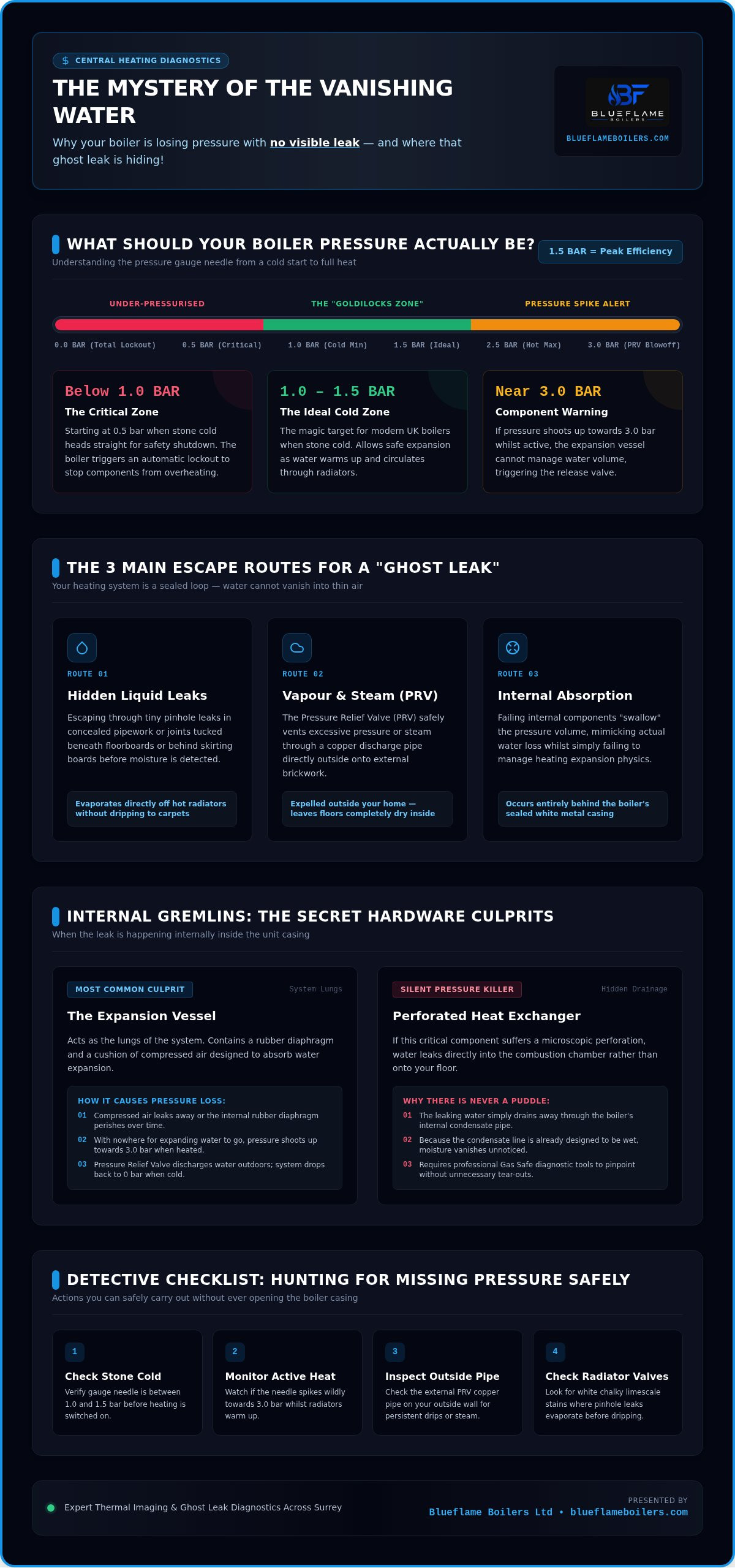
Your central heating system is designed as a sealed loop. In simple terms, the water inside stays inside, circulating from the boiler to your radiators and back again. Understanding how boilers work helps you realise that this water shouldn't just vanish. If that needle is moving, the seal has been compromised somewhere. When the pressure hits the "Critical Zone", which is usually anything below 1 bar, your boiler will likely trigger a safety shutdown. This "lockout" is a clever bit of engineering that prevents internal components from overheating, but it leaves you in the cold until the mystery is solved.
What Should Your Boiler Pressure Actually Be?
Think of your boiler pressure like a car's tyre pressure; there's a "Goldilocks Zone" where everything runs perfectly. For most modern UK boilers, 1.5 bar is the magic number for peak efficiency. It's vital to remember that water expands when it gets hot, so you'll naturally see the needle rise whilst the heating is active. Ideal pressure is being between 1.0 and 1.5 bar when the system is stone cold. If you're starting at 0.5 bar whilst cold, you're already heading for a lockout.
The Three Main Ways Water 'Disappears'
If you're facing a boiler losing pressure no visible leak, the water is usually making its exit in one of three ways:
- Hidden Liquid Leaks: Water is escaping through tiny pinhole leaks in pipework or joints hidden under floorboards or behind skirting where you can't see the dampness.
- Vapour and Steam: The Pressure Relief Valve (PRV) might be venting water or steam out of the discharge pipe on your external wall because of an internal fault.
- Internal Absorption: Components like a failing expansion vessel can "swallow" the pressure, making it look like water has gone when the system is actually just failing to manage the expansion.
Internal Boiler Gremlins: The Secret Components Causing Pressure Loss
When you're dealing with a boiler losing pressure no visible leak, the culprit is often hiding behind the metal casing. Most homeowners spend their time checking radiator valves and floorboards, but the real drama usually happens inside the "white box" on your wall. Your boiler contains a complex network of valves and vessels that manage the physics of hot water. When these components fail, the water doesn't necessarily end up on your kitchen floor; it finds more secretive ways to escape.
One such secret exit is the heat exchanger. If this component develops a tiny perforation, the system water can leak directly into the combustion chamber. From there, it simply drains away through the condensate pipe, which is designed to carry away waste liquid. Because this pipe is already meant to be wet, you'll never see a puddle. It's a silent pressure killer that requires a professional eye to diagnose. If you suspect your system is losing water internally, it's worth booking a diagnostic visit with a local expert to stop the cycle of constant top-ups.
The Expansion Vessel: The Most Common Culprit
Think of the expansion vessel as the "lungs" of your heating system. It's a small tank, usually tucked away at the back of the boiler, containing a rubber diaphragm and a cushion of compressed air. This air cushion absorbs the extra volume created when water heats up and expands. Over time, this air charge can leak away, or the diaphragm can perish.
When the vessel is flat, there's nowhere for the expanding water to go. You'll notice the pressure needle shooting up towards 3 bar as soon as the heating comes on, only to drop back to zero once the system cools down. This isn't a DIY fix. A Gas Safe engineer needs to use professional pumps to re-pressurise the vessel or replace it entirely if the seal has failed. It's a routine task for an expert but essential for system stability.
The Pressure Relief Valve (PRV) and the Copper Pipe
The PRV is the safety "ejector seat" for your boiler. If the pressure gets too high, this valve opens to dump excess water and protect the system from damage. You can find the evidence by looking at the small copper pipe poking through your external wall. Engineers call this the "telltale" pipe. If you see it dripping or notice white lime-scale stains on the brickwork beneath it, your PRV is leaking water outside.
A leaking PRV is often just a symptom of a failed expansion vessel. Once the valve has been forced open by high pressure, it rarely seals perfectly again, leading to a slow, continuous pressure drop. Checking this external pipe is one of the easiest ways to confirm why your system is losing its grip without ever picking up a screwdriver.
Hidden Ghost Leaks: Tracking Down Water Escaping Behind the Scenes
If you've checked the internal components and found nothing, it's time to look amongst your living spaces. A boiler losing pressure no visible leak often means the water is escaping in such small quantities that it never reaches the carpet. Think of your radiators like a kettle; if a tiny pinhole leak develops on a hot radiator, the water can evaporate into the air before it even has a chance to drip. You're left with a pressure drop but no physical evidence. It's a frustrating cycle, but these "ghost leaks" are common in older Surrey homes where pipework has seen decades of service.
Sometimes, these weak spots only appear after a professional maintenance session. For instance, power flushing Surrey systems is a brilliant way to restore efficiency, but the process can occasionally highlight old, corroded joints that were previously held together by sludge and debris. It's far better to find these vulnerabilities during a controlled service than to have them fail unexpectedly during a January cold snap. Finding the leak now prevents expensive floorboard damage later.
Radiator Valves and 'Weeping' Joints
Microscopic leaks often hide around your Thermostatic Radiator Valves (TRVs). Try the "Tissue Paper Test" tonight. Wrap a dry piece of kitchen roll around the valve joints and leave it whilst the heating is off. You might be surprised to find it damp in the morning. This happens because metal contracts as it cools; a joint that stays sealed whilst hot might start "weeping" once the temperature drops. In many cases, simply tightening the gland nut with a spanner can stop the leak instantly. It's a simple, satisfying DIY fix that could save you a callout fee.
Underfloor Pipework and Hidden Voids
The "Floorboard Fear" is a common source of anxiety for homeowners. In many properties, pipes run through the voids between storeys, meaning a leak could be soaking into insulation or timber for weeks before a ceiling stain appears. Keep an eye out for unusual "hot spots" on your laminate or tiled flooring, or a faint, musty damp smell in specific rooms. Also, double-check your filling loop; if it's left slightly ajar, it can cause the system to over-pressurise and then dump water. In homes with concrete floors, water can travel along the pipe run and vanish into the sub-floor, making the source nearly impossible to find without specialist thermal imaging equipment.
Diagnostic Guide: Hunting for the Missing Pressure
Ready to crack the case? Before you call in the cavalry, you can gather some vital clues yourself. Being the "heating detective" helps us narrow down the search when we arrive at your door. However, safety is our absolute priority. You must never open the boiler casing yourself. Only Gas Safe registered engineers are legally permitted to remove the cover and inspect the internal "gremlins" we discussed earlier. Stick to the external checks listed below to stay safe whilst you investigate.
The 5-Minute Visual Inspection
Grab a torch and follow these three simple steps to spot the evidence of a hidden leak:
- Step 1: Head outside and locate the small copper discharge pipe poking through the wall behind your boiler. Check if it's currently dripping or if the brickwork below is damp.
- Step 2: Take a dry piece of kitchen roll and wipe every radiator valve and joint in the house. Even a microscopic damp spot on the paper confirms a "weeping" joint that might be evaporating before it hits the floor.
- Step 3: Look up. Walk through your home and inspect the ceilings directly below your radiators or the boiler cupboard. Faint, yellow circular staining is a telltale sign of a slow leak hiding in the floor void.
If you find the gauge is sitting at zero and the boiler has locked out, you might need an immediate fix to get the hot water running again. You can learn Boiler Pressure Low? How to Safely Top It Up using our simple guide. Just remember that topping up is a sticking plaster, not a cure. Doing it too often introduces fresh, oxygenated water into your system, which eventually leads to internal rust and sludge.
The 'Pressure Drop' Log
Start a simple log on your phone or a piece of paper. Note down the exact time and date when you top the system up to 1.5 bar. Then, record how long it takes to drop back down to the 0.5 bar "danger zone". Does the pressure plummet whilst the heating is running full blast, or does it happen slowly overnight whilst the pipes are cold? Recording these specific details will help your Blueflame engineer diagnose why you have a boiler losing pressure no visible leak much faster. This data can save significant time during a repair visit.
Expert Solutions in Surrey: How Blueflame Boilers Ltd Cracks the Case
When you've reached the end of your tether with a boiler losing pressure no visible leak, it's time to call in the local experts. At Blueflame Boilers Ltd, we take pride in being the go-to team for homeowners across Epsom, Leatherhead, and Woking. Whether you live in a Victorian terrace in Epsom or a modern build in Woking, we understand the specific pipework quirks of Surrey homes. We don't just guess where the water is going; we use professional diagnostic tools to find the truth. Our engineers often use thermal imaging cameras to see through walls and under floors. These high-tech 'detective' tools allow us to pinpoint tiny leaks in your pipework without causing unnecessary disruption to your home. It's about finding the answer quickly so you can get back to your day.
Prevention is always better than a frantic search for a ghost leak in the middle of winter. Investing in annual boiler servicing in Epsom is the smartest way to keep your system stable and efficient. During a service, we check the expansion vessel's charge and inspect the heat exchanger for those microscopic perforations we mentioned earlier. Our team brings a friendly, upbeat energy to every job, ensuring your home stays warm and your boiler remains safe. We take the stress out of home maintenance whilst ensuring your warranty remains valid and your radiators stay hot throughout the year.
Why DIY Topping Up Isn't a Long-Term Fix
It's tempting to just keep turning that filling loop handle, but constant topping up is actually damaging your system. Every time you add water, you're introducing fresh oxygen. This leads to 'Fresh Water Corrosion', a process where internal components begin to rust from the inside out. Eventually, this creates magnetite sludge that causes blockages and further pressure drops. Whether you need a professional expansion vessel recharge or a full component replacement, a Gas Safe certified repair provides the peace of mind that your home is safe and your boiler is running at peak efficiency. We'll find the root cause rather than just treating the symptoms.
Ready to Fix Your Ghost Leak?
If your system is currently locked out and you're shivering, don't wait for the problem to resolve itself. We offer a fast emergency boiler repair in Surrey service for those urgent cases where the hot water just won't stay on. Booking a diagnostic visit now can prevent a small, hidden leak from becoming a massive, floorboard-ripping disaster. Our engineers are ready to crack the case and restore your stable pressure for good. We're local, we're thorough, and we're ready to help you reclaim your comfort. Don't let a ghost leak win; let our experts put things right.
Take Control of Your Home Comfort Today
Dealing with a boiler losing pressure no visible leak doesn't have to be a guessing game. You've now seen how water can vanish through internal gremlins like the expansion vessel or evaporate silently from a hot radiator joint before it even hits the carpet. Whilst topping up the system gets the heat back on, it's the professional "detective work" that prevents long-term corrosion and protects your expensive heat exchanger from fresh oxygen damage. The team at Blueflame Boilers Ltd brings local Epsom expertise to every callout, using advanced diagnostic tools to find those elusive ghost leaks. Whether you need a simple vessel recharge or a complex internal repair, our Gas Safe Registered engineers are ready to restore your peace of mind and keep your family warm. We even offer emergency callouts across Surrey for those times when you simply can't wait for the morning to solve the mystery.
Don't let a vanishing leak dampen your spirits or damage your property. Reach out to our friendly team today and let's get your heating system back to peak performance for the season ahead. We are ready to help you reclaim your home comfort with professional, reliable service.
Frequently Asked Questions
Is it dangerous if my boiler is losing pressure but there's no leak?
Low pressure itself isn't typically dangerous because modern boilers have safety sensors that trigger a lockout before damage occurs. However, a boiler losing pressure no visible leak is a clear sign that an internal component is failing. The real danger comes from ignoring the issue; constant topping up introduces fresh oxygen that corrodes your system from the inside. It's best to have a Gas Safe engineer investigate to prevent long term damage.
How often should I have to top up my boiler pressure?
You should only need to top up your boiler pressure once or twice a year, usually after bleeding your radiators. A sealed system shouldn't lose water; if you find yourself reaching for the filling loop every few weeks or months, you have a leak. Frequent topping up is a symptom of a larger problem that needs professional diagnosis to protect your boiler's warranty and internal components like the heat exchanger.
Can a faulty expansion vessel cause my boiler to lose pressure?
A faulty expansion vessel is actually one of the most common reasons for pressure loss. If the internal air cushion fails, the water has nowhere to expand as it heats up. This forces the safety valve to dump water outside, leaving your system empty once it cools down. If your needle bounces between high and low extremes, our Epsom based team can usually recharge or replace the vessel to stabilise your system quickly.
Will a power flush fix my boiler pressure problems?
A power flush is designed to remove sludge and debris rather than fix a leak directly. However, it can improve system circulation and prevent the blockages that lead to over-pressurisation. In some cases, cleaning out the system reveals tiny "pinhole" leaks that were previously blocked by rust. Whilst it isn't a direct cure for a boiler losing pressure no visible leak, it's a vital maintenance step for overall heating health in Surrey homes.
What happens if I keep using a boiler with low pressure?
If you continue to use a boiler with low pressure, the system will eventually "lock out" and stop providing heat or hot water. This is a safety feature to prevent the pump from running dry and burning out. Beyond the lack of comfort, running a system on low pressure forces the boiler to work harder, reducing its lifespan and increasing your energy bills. Addressing the issue early saves you from an expensive emergency replacement.
Could the leak be under my floorboards if I can't see it?
It's very possible for a leak to hide in the voids beneath your floorboards, especially in older properties across Leatherhead and Woking. Water can soak into timber or insulation for a long time before appearing as a stain on the ceiling below. Our engineers use thermal imaging technology to track these hidden "hot spots" without needing to rip up your flooring, making the diagnostic process much cleaner and faster for local homeowners.
Why does my boiler pressure go up when the heating is on but then drop to zero?
This specific behaviour is a classic sign of an expansion vessel failure. Without a functional air cushion to absorb expanding hot water, the pressure spikes and triggers the Pressure Relief Valve (PRV) to vent water out of the discharge pipe. Once the system cools and the remaining water contracts, the pressure drops to zero. It's a frustrating cycle that requires a Gas Safe Registered engineer to fix the internal vessel and reset the system.
Should I call an emergency plumber for a pressure drop?
If a pressure drop leaves you without heating or hot water during a cold Surrey winter, you should certainly consider an emergency callout. We provide 24/7 emergency response across Reigate, Sutton, and Epsom to get families back in the warm. Whilst a slow pressure drop can often wait for a scheduled repair, a complete lockout is a priority situation that our local "heating detectives" are always ready to handle with professional care.


