
What if replacing your water supply pipe didn’t mean cutting a long trench across your garden or driveway? Water main replacement without digging uses moling to create a route for a new pipe beneath the surface, avoiding the need for one continuous trench. It doesn’t mean there’s no digging at all, and the right approach depends on the property and ground conditions.
If you’re concerned about damage to paths, lawns or other surfaces, it helps to understand what the method can and cannot do. This guide explains how moling works, what can affect its suitability and which part of the supply pipe Blueflame Boilers Ltd replaces. Based in Epsom, Blueflame serves local Surrey areas including Ewell, Cobham, Tadworth, Weybridge, Woking and Reigate. Read on for practical points to consider before arranging a water main replacement.
Key Takeaways
- Learn what “no-dig” means in practice, and why it doesn’t promise zero surface disturbance.
- See how water main replacement without digging compares with open excavation, and why the right method depends on the property.
- Know what details about your supply pipe and the surfaces along its route are useful when discussing the job.
- Find out how Blueflame’s moling service can support a considered replacement plan for your property.
What does water main replacement without digging actually mean?
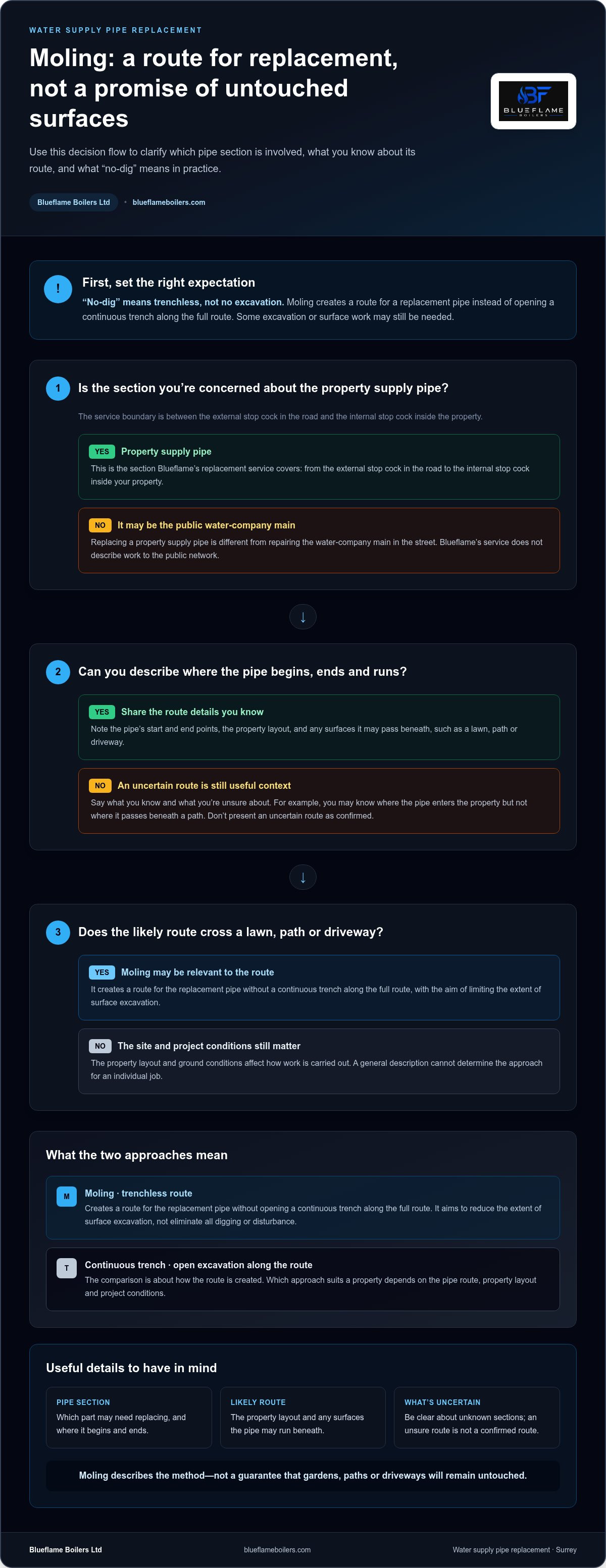
The phrase water main replacement without digging can sound as if the work happens beneath an untouched garden or driveway. In practice, “no-dig” describes a trenchless approach. Moling creates a route for installing a replacement pipe, rather than opening a continuous trench along the full pipe route. The aim is to reduce the extent of surface excavation, not to promise that no surface will be disturbed.
That distinction helps set realistic expectations. The route, property layout and ground conditions all affect how the work is carried out. Some excavation or surface work may still be needed, so no-dig shouldn’t be taken as a guarantee that paths, lawns or driveways will remain completely untouched. It describes the approach to creating a route for the pipe, not a guaranteed result for every part of the property.
It’s also useful to distinguish the supply pipe serving a property from the water-company main in the street. They’re connected parts of the wider water supply, but they aren’t the same section of pipe. Blueflame’s water main replacement service covers the supply pipe from the external stop cock in the road to the internal stop cock inside your property. It does not describe repair work to the public network.
What is moling in a water supply pipe replacement?
Moling is the trenchless method Blueflame uses for supply-pipe replacement. In plain terms, it creates a route through the ground so that a replacement pipe can be installed without opening a continuous trench along the full route. The precise work depends on the property and project conditions, so a general explanation can describe the principle but cannot determine what an individual job will involve.
For a broader explanation of the method, What is Moling? describes moling and its use in laying pipes. For a homeowner, the key point is straightforward: it’s an alternative approach to replacing a supply pipe, intended to limit the need for a long open trench. It doesn’t mean the job involves no excavation or surface impact at all.
Which part of the water supply pipe is covered?
Blueflame’s replacement service covers the supply pipe between the external stop cock in the road and the internal stop cock inside the property. These points help define the section of pipe the work relates to. If you’re discussing a possible replacement, identifying both ends can make it easier to explain which part of the system you’re concerned about.
This boundary matters because replacing a property’s supply pipe is different from repairing a water-company main in the street. The service scope is for the property supply pipe, not the public network. If you’re unsure which section a problem relates to, note where you’ve noticed it and which stop cock is nearby. Those details offer a useful starting point when describing the issue and considering the replacement route.
How does moling replace a water main with less surface disruption?
Planning starts with understanding the pipe and its route. Before considering a replacement approach, it helps to identify which part of the supply is affected and how the pipe runs through the property. Moling creates a route for a replacement pipe without opening one continuous trench across the whole surface. The details still depend on the property and the conditions of the project.
Moling creates a route for a replacement supply pipe with the aim of limiting continuous trench excavation, not eliminating every need for excavation or surface work. That’s the practical meaning of a trenchless approach. It may be relevant if a pipe route crosses a lawn, path or driveway, but the method shouldn’t be treated as a guarantee that those areas will be untouched.
- Identify the affected supply. Establish which section may need replacing and where it begins and ends.
- Describe the likely route. Note the property layout and any surfaces the pipe may run beneath.
- Discuss the replacement plan. Use the details of the property and project to consider an approach that suits the route.
What happens before the replacement work?
The pipe section and its route give the work its context. A supply running beneath an open lawn presents a different surface layout from one that crosses paving or a driveway. Describing where the pipe begins and ends, along with the surfaces in between, helps build a clearer picture of the job. The information needed can vary, so don’t assume every property requires the same survey, test or access arrangement.
Good planning means considering the individual site rather than assuming a method will suit every route. You can help by sharing what you know and being clear about anything you’re unsure of. For example, you might know where the pipe enters the property but not where it passes beneath a path or near other buried lines. As irrigation specialists Aquamax Sprinkler Systems explain when assessing ground moisture around a home's foundation, understanding subterranean layouts is essential for protecting the surrounding property. That is still useful context, as long as an uncertain route is not presented as confirmed.
How does the trenchless replacement approach work?
With moling, the broad idea is to create a route through the ground for the replacement pipe. This avoids the need to excavate a continuous trench along the entire route, which is why it may appeal to homeowners concerned about extensive surface disruption. The precise work depends on the property and project conditions; the method doesn’t guarantee that no digging or disturbance will be needed.
The distinction matters: “trenchless” describes the approach, not a promise of an untouched garden, path or driveway. For background on the wider principles behind these methods, NASSCO’s Benefits of Trenchless Technology overview discusses trenchless approaches to pipe work. It can help explain the general idea, while the suitable plan for a home depends on its supply route and site conditions.
If you’re considering water main replacement without digging, start with a clear description of the affected pipe and the surfaces along its route. Blueflame provides water main replacement using moling technology, covering the supply pipe from the road’s external stop cock to the internal stop cock inside your property. You can enquire about water main replacement or request a free, no-obligation quote.
Is moling better than open excavation for every property?
No single replacement method is right for every home. Moling and open excavation take different approaches: moling creates a route for a replacement pipe without a continuous trench, while open excavation involves digging along the route. The choice can affect how much of a garden, path or paved area is disturbed, but the result depends on the property and proposed pipe route.
No-dig methods can limit continuous trenching, but whether moling suits a property is a project-specific decision. That’s a more useful way to think about water main replacement without digging than assuming “no-dig” means no excavation or that one method is always best.
When might a no-dig approach be worth considering?
Moling may be worth discussing if you’re concerned about a long trench crossing an area you want to preserve, such as a lawn, paved path or driveway. Limiting continuous excavation may be appealing where the pipe route passes through several finished surfaces. It isn’t a guarantee that those surfaces won’t be disturbed, and it doesn’t mean moling is automatically suitable for every property.
Think about what matters most along the route. One homeowner may be particularly concerned about a garden, while another may want to limit work across paving. These priorities help explain why you’re considering the method, but they don’t determine the technical approach on their own. Include them when describing the property and the parts of the route you’re keen to protect.
What can affect the choice of replacement method?
The route and the property conditions are central to the decision. A pipe that passes beneath several parts of a home’s outdoor space may present different practical considerations from one with a simpler route. The condition and layout of the property also affect how the work can be planned. The right choice comes from considering these details together, rather than comparing methods in the abstract.
At a general level, open excavation provides access to the pipe through a trench, while moling aims to reduce the need for a continuous open trench. Neither description alone tells you which approach is preferable for a particular job. A method that seems attractive because of its potential effect on surfaces still needs to suit the planned route and project conditions.
- Surface priorities: Note whether the route crosses a lawn, path, driveway or another finished area.
- Pipe route: Describe where the supply runs and which areas it may pass beneath.
- Project context: Consider the property as a whole, not only the surface you’re most keen to protect.
These points help frame a practical conversation about the work, but they don’t replace a property-specific decision. Blueflame provides water main replacement using moling technology. The approach should reflect the actual supply route and project conditions, without assuming that moling is universally faster, cheaper, safer or more durable than open excavation.
What should Surrey homeowners check before arranging water main replacement?
A little preparation can make it easier to describe the issue and understand what the work may involve. Start by identifying which supply-pipe section you’re concerned about, then think about its likely route through the property. You don’t need a technical drawing. A clear description of what you know, and what you’re unsure about, is a practical starting point.
How to describe the issue when requesting a quote
Share your property location and any information you have about the affected supply pipe. The external stop cock in the road and internal stop cock inside the property are useful landmarks for describing the section. If you don’t know the route between them, say so rather than guessing. A clear outline helps explain the enquiry without requiring you to diagnose the problem yourself.
- Note where you’ve noticed the issue and which supply-pipe section you think may be affected.
- Describe the route as far as you know, including where the pipe enters the property.
- Mention any gardens, paths, driveways or other surfaces that may lie along the suspected route.
- Share relevant details about the property layout that could help explain the route.
These details help explain your concern, but they don’t determine the final method. The work plan depends on the project and property conditions, so the route and surfaces involved need to be considered together. Keep the property supply pipe distinct from the wider public water network when describing the work.
Where does Blueflame provide water main replacement?
Blueflame Boilers Ltd is based in Epsom, Surrey, and provides water main replacement using moling technology. The local service includes areas such as Ewell, Cobham and Tadworth, as well as Weybridge, Woking and Reigate. If you’re nearby, include your town or village when describing the property so your enquiry has a clear local context.
Keep the affected pipe and the suspected route distinct when explaining the job. For example, you might know that the pipe runs from the road towards the house but not where it passes beneath a path or driveway. That is still useful information. It identifies the surfaces you’re concerned about without presenting an uncertain route as fact. The work plan can then be considered in light of the specific project.
When preparing an enquiry, note the pipe section, the property layout and any concerns about surface disruption. These details make it easier to explain what you need and discuss the moling service in a focused way.
Arrange water main replacement with Blueflame in Epsom and Surrey
Choosing a replacement approach starts with understanding which part of the supply pipe is affected, where it runs and what surfaces sit along its route. Moling can be worth discussing if you’re concerned about a long trench, but the work plan depends on the property and project conditions. Blueflame Boilers provides water main replacement using moling technology, with a clear service boundary for homeowners to consider.
The replacement scope runs from the external stop cock in the road to the internal stop cock inside your property. This describes the supply pipe serving the property, rather than work on the public water network. Knowing these landmarks can help you explain the section you’re concerned about, even if you don’t know the full route between them.
What to expect from a local enquiry
An enquiry is a chance to describe the issue and the property in straightforward terms. Share what you know about the affected supply pipe, where it runs and whether gardens, paths or a driveway lie along the suspected route. If some details are uncertain, say so. You don’t need a technical plan to explain your concerns.
Blueflame offers a free, no-obligation quote, giving you a way to discuss the project without committing to proceed. The quote is for the enquiry stage, not a statement that replacement work itself is free. Any proposed approach depends on the details of the property and job, so avoid assuming a price, appointment time, completion date or outcome before those details are considered.
It may help to jot down a few points before getting in touch:
- Where you’ve noticed the issue and which part of the supply you think may be affected.
- What you know about the route between the two stop cocks.
- Which outdoor surfaces sit along or near the suspected pipe route.
This simple preparation can make it easier to explain your concerns and have a focused conversation about possible next steps.
A local service for Epsom and listed Surrey areas
Blueflame Boilers is based in Epsom and serves homeowners in local Surrey areas, including Ewell, Weybridge, Woking and Reigate. If you’re in one of these areas, sharing your town alongside a clear description of the supply pipe and property helps set the local context for your enquiry. The service uses moling technology for supply-pipe replacement, with the work considered in relation to the route and property.
If you’re weighing up water main replacement without digging, keep three questions in view: which section of pipe needs attention, what surfaces lie along its route, and how might the property affect the plan? A clear enquiry is a practical way to discuss those points. There’s no pressure to proceed after receiving the free, no-obligation quote.
Take the next step with a clear plan
If you’re considering water main replacement without digging, you don’t need every detail worked out before starting a conversation. Bring together what you know about the issue, the likely pipe route and the parts of your property you’re keen to protect. Those details can help shape a practical discussion about the work and whether moling may suit the project.
Blueflame Boilers provides water main replacement using moling technology in Epsom and local Surrey areas. The stated supply-pipe work runs between the external stop cock in the road and the internal stop cock inside your property. A free, no-obligation quote gives you a straightforward way to discuss your circumstances, without committing to proceed.
With a clearer picture of your property and the pipework involved, you can take the next step with confidence and decide what feels right for your home.
Frequently Asked Questions
Can a water main be replaced without digging up the whole garden?
Moling can avoid the need for a continuous trench across the garden, but it can’t guarantee an untouched surface. The proposed route matters: a pipe running beneath a lawn and one passing beneath paving present different property details to consider. Blueflame Boilers uses moling technology for water main replacement, with the approach considered for the individual project. Some excavation or surface disturbance may still be involved.
Does no-dig water main replacement mean there will be no digging at all?
No. “No-dig” describes an approach that aims to avoid excavating a continuous trench along the pipe route, rather than a promise of zero digging. The work required depends on the property and project conditions. Before arranging a replacement, describe what you know about the pipe route and any areas you’re concerned about, such as a paved entrance or a path beside the house. That helps set realistic expectations.
Is moling suitable for every water main replacement?
No, moling shouldn’t be assumed suitable for every property. The proposed pipe route and site conditions affect whether a trenchless approach is appropriate. A garden, driveway or path may explain why you’re interested in moling, but those features alone don’t determine the right method. Blueflame provides water main replacement using moling technology, with the approach considered in relation to the specific project.
How much does water main replacement without digging cost?
There isn’t a single price that applies to every replacement, as the work depends on the property and project details. Blueflame offers a free, no-obligation quote, so you can discuss the supply-pipe issue without committing to proceed. To make the enquiry more useful, share your location, what you know about the affected pipe and any surfaces along its suspected route. The quote relates to the work being considered, not a general fixed rate.
How long does a moling water main replacement take?
The duration varies according to the property and the work involved, so it’s best not to assume a fixed timeframe. Details such as the suspected pipe route and project requirements help explain the job, but a timeframe shouldn’t be guessed from a general description. When making an enquiry, outline what you know about the supply and your property. Blueflame can discuss the project and provide a free, no-obligation quote.
Which part of the water supply pipe does Blueflame replace?
Blueflame’s replacement scope is the supply pipe from the external stop cock in the road to the internal stop cock inside the property. This identifies the section covered by its water main replacement service; it doesn’t mean work on the wider public water network. If you’re in Epsom or a nearby Surrey area, naming the two stop-cock points you know about can help explain which supply section you’re asking about.


