
Could a replacement water pipe reach your home without a long trench across your driveway or garden? If you’re considering a moling water supply pipe in Epsom, the right approach depends on the route, ground conditions and access at your property. Understanding those details helps you compare the options and plan for the work.
It’s natural to want to know what replacing a buried pipe involves before work begins around your home. This guide explains how moling can be used to replace a supply pipe, what property and access information matters, and what to consider when planning the work. Blueflame Boilers replaces mains water supply pipes from the external stop cock in the road to the internal stop cock inside your property. Read on to see where moling may suit a route, what its limitations are and how to discuss a replacement for your Epsom home.
Key Takeaways
- Moling may reduce the need for a continuous trench, but the route, ground and access determine whether it suits a particular replacement.
- Knowing the main stages of a moling water supply pipe Epsom project helps you prepare access and understand what the work may involve.
- Moling and open trenching have different access and surface considerations. Compare them against the pipe route and areas that could be affected.
- Before work is planned, note visible clues about the pipe route, affected surfaces and the locations of your external and internal stop cocks.
- Blueflame replaces the supply pipe from the external stop cock in the road to the internal stop cock inside your property.
Moling water supply pipe replacement in Epsom: when might it be needed?
A buried water supply pipe can go unnoticed until a problem appears. If it runs beneath a driveway, paved frontage or established garden, replacing it may raise concerns about how much of the property will be disturbed. Moling is a trenchless way to install or replace an underground pipe, which can reduce the need to excavate a continuous trench. It does not mean there will be no digging: access points may still be needed, and the route and site conditions affect whether moling is suitable.
In simple terms, moling creates an underground route for a pipe without opening a trench along its entire length. The term describes a trenchless approach used in different underground applications. For homeowners, the practical question is whether the planned route and access at the property make it a suitable option. You can read more about moling, a trenchless method for pipe installation.
It also helps to distinguish the supply pipe from your internal plumbing. The supply pipe brings mains water from the external stop cock towards the stop cock inside your property. Internal plumbing is the network of pipes and fittings that carries water around your home, including to taps and appliances. A problem in one area does not automatically mean the other needs replacing.
What signs could point to a supply pipe problem?
Visible leaks, unexplained wet patches outdoors or a change in your water supply are clues worth investigating. For example, a persistently damp area along the approximate route of a buried pipe may warrant a closer look. These signs are not a diagnosis and can have other causes. An assessment of the property can help identify whether the supply pipe is involved and inform the next step.
What does a mains water supply pipe replacement cover?
Blueflame replaces the mains water supply pipe from the external stop cock in the road to the internal stop cock inside your property. The route and arrangement vary between homes, depending on where the pipe enters and how it crosses the property. If you can identify both stop cocks, noting their locations is a useful starting point for discussing the work.
This is separate from repairs to internal household plumbing. If you are unsure where the supply pipe runs, note visible clues such as damp ground, access covers or where the pipe appears to enter the building. These observations can help explain the layout, but they do not confirm the cause of a problem. For a moling water supply pipe Epsom project, the route, access and symptoms all help shape the replacement plan.
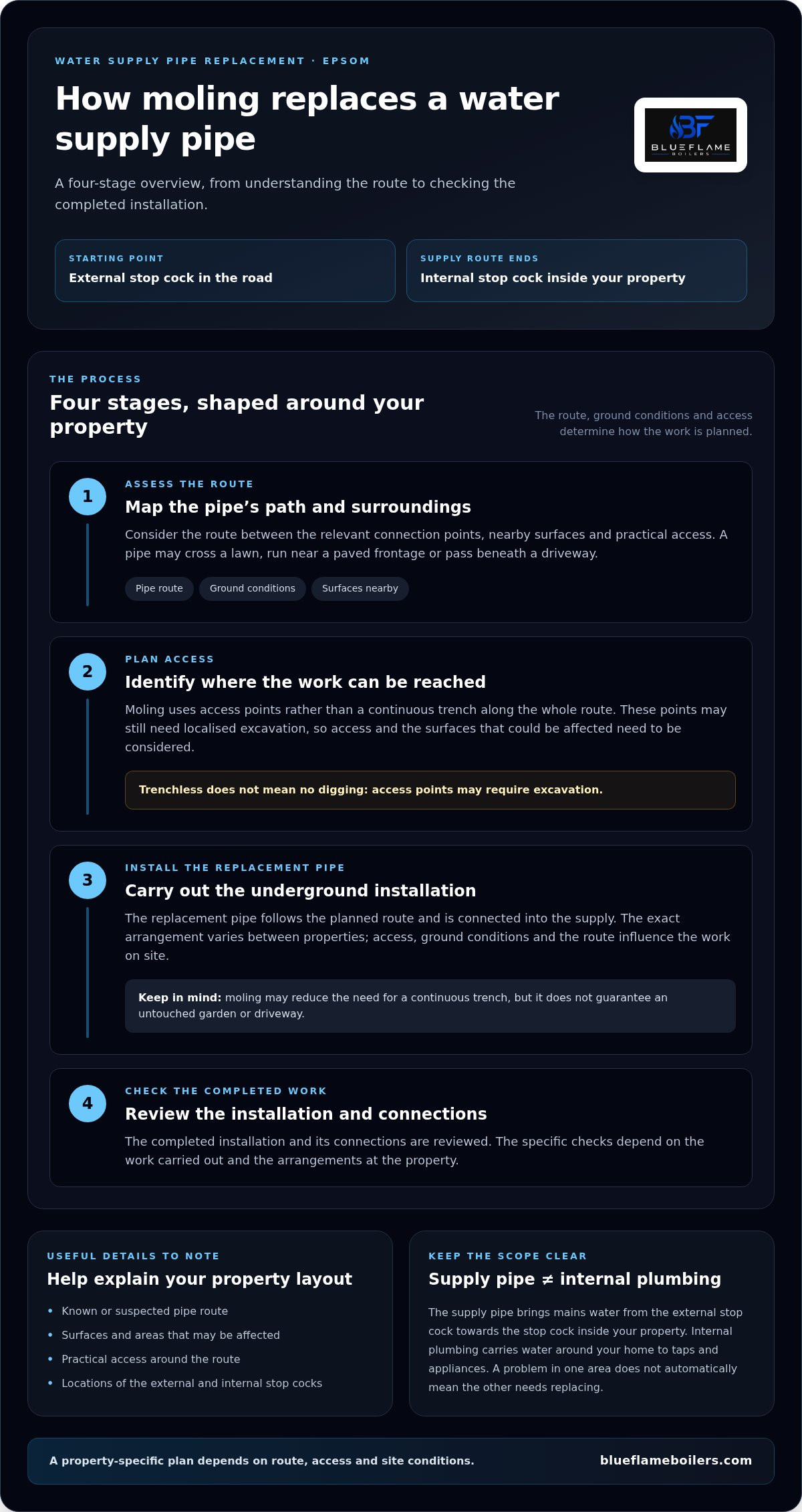
How moling replaces a water supply pipe: the main stages
Moling is a trenchless method of installing or replacing an underground pipe. It uses access points rather than a continuous trench along the entire route. This can limit surface excavation, although the work still needs suitable access and may involve some digging. The approach for a moling water supply pipe Epsom project depends on the property and pipe route.
The stages below provide a general overview, not a fixed layout or a promise of a particular number of access points. A front garden, paved path and driveway each create different access and surface considerations, so the work plan needs to reflect the site.
- Assess the route. Consider the pipe’s path between the relevant connection points, nearby surfaces and practical access.
- Plan access. Identify where access is needed for the installation. These points may require localised excavation, even when a continuous trench is not needed.
- Install the replacement pipe. Carry out the underground installation and make the connections required for the replacement.
- Check the completed work. Review the installation and connections. The specific checks depend on the work and property arrangements.
What happens during the initial route assessment?
A route assessment relates the plan to the actual layout of your home. The pipe may cross a lawn, run near a paved frontage or pass beneath a driveway. Each situation can affect where access is practical and which surfaces may be disturbed. Sharing what you know about the route and the areas you want to protect helps inform a work plan for your property. Do not assume your layout will match a neighbour’s.
What should homeowners expect during installation?
Access points allow the underground work to be carried out, while the replacement pipe follows the planned route and connects into the supply. The arrangement can vary between properties, so an example showing openings at either end should not be taken as the layout for every home. Access, ground conditions and the route all influence the work on site.
Before work begins, discuss which surfaces may be affected and how access will be arranged. Moling does not guarantee an untouched garden or driveway, and not every project follows the same sequence. If you are concerned about a lead supply pipe, the US Environmental Protection Agency’s guidance on lead service line replacement provides background, but it describes US guidance rather than UK requirements.
For a clearer idea of how the stages may apply to your home, discuss your supply pipe replacement with Blueflame Boilers. Share what you know about the route, access and surfaces around it.
Moling or open trenching in Epsom: how to think about the options
Choosing between moling and open trenching starts with the pipe route and the property, not a one-size-fits-all rule. Moling may avoid a continuous excavation, although access points can still be required. Open trenching exposes the route through excavation. Either method may suit a particular replacement, depending on access, ground conditions and the surfaces involved.
Use this comparison to organise the practical questions for your property:
| Consideration | Moling | Open trenching |
|---|---|---|
| Route access | Needs suitable access for the underground installation. The number and position of access points depend on the route. | Access is needed along the section being excavated, so the planned trench route matters. |
| Surface disruption | May avoid opening a continuous trench, but localised digging and disturbance may still be required. | Surfaces above the pipe route are opened along the excavation, with the affected area depending on the work. |
| Site constraints | Access, existing services, ground conditions and the layout can affect whether the method is suitable. | Available working space, the route and affected surfaces help determine whether excavation is practical. |
| Planning considerations | Plan for access points and consider whether the route suits an underground installation. | Consider the excavation route and how the affected surfaces will be managed. |
When might a trenchless approach be worth considering?
If a buried supply pipe crosses a garden, driveway or paved area, limiting open excavation along the route may be appealing. Moling can help reduce disturbance across that area, but the result depends on the property and ground conditions. Do not assume the method can pass beneath every surface or obstacle. The route needs a practical, site-specific assessment.
What site conditions can affect the choice?
Access, route length, existing services and the property layout are useful factors to consider. These relate to individual homes, not assumptions about ground conditions throughout Epsom. The actual site determines whether moling is suitable. Sharing a clear description of the route and surfaces helps make the discussion more useful.
For example, a route with limited access or several changes in direction may need a different plan from a clear run across an open area. Existing services near the proposed route also matter. Do not assume moling will be suitable simply because you want to protect a surface, or that trenching is automatically necessary. A moling water supply pipe Epsom project needs to be considered in light of the route, access and property conditions together.
The practical choice is the method that fits the site and the replacement work. Comparing likely access arrangements and affected areas gives you a clearer basis for discussing the options, without treating either approach as a universal winner.
Preparing your Epsom property for water pipe replacement
A few clear notes can make it easier to discuss a supply pipe replacement and the practical details of your property. You do not need to trace a buried pipe yourself or decide whether moling is suitable. Focus on what you have noticed, where you think the pipe runs and which areas may need access. This gives Blueflame useful context for a property-specific discussion.
What information is useful before discussing the work?
Write down when you first noticed a possible problem and how it has changed. For example, note when a wet patch appeared or when you noticed a change in the water supply. Describe the likely route from the external stop cock in the road towards the internal stop cock, even if you only know part of it. Mention access restrictions and surfaces along the route.
- Stop cocks: Note where you believe the external and internal stop cocks are. If you are unsure, say so rather than guessing.
- Visible clues: Record damp areas or other changes you have observed, with their approximate locations.
- Likely route: Sketch or describe how the pipe may run between the road-side stop cock and the one inside your home.
- Surfaces: List any garden, driveway, path or paved frontage above or near the possible route.
- Access: Mention gates, narrow passages, parked vehicles or other features that could affect access to the relevant areas.
- Known buried services: Share any information you already have about other services near the route. This can inform the discussion, but do not attempt to locate or expose services yourself.
Your notes do not need to be a formal plan. A simple sketch, a few dated observations or a description of what you have seen can help explain the layout. For a moling water supply pipe Epsom project, the actual route and access conditions matter more than assumptions based on a neighbouring property.
How can you plan around access and surface disruption?
Access needs and affected areas depend on the route and work involved. Before an assessment or agreed work, make relevant areas accessible where practical. This could mean moving garden furniture, clearing a path to the stop cock or arranging access through a side gate. You do not need to clear the whole property. Focus on areas connected to the possible pipe route.
Identify which surfaces concern you most and point them out when discussing the work. A driveway, planted border and paved path each need different consideration. Moling can limit continuous excavation, but may still involve access points and localised disturbance. Clear expectations start with an accurate picture of the property.
Once you have gathered your notes, discuss the route, access and replacement work with Blueflame Boilers.
Arrange moling water supply pipe replacement with Blueflame in Epsom
If you are considering a replacement, start by identifying which part of the water supply pipe the work covers. Blueflame Boilers provides a moling service for supply pipe replacement in Epsom, from the external stop cock in the road to the internal stop cock inside your property. This gives you a clear starting point for discussing the route and access at your home.
What does Blueflame’s supply pipe service cover?
The replacement covers the mains water supply pipe between those two stop cocks. Blueflame uses moling technology for this supply pipe service, with the route and property layout informing how the work is approached. The service relates to this section of the mains supply pipe, not the pipes and fittings that distribute water around your home or the public water network.
Every property has its own layout. The supply pipe may cross a garden, paved area or driveway, and available access can shape the work plan. Moling is considered in relation to these details, including the route and site conditions. You do not need a complete plan before making an enquiry. A description of what you know is a useful start.
How can an Epsom homeowner take the next step?
When you get in touch, share your property location and what you have noticed. Helpful details include:
- When the issue began and what has changed since.
- Where you believe the external and internal stop cocks are located.
- Any visible signs, such as a wet area or a change in the water supply.
- Surfaces or access restrictions along the likely pipe route, such as a driveway, garden path or narrow side passage.
- Any known buried services near the route, if you have that information.
You do not need to diagnose the problem or locate buried pipework yourself. Clear observations are enough to explain the situation and focus the discussion on your property, route and access. If you are unsure where the pipe runs, an approximate description is still useful.
A moling water supply pipe Epsom enquiry is a straightforward way to discuss replacing your pipe and the practical next steps. Blueflame can discuss the route from the external stop cock in the road to the internal stop cock, taking account of the details you share. The work plan depends on understanding the property and site conditions.
Take the next step towards a clear plan
A buried pipe problem can feel daunting when you are unsure what lies beneath your driveway or garden. You do not need to settle every detail before starting a conversation. Share what you have noticed, which areas concern you and any clues you have about the pipe’s route. That gives the discussion a practical starting point based on your property.
If you are considering a moling water supply pipe Epsom replacement, use your enquiry to discuss the options for your home. The route, available access and nearby surfaces all help shape the conversation. Even an approximate description can be useful.
Blueflame Boilers serves Epsom and nearby areas including Ashtead, Leatherhead, Oxshot, Cobham, Weybridge, Ewell, Worcester Park, Cheam, Sutton, Carshalton, Banstead, Reigate, Tadworth, Woking, Bookham, Effingham, Horsley, Ripley and Kingswood in Surrey.
Share your observations and discuss your water supply pipe replacement with Blueflame Boilers to take the next step towards a plan for your property.
Frequently Asked Questions
Can moling replace a water pipe beneath a driveway?
It may be possible, depending on the pipe route, access and conditions beneath the driveway. Moling can reduce the need to excavate continuously across a surface, but it is not suitable for every route or site. If you are discussing a moling water supply pipe Epsom project, describe where the driveway sits in relation to the likely pipe route and mention any access restrictions. This makes the property-specific discussion more useful.
Does moling mean there will be no digging at all?
No. Moling is a trenchless approach, but access points may still need excavation, so some localised digging or surface disturbance can be involved. The amount and location depend on the route and property conditions. A pipe crossing a paved area, for example, may need access at suitable points rather than an open trench along its full length. Do not assume every surface will remain untouched.
How long does a moling water supply pipe replacement take?
There is no single duration for every replacement. The time needed depends on factors such as the route, access, ground and arrangements at the property. A route that looks straightforward may still involve site-specific considerations, so a general estimate should not be treated as a confirmed schedule for your home. Share what you know about the layout when discussing the work, then plan around the project details for your property.
Will my water supply be interrupted during pipe replacement?
The water supply may need to be turned off as part of replacement work, but the timing and arrangements depend on the job. Do not assume water will remain available throughout or that it will be off for a set period. Before work starts, plan everyday tasks that rely on mains water and make sure you understand the arrangements for your property. Keep drinking water accessible if you expect a temporary interruption.
Can moling be used at every Epsom property?
No single method suits every home. Access, the proposed route, existing services and site conditions all affect whether moling is appropriate. These details need to be considered for each property, rather than assumed from a nearby home. Blueflame Boilers serves Epsom and nearby areas including Ashtead, Ewell, Leatherhead, Cheam and Sutton. Sharing your location and a description of the route helps make the discussion specific to your home.
Can an existing water supply pipe be repaired instead of replaced?
Sometimes a fault may be localised, but whether repair is practical depends on its cause, position and the condition of the pipe. A wet patch does not identify the fault by itself. If the pipe needs replacing, Blueflame’s service uses moling technology for the mains supply pipe. Describe what you have observed and where it appears so the next step can be considered in context.
What should I do if I suspect a leak in my supply pipe?
Note what you have seen, when it began and whether the signs have changed. An unexplained wet area or a change in supply can have different causes, so do not treat it as a confirmed leak or dig to find the pipe. If you can safely identify the internal stop cock, make a note of where it is for future reference. Share your observations and property location when discussing the issue with Blueflame.


