
Have you ever glanced at your boiler's pressure gauge and felt a sudden jolt of worry? You aren't alone. Many homeowners across Surrey find themselves staring at a flat needle and wondering: is low boiler pressure dangerous? The short answer is a resounding no. In fact, that low reading is a clever safety feature designed to protect your home. It's a cry for help rather than a reason to panic. We understand the frustration of a cold morning shower or the fear of a looming repair bill, but we're here to put your mind at ease and get your home feeling cosy again.
In this 2026 guide, we'll help you discover exactly why your pressure has dropped and how to get your heating back to its brilliant best. We promise to show you that most pressure issues are simple fixes you can often handle yourself without any technical confusion. We'll explore the common causes for a dip in bar levels, provide clear instructions for a DIY top up, and let you know exactly when it's time to call in a friendly local expert to get things sorted. Let's dive in and get that boiler humming once more.
Key Takeaways
- Stop the worry! Discover why the answer to "is low boiler pressure dangerous" is actually a clever safety feature designed to keep your home and family secure.
- Learn how to identify the "usual suspects" behind a dropping gauge, from tiny hidden leaks to common maintenance tasks that accidentally lower your bar levels.
- Follow our simple, panic-free guide to repressurising your system yourself using the filling loop to get your hot water back to its brilliant best.
- Find out how professional power flushing and annual servicing can keep your boiler's "heart" healthy and prevent frustrating pressure fluctuations.
- Recognise the clear signs that it's time to call in a friendly Surrey expert for a professional boiler repair to protect your home's long-term comfort.
Boiler Pressure Explained: What is Actually Happening Inside Your System?
Think of your boiler as the heart of your home. It is a hard-working engine that pumps life-giving warmth through every pipe and radiator in your house. For this process to work perfectly, it needs the right amount of force. This force is what we call boiler pressure. It is essentially the balance of water and air that keeps your heating moving efficiently. Without it, that hot water would just sit there, leaving your radiators in Epsom feeling stone cold and your morning shower a chilly disappointment.
Understanding the basics of a boiler and steam generator helps demystify what is going on behind the casing. Inside the system, water is heated and then pushed along by pressure. We measure this force in units called bars. Most modern systems are looking for a specific sweet spot on the gauge to stay happy and healthy. If you have been asking yourself, is low boiler pressure dangerous, remember that the gauge is simply a communication tool. It tells you if the system has enough push to do its job properly.
The Magic Number: Where Should Your Gauge Be?
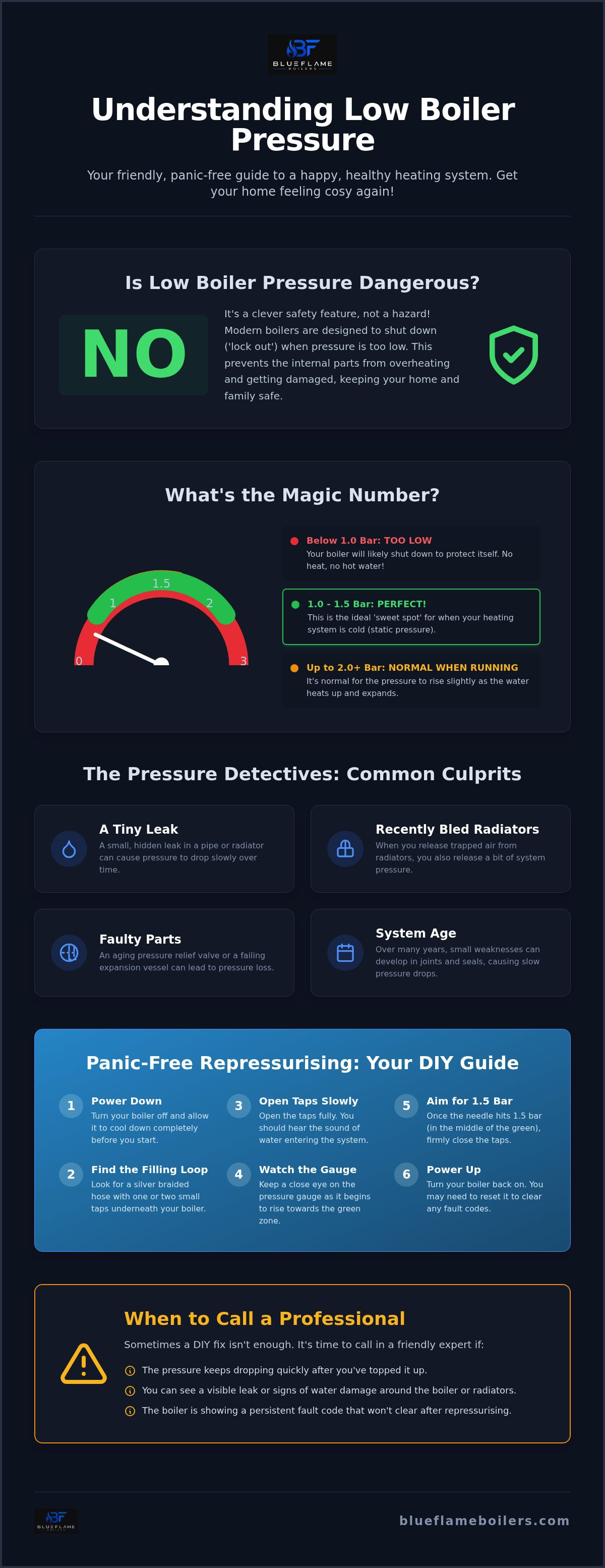
For the vast majority of UK homes, the gold standard for boiler pressure is between 1.0 and 1.5 bar. This is the ideal range when your system is cold. When you flick the heating on and the water starts to expand, it's perfectly normal to see the needle climb slightly, often reaching up to 2.0 bar. This is the difference between static pressure, when everything is off, and running pressure. If your needle is bouncing around in this range, you can relax. Your heating is in top shape!
If that needle dips below 1.0 bar, you have entered the zone where performance starts to suffer. Whilst it isn't a safety risk in the sense of a hazard, it's definitely a danger to your comfort. Most modern boilers are clever enough to notice this drop. If it hits 0.5 bar, many units will simply lock out to prevent internal damage. If your system is acting up, a quick check of the gauge is the first step before booking a professional boiler repair to get things back on track.
The Different Types of Gauges You Might Encounter
Not every boiler looks the same, and neither do their gauges. You might have a classic hydraulic dial gauge. These look like a small clock face with a physical needle. They are reliable and easy to read at a glance. Many older units in Surrey still use these, and they often feature helpful colour-coded zones. Green is your best friend, showing everything is perfect, whilst red indicates that action is needed immediately.
Modern boilers often favour digital displays. Instead of a physical needle, you will see a number on an LCD screen. These are incredibly precise, showing you exactly when you have hit that 1.2 bar target. Some even flash a warning code if the pressure gets too low. Whether it is a digital screen or a physical dial, keeping an eye on this number is the easiest way to ensure your home stays warm and your energy bills stay manageable. It is all about maintaining that perfect balance for a cosy home.
Is Low Boiler Pressure Dangerous? Setting the Record Straight
Let's clear the air and settle those nerves. If you've been losing sleep wondering is low boiler pressure dangerous, you can finally breathe a sigh of relief. The short answer is a flat no. Low pressure is almost never a threat to your family or your home's structure. Unlike high pressure, which can stress seals and valves, low pressure simply means the system lacks the "oomph" to move water around. It's like trying to run a marathon on an empty stomach; you won't explode, but you certainly won't be winning any races. Your boiler is simply telling you it's thirsty for a bit more water.
Why Your Boiler is Smarter Than You Think
Modern boilers are brilliant pieces of kit designed with your protection in mind. They are built to follow rigorous safety standards that ensure they fail safely every single time. If your boiler refuses to fire up on a frosty morning, it's actually doing its job perfectly. It has detected that the pressure is too low to operate and has triggered a "Low Pressure Cut-off" feature. This is a deliberate move to prevent the heat exchanger from overheating. Forget the Hollywood myths of exploding boilers; low pressure is the polar opposite of that risk. It is a safety feature, not a safety failure, meant to keep your Epsom home secure.
The Real Danger: What Happens if You Ignore It?
So, if it isn't going to go bang, why should you care? The real danger is the massive inconvenience and the creeping cost of neglect. Ignoring a dropping gauge puts immense strain on the internal pump. It has to work twice as hard to move half as much water, which wears out expensive components. This extra effort often leads to a premature boiler repair bill that could have been avoided. It is a classic case of a small issue turning into a big headache if left to simmer.
Beyond the hardware damage, a struggling system is an inefficient one. You'll likely see your energy bills rising whilst your radiators stay lukewarm and your morning shower remains a tepid disappointment. In the middle of a Surrey winter, a total breakdown is the last thing you need. If you've noticed the needle dipping frequently, it's a sign that something isn't quite right. You can always chat with our friendly team to get your system back to its brilliant best before the cold truly sets in.
The Pressure Detectives: Why Does Your Boiler Keep Losing Power?
Time to put on your detective hat. If you've been checking your gauge more often than your phone lately, you're likely hunting for a culprit. In our experience across Surrey, a dropping needle is rarely a random event. It's usually the result of a specific change within your heating system. Whilst you're investigating, you might still be asking: is low boiler pressure dangerous? As we've established, it's not a safety hazard, but it is a clear signal that your system's "blood volume" is low. Understanding whether you have a one-off dip or a chronic condition is the first step to a permanent fix.
UK weather plays a surprising role in this mystery. When a cold snap hits Epsom, your pipes and components contract. This physical shift can sometimes cause a tiny, negligible drop in pressure. However, if you're topping up the system every few days, you aren't dealing with the weather; you're dealing with a system flaw. Identifying the usual suspects early can save you from a more complex boiler repair later down the line.
The Radiator Culprit: Bleeding and Balancing
Have you recently used a radiator key to let out some trapped air? Bleeding your radiators is fantastic for getting rid of cold spots, but it comes with a trade-off. When you hiss that air out of the top of a radiator, you're effectively removing volume from a sealed system. As the air leaves, the overall pressure drops. It's one of the most common reasons for a "one-off" pressure dip. Our pro tip is simple: always head straight to your boiler gauge immediately after bleeding your radiators. If the needle has wandered into the grey or red zone, it's time for a quick top-up to restore the balance.
The Hidden Leak: From Pinholes to Puddles
If you haven't touched your radiators and the pressure is still vanishing, you might have a hidden leak. These aren't always dramatic gushes of water. In fact, a tiny "pinhole" leak in a copper pipe joint can cause a frustratingly slow drop over several weeks. The water often evaporates before it even hits the floor, making it hard to spot. Keep a close eye on these areas:
- Radiator valves: Look for crusty green or white deposits around the nuts.
- Pipe joints: Check for damp patches or peeling wallpaper near your skirting boards.
- The boiler itself: Peek underneath the unit for any tell-tale drips.
Finding a puddle is actually good news for a detective, as it points exactly to the problem. If you can't find the source but the needle keeps falling, the leak might be internal. This is the perfect time to enquire with a local expert who can use professional tools to track down the escapee and get your home's "heart" beating strongly again.
The Great Repressurising Guide: How to Fix Low Pressure Yourself
Ready to be the hero of your own home? If you've been glancing at your gauge and wondering is low boiler pressure dangerous, you already know it's a simple cry for help. Topping up your system is a fantastic way to save on call-out fees and get your heating back to its brilliant best in minutes. It's a straightforward task that most homeowners in Epsom and Reigate can handle with total confidence. Follow our panic-free steps to get that needle back into the green zone.
- Step 1: Locate your filling loop. This is usually a silver, braided flexible hose found directly underneath your boiler. It connects your main water supply to your central heating system.
- Step 2: Safety first. Ensure the boiler is switched off and the system is cool to the touch. You don't want to be working with scolding hot pipes.
- Step 3: Open the valves. You will usually see two small tap handles. Open them slowly, one at a time. You'll hear the satisfying hiss of water entering the system. Keep a keen eye on the pressure gauge whilst you do this.
- Step 4: Close them tight. As soon as the needle hits that 1.2 bar sweet spot, close both valves completely. Be firm but gentle; you don't want to snap the plastic handles.
- Step 5: Power up. Switch the boiler back on and celebrate your DIY victory. Your radiators should start to feel toasty almost immediately.
Filling Loops vs. Internal Keys: What Have You Got?
Whilst external filling loops are the most common setup across Surrey, some modern boilers do things differently. If you have a Worcester Bosch model, you might find an internal filling key instead. This is often a blue plastic tool tucked into a slot at the base of the unit. You simply push it in, turn it, and watch the gauge. If your filling loop is missing, looks damaged, or starts to drip water when you touch it, stop immediately. It is much better to be safe than sorry if the hardware looks past its best.
When the DIY Fix Doesn’t Work
Sometimes, even the most careful DIY efforts don't quite hit the mark. If you top up the system only to watch the needle sink back down to zero within an hour, you aren't just dealing with low volume; you have a leak that needs professional attention. Another common hiccup is accidentally "over-pressurising" the system. If you get distracted and the needle hits 3 bar, don't panic. You can easily lower the pressure by bleeding a small amount of water from a radiator using your radiator key. However, if the gauge refuses to stay steady or the valves feel stuck, it's time to call in a professional Surrey engineer to investigate the root cause.
Long-Term Health: How to Keep Your Pressure Perfect for Years
Maintaining perfect pressure is like keeping a car well-serviced; it's much cheaper than dealing with a total breakdown. Whilst we've answered the big question, is low boiler pressure dangerous, and found that it's mostly an inconvenience, long-term neglect is the real enemy of your wallet. One unsung hero in this story is the expansion vessel. This small tank inside your boiler handles the extra volume when water heats up and expands. If this part loses its "charge," you'll see your needle jumping like a kangaroo every time the heating kicks in. Modern smart thermostats are another fantastic tool for your arsenal. They don't just control the temperature; they can often alert you to health issues or efficiency drops before you even notice a cold radiator.
Booking an annual boiler service in Epsom is the single best thing you can do for your system's longevity. Our engineers check the expansion vessel, clean the internal filters, and ensure those pesky sensors aren't being tricked by debris. It's the difference between a system that lasts fifteen years and one that gives up after five. We make sure every component is working in harmony so you can enjoy total peace of mind throughout the colder months.
The Power Flush: A Deep Clean for Your Heating
Over time, the water inside your radiators can turn into a thick, black "sludge" known as magnetite. This gunk is a nightmare for pressure stability. It can clog up the tiny pipes inside your heat exchanger and give false readings to your pressure sensors. A professional power flush in Surrey acts like a detox for your heating. It scours the system clean, restoring efficiency and ensuring that your pressure stays rock-solid. It's a detox for your heating. A clean system is a quiet, reliable, and happy system that won't leave you shivering when you need warmth the most.
Blueflame Boilers: Your Local Pressure Experts
We love being the favourite choice for heating upgrades and maintenance across the local community. Our Epsom-based team believes in a "no jargon" approach. We'll explain exactly what's happening with your system in plain English. Whether you need a quick top-up lesson or a full system redesign, we're here to help. Don't wait for a boiler emergency to strike during a Surrey cold snap. If you are still wondering, is low boiler pressure dangerous for your particular setup, our team can provide the definitive answer and a swift solution. We'll get your home back to its brilliant best with a smile and the expert care you deserve.
Take Control of Your Home's Comfort Today
You can now rest easy knowing the answer to is low boiler pressure dangerous. It is a clever safety mechanism, not a household disaster. By locating your filling loop and keeping an eye on that 1.2 bar sweet spot, you have the tools to handle most minor dips yourself with total confidence. Proactive care, such as annual servicing or a professional power flush, remains the secret to a quiet and efficient system that won't let you down during a chilly Surrey winter.
Our Gas Safe Registered Engineers at Blueflame Boilers Ltd are always on hand to provide the expert support you need. As local Epsom experts, we offer 24/7 emergency support to ensure your family stays warm and your system stays healthy. We pride ourselves on clear advice and honest service without any confusing technical jargon. Don't let a small needle drop turn into a big worry when help is just a click away.
Stay cosy, stay informed, and enjoy the peace of mind that comes with a perfectly balanced heating system. Your home is in safe hands with us.
Frequently Asked Questions
Is it safe to sleep with a boiler that has low pressure?
Yes, it is completely safe to sleep in a house where the boiler has low pressure. You might be worried and asking, is low boiler pressure dangerous to your health, but the reality is that the system will simply lock out and stop working if the levels drop too low. Modern safety sensors are designed to shut the unit down long before any risk occurs, so the only real danger is waking up to a cold house.
Can I still use my hot water if the boiler pressure is low?
You can usually use your hot water as long as the pressure remains above the 0.5 bar threshold. Once it dips below this point, most modern boilers in Surrey will trigger a safety shutdown to protect the internal heat exchanger. If your taps are running cold, check the gauge first. A quick top-up via the filling loop is often all that is needed to get your brilliant hot water flowing again.
How often should I have to repressurise my boiler?
How often should I have to repressurise my boiler?
You should only need to repressurise your system once or twice a year, typically after you have bled your radiators to remove trapped air. If you find yourself reaching for the filling loop every few weeks, you likely have a small leak or a faulty expansion vessel. Constant topping up can lead to internal corrosion, so it is best to book a professional service to identify the root cause of the drop. When choosing an engineer, it helps to know which qualities to prioritise; for instance, ProServ Las Vegas provides a helpful guide on what to look for in a qualified expert.
Yes, low pressure can lead to higher energy bills because your system has to work much harder to circulate heat. When the pressure is incorrect, the pump struggles to push water through the radiators, leading to cold spots and longer heating times. This inefficiency means your boiler stays on for longer to reach the desired temperature, which quickly adds up on your monthly gas statement. Keeping it at 1.2 bar ensures peak efficiency.
What happens if I accidentally put too much pressure in my boiler?
Don't panic if the needle hits the red zone after a top-up. Most boilers feature a pressure relief valve that automatically discharges excess water to keep the system safe. If the gauge is sitting at 3 bar, you can easily lower it yourself by bleeding a small amount of water from a radiator using a standard key. If the pressure remains high despite your efforts, it could indicate a faulty filling loop or internal valve.
Why does my boiler pressure drop every time the heating comes on?
It is actually more common for pressure to rise slightly when the heating is on, as water expands when heated. If you notice a drop instead, you might have a leak that only opens up when the pipes expand with heat. Alternatively, your expansion vessel might be failing to manage the volume changes. This is a technical issue that usually requires a Gas Safe registered engineer to inspect and recharge the vessel.
Can a leaking radiator cause low boiler pressure?
Absolutely. Even a tiny, persistent drip from a radiator valve or a pinhole leak in the radiator body will cause the system pressure to plummet over time. Because central heating is a sealed loop, any loss of water directly impacts the bar level on your gauge. Check the floor around your radiators for damp patches or look for green weeping marks on the valves, as these are clear signs of a leak.
Is low pressure a sign that I need a new boiler installation?
Not necessarily. Most low-pressure issues are solved with a simple repair or a professional service. However, if your boiler is over ten years old and the pressure is constantly fluctuating despite repairs, it might be time to consider a fresh boiler installation. Modern units are far more reliable and efficient, saving you from the stress of a failing gauge and the high costs of maintaining an ageing, temperamental heating system. To explore the benefits of upgrading to a high-efficiency unit, visit Fast Furnace Company.


