
Could a boiler that seems to work perfectly still need attention during a landlord gas safety check? Yes. A CP12 is a written record of a gas safety inspection, not a substitute for routine boiler servicing. If you’re arranging a CP12 certificate for landlords Leatherhead, understanding what the engineer will check can help you prepare and make sense of the results.
Landlords often want to know which appliances are covered, how to organise access with tenants and what happens if the engineer finds a fault. This guide explains the inspection in plain English, with practical steps for preparing the property and handling any follow-up work.
Blueflame Boilers Ltd carries out landlord gas safety checks and provides CP12 certificates for Leatherhead properties. Here’s what to expect and how to get ready for your appointment.
Key Takeaways
- A CP12, also called a landlord gas safety record, documents the findings for the gas appliances, fittings and flues checked.
- Knowing what the engineer needs to access helps you plan the visit and understand the inspection.
- A gas safety check and a boiler service have different purposes and produce different records.
- Coordinate access with tenants or agents, clear the way to relevant appliances and keep previous records handy.
- Blueflame Boilers Ltd carries out landlord gas safety checks and provides CP12 certificates for Leatherhead properties.
What a CP12 certificate means for landlords in Leatherhead
A CP12, also called a landlord gas safety record, is the written record of a gas safety check at a rental property. It sets out the findings for the gas appliances, fittings and flues inspected. Keep it with your property records so you can see what was checked and whether the engineer noted any safety issues.
Landlords arrange gas safety checks to help ensure gas equipment in their rental properties is safe to use. The UK’s Gas Safety (Installation and Use) Regulations 1998 set out landlord responsibilities, but requirements and deadlines can depend on the circumstances. Check current official guidance, such as GOV.UK, for the rules that apply to your property and tenancy. For background on the registration scheme, see this overview of the Gas Safe Register. The engineer carrying out a gas safety check must be registered for the relevant gas work.
What does a landlord gas safety record document?
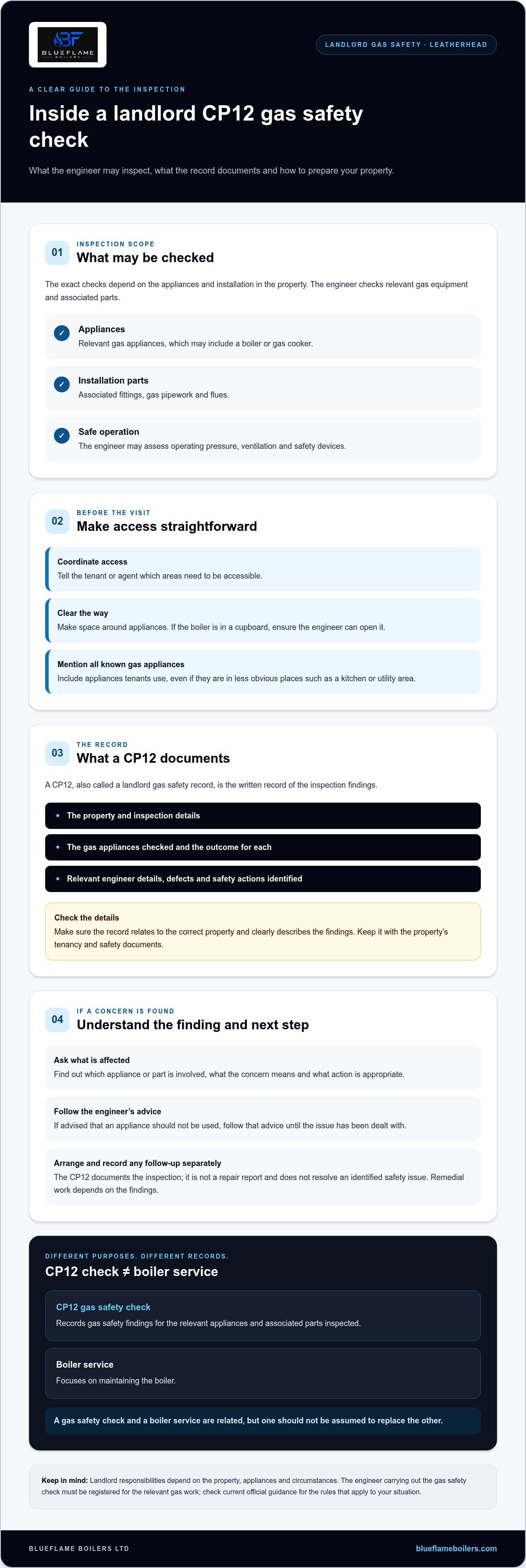
The completed record should identify the property and inspection, list the gas appliances checked and show the outcome for each. It should also include relevant details about the engineer and any defects or safety actions identified. Layouts can vary, so check that the record relates to the correct property and clearly describes the findings. File it with the property’s tenancy and safety documents.
If the engineer reports a fault, read the finding and any stated action carefully. The record tells you what was inspected, but it is not a repair report and does not resolve an identified safety issue. Make sure any required follow-up is arranged and recorded separately.
Which Leatherhead rental properties may need a check?
Your responsibilities depend on the rental property and the gas appliances involved, not on where you live or receive post. A landlord based elsewhere may still have responsibilities for a home in Leatherhead. A correspondence address in Leatherhead, on its own, does not determine whether a particular property or arrangement falls within the rules.
Properties with gas appliances or flues may need a check, but responsibilities can be less straightforward in some situations. Examples include a shared property, a change in how rooms are let or a tenancy arrangement that differs from a typical private rental. Check current official guidance for your circumstances rather than relying on a general rule of thumb.
Blueflame Boilers Ltd carries out landlord gas safety checks and provides CP12 certificates for Leatherhead properties. The company also serves landlords in Epsom, Ashtead, Oxshot, Cobham, Weybridge, Ewell, Worcester Park, Cheam, Sutton, Carshalton, Banstead, Reigate, Tadworth, Woking, Bookham, Effingham, Horsley, Ripley and Kingswood, Surrey.
What happens during a landlord CP12 gas safety check?
The engineer needs access to the relevant gas equipment, carries out the safety checks, explains any findings and completes the record. The CP12 documents the results for the appliances, fittings and flues inspected.
Before the visit, tell the tenant or agent which areas need to be accessible. If the boiler is inside a cupboard, for example, clear the space around it and make sure the engineer can open the cupboard. The exact checks depend on the appliances and installation, so the inspection may differ from one Leatherhead home to another.
Which appliances and parts of the installation are considered?
The check covers relevant gas appliances and associated parts of the installation, including fittings, gas pipework and flues. Depending on the property, this may include a boiler or gas cooker. As part of assessing safe operation, an engineer may check operating pressure, ventilation and safety devices. For an authoritative overview of the inspection scope and landlord responsibilities, consult the HSE gas safety guidance for landlords.
Tell the engineer about any gas appliances you know are in the property, including appliances tenants use. This can help identify equipment in less obvious places, such as a kitchen or utility area. The engineer can explain which items are included in the check and note any access limitations.
What if the engineer identifies a safety concern?
A check does not mean every appliance will necessarily be found safe. If the engineer identifies a concern, they should explain what they found, what it means and what action is appropriate. The next step depends on the inspection findings, so don’t assume a particular repair will be needed before the engineer has assessed the appliance.
Ask which appliance or part is affected, whether it can be used and what needs to happen next. If the engineer advises that an appliance should not be used, follow that advice until the issue has been dealt with. The CP12 inspection itself is not a repair; any remedial work depends on the findings and may need to be arranged separately.
After the inspection, check that the record identifies the right property and appliances. Make sure you understand any notes or recommended actions, then file the record with your property documents. To arrange a CP12 certificate for landlords Leatherhead, enquire about a landlord gas safety check with Blueflame Boilers Ltd.
CP12 check or boiler service: what does a landlord need?
A boiler service and a landlord gas safety check are related, but they have different purposes and produce different records. A service focuses on maintaining the boiler. A CP12 documents the findings of a gas safety inspection. Don’t assume one replaces the other.
What is the difference between a CP12 and a boiler service?
A CP12 check records the gas safety findings for the relevant appliances and associated parts inspected. A boiler service focuses on maintenance of the boiler. The work can vary according to the service scope, so the name of an appointment alone does not tell you that both activities have been carried out.
Quick comparison
| Activity | Purpose and focus | Resulting documentation |
|---|---|---|
| Landlord gas safety check | Assess gas safety for relevant appliances and associated parts within the inspection scope. | A landlord gas safety record, commonly called a CP12. |
| Boiler service | Maintenance focused on the boiler, with work determined by the service scope. | Service documentation may be provided; it isn’t the CP12 record. |
A service record helps you track boiler maintenance; the CP12 records the gas safety check. If you book a service, confirm that the landlord gas safety check is also included before treating the visit as covering both. The appropriate safety record must be completed for the gas safety check.
How should landlords plan both activities?
Keep separate records for each property: the date and paperwork for its gas safety check, plus any boiler service documents and maintenance history. This makes it easier to identify what has been done, what still needs arranging and which documents belong to each address, particularly if you manage several rentals.
Plan each activity around the property’s needs rather than treating one as a substitute for the other. Check current official guidance for applicable gas safety requirements and deadlines, and use the service paperwork to track maintenance separately. Clear records also give the engineer useful context, such as previous service findings or work already completed.
For more on routine boiler maintenance, see the boiler servicing guide. For a rental property in Leatherhead, keep the CP12 check as a separate task and file its record with the correct property documents. That way, maintenance paperwork is less likely to be mistaken for a gas safety record.
How Leatherhead landlords can prepare a property for its CP12 visit
A little coordination can make access easier for everyone. Agree how the engineer will enter, make relevant gas appliances reachable and pass on useful information about the property. Start with clear communication and a few practical checks rather than turning preparation into a major job.
What should a landlord arrange before the visit?
Agree access with the tenant or property manager. Confirm who will be at the property or how entry will be arranged, then share the plan with everyone involved. If an appliance is in a locked cupboard or a particular room, make sure the person arranging access knows in advance.
- Explain the purpose of the visit. Let the tenant or agent know that an engineer will carry out a landlord gas safety check and what areas need to be accessible.
- Clear access to appliances. Move items blocking the boiler, cooker or another gas appliance, and make sure the relevant cupboard or room can be opened.
- Share useful property details. Pass on what you know about the appliances, their locations and any access restrictions.
- Keep previous records handy. Earlier gas safety records can provide useful context. Treat them as background information, not as a substitute for the new check.
Consider the route to each appliance. A clear path and an accessible cupboard can prevent avoidable delays. If an appliance cannot be reached or access arrangements change, tell the tenant, agent and engineer as early as possible.
How can tenants and agents help the appointment run smoothly?
Tenants and agents can help by confirming access and flagging practical details, such as a restricted entrance or an appliance in a room that may be occupied. Explain the visit calmly: its purpose is to check gas safety, not to assess how a tenant keeps the home. The landlord or agent can answer questions about the arrangements before the appointment.
After the visit, note that the check took place and file the completed record with the right property documents. If the engineer identifies an issue or recommends further action, record what needs follow-up and who is responsible for arranging it. Keeping each property’s inspection and maintenance history separate is especially useful when managing more than one address.
Before booking, agree access, clear the way to relevant appliances, share useful property details and decide where to file the completed record. These steps make arranging a CP12 certificate for landlords Leatherhead more straightforward.
Arrange a landlord CP12 certificate in Leatherhead with Blueflame
Once you know what the inspection involves and have planned access, the next step is to arrange the check. Blueflame Boilers Ltd carries out landlord gas safety checks and provides CP12 certificates for Leatherhead properties, with certified engineers carrying out official gas safety checks. When you enquire, explain which property needs a check and share the details that help describe the job.
If you manage several rental properties, focus on the Leatherhead address that needs attention so its details don’t get mixed up with another home in your portfolio. A clear outline of the property and access arrangements is a practical starting point.
What to include when enquiring about a Leatherhead property
Give the property location, say whether it is let to tenants and describe the gas appliances you know about. You can also explain who manages the property, how access is arranged and any practical restrictions, such as an appliance behind a locked door. You don’t need to guess technical details or have every document to hand.
- Property: Give the Leatherhead address or a clear location.
- Tenancy: Say whether the property is occupied and who coordinates access.
- Appliances: List the gas appliances you know about, such as a boiler or cooker.
- Access: Describe relevant arrangements or restrictions, including rooms or cupboards the engineer needs to reach.
- Context: Share any other information that helps explain the property’s setup.
If you’re unsure about an appliance or its location, say so. Straightforward, accurate information is more useful than a guess. The inspection will establish its findings, and any action required will depend on those findings.
What happens after the landlord makes an enquiry?
Your enquiry begins the process of arranging a CP12 check for the rental property. Set out what you need and explain the access arrangements so the details can be discussed clearly. Keep the property information to hand as you make plans for the visit.
For a CP12 certificate for landlords Leatherhead, start with the property location and what you know about its gas appliances. Blueflame’s local landlord gas safety check service gives you a direct way to arrange the inspection.
Take the next step with confidence
Make your next step simple: identify the rental property and decide who will coordinate access. Keeping the enquiry focused on one address makes it easier to discuss the arrangements and practical details for the visit.
If you need a CP12 certificate for landlords Leatherhead, have the property location and any information about its gas appliances ready. Then enquire with Blueflame Boilers Ltd to arrange a landlord gas safety check.
With access planned and the right property details to hand, you can keep the inspection and its paperwork organised.
Frequently Asked Questions
How long is a landlord CP12 certificate valid?
A landlord gas safety check is normally required every 12 months. The record relates to the check and should not be confused with a boiler service schedule. For a CP12 certificate for landlords Leatherhead, note the next due date from the record and arrange the next check in good time. Don’t assume a record remains valid beyond its stated period or that an expired certificate has a grace period.
Can a tenant ask their landlord for a copy of the gas safety record?
Yes. A tenant can request the relevant record from their landlord or managing agent. Current UK guidance says a copy must be given to an existing tenant within 28 days of the check, and to a new tenant before they move in. Identify the property in your request. Putting it in writing can help keep a clear record. Keep the response with your tenancy documents.
What happens if a landlord cannot arrange access for a gas safety check?
Record attempts to arrange access and keep communication with the tenant or agent clear and reasonable. If access remains difficult, follow up early and document the steps taken, but don’t assume that a particular number of attempts automatically meets your obligations. The right approach can depend on the circumstances. Check current official guidance, including the HSE’s advice for landlords, for your situation.
Can a CP12 be issued if an appliance has a safety problem?
The record should reflect the engineer’s actual findings, not an assumed pass. If a safety concern is found, ask which appliance or part is affected, what the finding means and what action is advised. Any repair or other remedial work depends on the issue identified. Don’t assume the record means every appliance is safe to use, or that a particular outcome can be guaranteed before the inspection.
Does a new boiler mean a landlord no longer needs a gas safety check?
No. A new boiler installation does not automatically remove a landlord’s ongoing gas safety responsibilities. The applicable requirement and timing may depend on current rules and the property’s circumstances, so check authoritative guidance rather than guessing a first-check date. Keep the installation paperwork alongside the property’s gas safety records to distinguish information about the new appliance from records of later checks.
What should a landlord do if a tenant reports smelling gas?
Treat a reported gas smell as an urgent potential emergency, not a routine CP12 request. Tell the tenant to avoid flames and electrical switches, open doors and windows, leave the property and call the National Gas Emergency Service on 0800 111 999 from outside. If safe, turn off the gas at the meter. Don’t wait for a scheduled inspection or use a suspect appliance.
Can a landlord arrange one CP12 check for several rental properties?
You can enquire about checks for several properties together, but each address and its relevant gas appliances need individual consideration. Don’t assume one record covers multiple homes. Give the landlord gas safety check service the property details for each address, whether in Leatherhead, Epsom, Ashtead, Oxshot, Cobham, Weybridge, Ewell, Worcester Park, Cheam, Sutton, Carshalton, Banstead, Reigate, Tadworth, Woking, Bookham, Effingham, Horsley, Ripley or Kingswood, Surrey. Check current guidance on record-keeping requirements.


