
Imagine walking into your kitchen on a crisp Epsom morning, only to find your boiler making a strange humming sound and the pressure needle pinned firmly in the red. It's enough to make any homeowner panic about potential leaks or a freezing cold living room, but here's the exciting news: a spike in pressure doesn't have to mean a disaster! Learning how to fix boiler pressure too high is often much simpler than you think, and most of the time, you won't even need a heavy toolbox to get your heating back on track.
We know that a climbing gauge can cause a fair bit of anxiety, especially with the fear of expensive repair bills or a total system shutdown. That’s why we’ve put together this guide to help you reclaim your peace of mind and get your system back to that perfect 1.5 bar sweet spot. We’ll walk you through the quick, DIY-friendly checks you can perform yourself, whilst highlighting exactly when it’s time to call in the local experts. From bleeding radiators to managing your filling loop, we’re going to show you how to keep your Surrey home warm, safe, and running perfectly.
Key Takeaways
- Master the "Goldilocks Zone" by understanding why the 1.0 to 1.5 bar range is the perfect setting for your boiler's health and efficiency.
- Discover the easiest way how to fix boiler pressure too high using just a radiator key and a cloth to release trapped water from your system.
- Unmask the common "Open Tap" trap where a slightly loose filling loop causes your pressure needle to climb higher than it should.
- Learn to spot critical warning signs, like a dripping external copper pipe, that indicate your pressure relief valve might need professional attention.
- Gain total peace of mind by knowing exactly when to call a local Surrey expert to keep your Epsom heating system running safely and smoothly.
Identifying the High-Pressure Headache: What Do the Dials Mean?
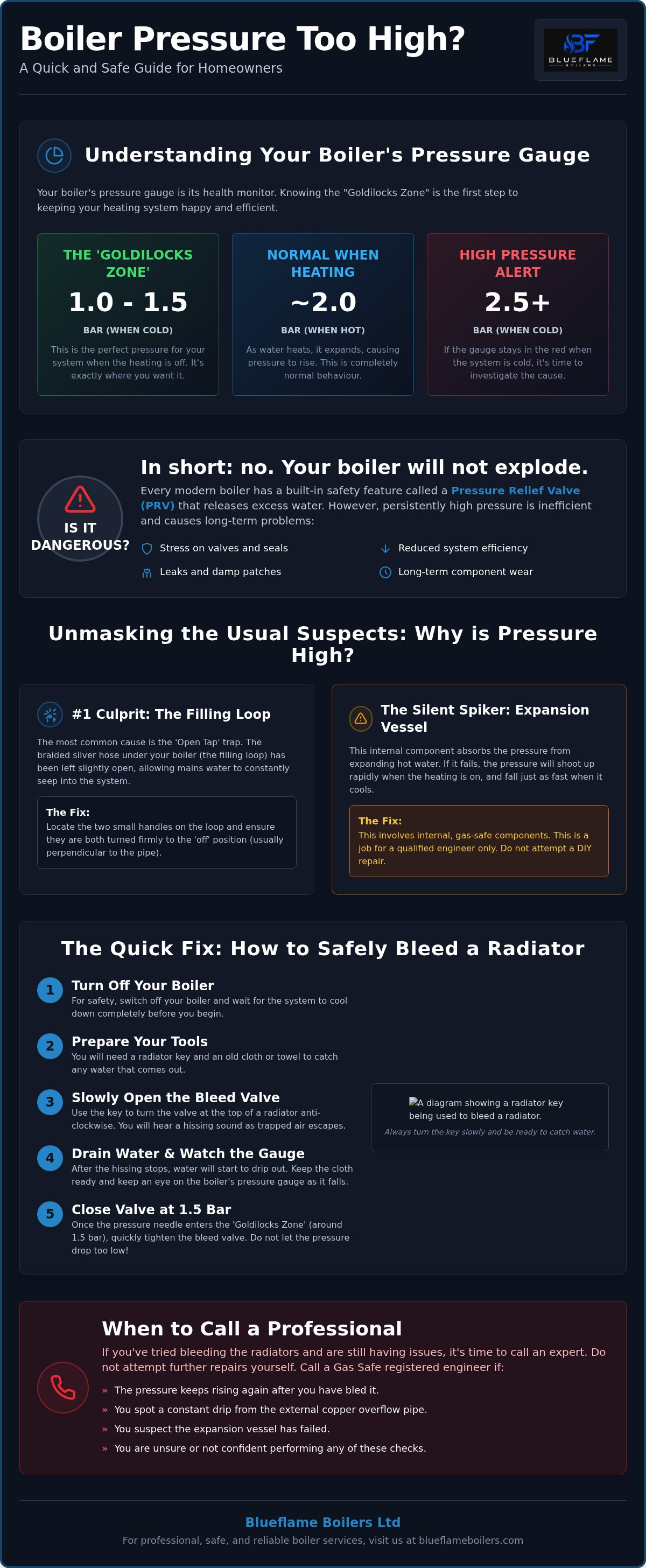
Walking past your boiler cupboard shouldn't feel like checking a ticking clock. For most Epsom homes, the pressure gauge is either a small, round dial with a physical needle or a modern digital screen. Think of the 1.0 to 1.5 bar range as the 'Goldilocks Zone'. It is just right. If the needle wanders into the red or your screen starts flashing, do not panic. Understanding What is a Boiler? and how it manages water is the first step to staying calm and keeping your home cosy.
The 'Cold vs. Hot' rule is a classic source of confusion for many homeowners in Surrey. When your heating is off and the water is cold, the pressure should sit comfortably between 1.0 and 1.5 bar. Once you fire up the radiators, the water expands, and the pressure naturally climbs. This is completely normal behaviour! You might see it reach 2.0 bar whilst the house is warming up. The real headache begins when that needle stays at 2.5 bar or higher even when the system is cold. This is exactly when you need to know how to fix boiler pressure too high before it causes a fuss.
Reading Your Boiler's Pressure Gauge Like a Pro
Most boilers have the gauge located clearly on the front control panel. A bar is the standard unit of atmospheric pressure used in UK heating systems to measure the force of the water inside your pipes. If your needle hits the 3 bar mark, your system is under significant strain. Modern digital displays often use a flashing error code to tell you something is wrong. Spotting these warning signs early prevents a minor tweak from turning into a full boiler repair callout.
Is High Boiler Pressure Actually Dangerous?
Is your boiler going to explode? In short: no. Every modern gas boiler is fitted with a Pressure Relief Valve (PRV). This clever component acts like a safety vent, releasing water if the internal pressure gets too high. Whilst it is very safe, high pressure is incredibly inefficient. It puts extra stress on your radiator valves, often leading to annoying damp patches and leaks around the house. Over time, ignoring a high pressure reading can wear down internal seals and pumps. This leads to expensive damage that could have been avoided with a simple bit of troubleshooting.
Why is My Boiler Pressure So High? Unmasking the Usual Suspects
Spotting a high-pressure reading is like your boiler waving a little red flag. It isn't trying to ruin your day; it's just telling you that something in the system has changed. In our experience across Epsom and Woking, the 'why' usually boils down to a few common culprits. Playing detective to find the source is the first step in learning how to fix boiler pressure too high without any stress. Most of these issues are simple to identify once you know where to look.
Sometimes, the local water main pressure in parts of Surrey is simply higher than average. This can put extra pressure on your boiler's internal components. We also encounter the 'Bleeding' Paradox quite often. Whilst most people think bleeding radiators is only for fixing cold spots, it's actually the most effective way to manually drop the bar when the system is overfilled. It is the quickest way to release that built-up tension in your pipes.
The Filling Loop: The #1 Cause of High Pressure
The filling loop is that silver, braided hose you'll usually find tucked away underneath your boiler. It's designed to let you top up the system with fresh water when the pressure gets too low. The 'Open Tap' trap happens when one of the small black handles on this loop isn't turned fully off. Even a tiny gap allows high-pressure mains water to slowly creep into your heating circuit, pushing that needle higher and higher every single hour. Always double-check that both handles are twisted firmly to the 'off' position to stop the creep.
Expansion Vessel Failure: The Silent Pressure Spiker
When water gets hot, it expands. Your boiler needs 'room to breathe', which is where the expansion vessel comes in. Think of it like a balloon inside a metal tank that absorbs that extra volume. If this component loses its 'bounce' or the internal diaphragm fails, there's nowhere for the expanding water to go. You'll notice the pressure shoots up incredibly fast as soon as the heating starts, only to drop back down once things cool off. Because this involves internal gas-safe components, this specific issue requires a Blueflame professional repair to get things back to normal safely.
If your detective work hasn't solved the mystery yet, you can always book a quick check-up with our friendly Surrey team to get your home's heating back to its best.
The 'Quick Fix' Toolkit: How to Safely Lower Your Boiler Pressure
Ready to take charge of your heating? You don't need a van full of heavy tools to get your Epsom home back to its best. Most of the time, the secret to how to fix boiler pressure too high is already sitting in your kitchen drawer or on top of the meter cupboard. All you really need is a radiator key, a dry cloth to catch any drips, and a positive, can-do attitude. This process is all about controlled release, turning that stressful red-zone reading into a calm, steady green.
The Radiator Bleeding Method: Step-by-Step
Safety is our top priority. Before you touch anything, turn off your heating and let the system cool down completely. Waiting at least 20 minutes ensures the water inside isn't scalding hot. Once it's cool, head to the radiator furthest from your boiler and follow these steps:
- Fit your radiator key into the small square bleed valve at the top of the radiator.
- Hold your cloth directly underneath the valve to protect your flooring.
- Turn the key slowly anti-clockwise. You'll hear a distinct 'hiss' as trapped air and water escape.
- Keep the valve open until the boiler needle starts to move downwards.
This is where teamwork helps! Have someone stand by the boiler to monitor the gauge whilst you work. You want to stop as soon as the needle hits 1.2 bar. If you go too far and the pressure drops too low, don't worry. You can always top it back up using the filling loop we discussed in the previous section. Once the needle is back in the green, tighten the bleed valve and you're good to go.
Using the Drain-Off Valve (For the Brave!)
If bleeding radiators feels a bit slow, there is a faster way to drop the bar. Most heating systems have a drain-off valve, usually located at the lowest point of the pipework or near an external door. This method is brilliant for removing a large amount of water quickly, but it does require a bit more care. You'll need to attach a garden hose to the notched nozzle and secure it with a clip to avoid a soggy carpet. If a hose isn't an option, a shallow bucket will do the trick, though you'll need to empty it frequently.
Open the valve slowly and keep a very close eye on that pressure gauge. Because the water leaves the system much faster this way, it's easy to over-correct. Once the needle is back in the green, tighten the valve firmly. If the thought of hoses and buckets feels a bit overwhelming, our friendly Surrey team is always happy to lend a helping hand with a professional system check.
Beyond the Bleed: When High Pressure Signals a Bigger Problem
Learning how to fix boiler pressure too high is a fantastic skill for any homeowner, but sometimes the needle refuses to budge despite your best efforts. If you have already bled your radiators and double-checked your filling loop handles, the problem might sit deeper within the hardware. High pressure can sometimes be a symptom of a mechanical failure inside the unit itself. These complex situations require the trained eye of a certified Gas Safe engineer to ensure your system remains efficient and, above all, safe.
Have you noticed water dripping from a small copper pipe on your outside wall? This is the discharge pipe for your Pressure Relief Valve (PRV). It is a clear warning sign. Whilst the valve did its job by releasing excess pressure during a spike, it now cannot close properly. This often happens because tiny bits of grit or system sludge get caught in the valve's seat. Another hidden culprit is a failing heat exchanger; if the internal metal plates develop a tiny pinhole, high-pressure mains water can leak directly into your central heating circuit, causing a constant climb.
When the PRV Won't Stop Dripping
Once a Pressure Relief Valve has been triggered, it is notoriously difficult to get it to seal perfectly again. Debris from older pipework in Surrey homes often prevents the rubber seal from sitting flush. You might be tempted to 'twiddle' the red cap on the valve to stop the drip, but this rarely works and can actually make the leak much worse. Our Blueflame approach focuses on a permanent fix. We usually replace the valve entirely to ensure a 100% watertight seal, preventing future pressure drops and protecting your flooring from damp patches.
Professional Expansion Vessel Re-pressurising
If your pressure gauge behaves like a rollercoaster, shooting up when the heating is on and crashing when it is off, your expansion vessel is likely the cause. Our engineers use specialist pumps to restore the essential air cushion inside the vessel to the manufacturer's exact specifications. During this process, we check for a 'perforated diaphragm'. If water escapes from the air valve, it means the internal balloon has burst, and a new vessel is the only solution. This is a key reason why we champion annual boiler servicing in Epsom; it allows us to catch these air-pressure issues before they lead to a total system failure.
Keep Your Epsom Home Cosy: Professional Care for Peace of Mind
Getting that pressure needle back into the green is a huge relief, isn't it? It feels absolutely brilliant to take control of your home's heating and see instant results from your DIY efforts. Whilst knowing how to fix boiler pressure too high is a fantastic skill to have in your back pocket, the real secret to a stress-free winter is a system that looks after itself. That is where our professional care comes into play. We believe that regular maintenance is the absolute best way to prevent 'pressure panic' before it even starts, ensuring your Epsom home stays cosy and your bills stay low.
Have you thought about upgrading your setup lately? A modern smart thermostat is a game-changer for monitoring your boiler's health. These vibrant digital tools do more than just adjust the temperature; they can often spot trends in your system's performance, giving you a heads-up if things start to drift out of the 'Goldilocks Zone'. It is like having a tiny heating expert living on your wall! Staying one step ahead of a breakdown is the most exciting way to manage your home's energy.
Surrey homeowners trust Blueflame because we are a genuine part of the local community. We have spent years helping families across the region stay warm, and we take immense pride in our reputation for reliability. From minor tweaks to full central heating installations, we bring the same high-energy focus to every single home we visit. We are here to make sure your gas boiler is always a source of comfort, never a source of anxiety.
Why Choose Blueflame for Your Boiler Fix?
Our local engineers know the streets of Epsom, Leatherhead, and Woking like the back of their hand. We don't do boring or dry service; we bring an upbeat, high-energy approach that takes the stress out of any repair. Our pricing is always transparent, so you can relax knowing there aren't any hidden surprises waiting for you. Every member of our team is fully committed to Gas Safe excellence and long-term heating efficiency, keeping your system in peak condition for years to come.
Ready to Get Back to Normal?
Don't spend another night staring at your boiler dials with a sense of dread! Life is far too short for heating headaches. Whether you need a quick annual service to keep your warranty valid or a fast emergency boiler repair in Surrey, we have got the tools and the talent to help you out.
Enjoy a Warmer, Worry-Free Home Today
You now have the tools and the knowledge to keep your heating system in top shape. From spotting the 'Goldilocks Zone' on your dial to mastering the radiator bleeding method, understanding how to fix boiler pressure too high puts you back in the driving seat whilst protecting your home. It's about more than just numbers on a gauge; it's about the peace of mind that comes with a safe, efficient system.
If the DIY steps don't quite do the trick, remember that you're never alone. Our Gas Safe Registered Engineers are your local Surrey experts, ready to jump in with 24/7 emergency callouts whenever you need us. We take the stress out of repairs with a high-energy, friendly service that gets your Epsom or Woking home back to its cosy best.
You've done the hard part by identifying the issue. Now, let's get that needle back to green and your house feeling like a home again!
Frequently Asked Questions
Is it safe to leave my boiler on if the pressure is too high?
It is generally safe to keep your boiler running because modern systems are fitted with a Pressure Relief Valve that vents excess water. However, you shouldn't ignore the problem for long. High pressure puts intense strain on seals and joints across your Epsom home, which can lead to annoying drips. If you are worried, learning how to fix boiler pressure too high by bleeding a radiator is a quick way to protect your system.
Can high boiler pressure cause a leak in my ceiling?
Yes, it certainly can if the excess pressure finds a weak point in your pipework. When the system is over-pressurised, water can be forced out of radiator valves or joints in the floorboards, which eventually seeps through to the ceiling below. If you notice damp patches in your Leatherhead property, check your boiler gauge immediately. Catching a high reading early prevents a small pressure spike from turning into a major plumbing headache.
How often should I have to top up or bleed my boiler system?
You should only need to top up or bleed your system once or twice a year, usually when you first turn the heating on for autumn. If you find yourself reaching for the radiator key every few weeks in Woking, it is a sign that water is escaping somewhere. Constant pressure drops followed by manual top-ups can lead to overfilling, making it essential to understand how to fix boiler pressure too high or call a professional.
Will bleeding radiators always lower the boiler pressure?
Bleeding radiators is the most effective manual fix, but it won't work if your filling loop is still letting water in. If the silver braided hose handles are even slightly open, new water will replace whatever you bleed out, keeping the needle in the red. Always ensure your filling loop is firmly closed before you start bleeding. If the pressure stays high after these steps, there may be a more complex internal component failure.
What should my boiler pressure be when the heating is turned off?
When your system is completely cold, the needle should sit comfortably between 1.0 and 1.5 bar. This is the ideal starting point for most gas boilers in Surrey homes. If it drops below 1.0, your boiler might struggle to fire up; if it sits above 2.0 whilst cold, you have too much water in the circuit. Keeping it in this 'green zone' ensures your radiators heat up quickly and efficiently.
Why does my boiler pressure go up when I turn the hot water on?
Pressure naturally rises because water expands as it gets hot. When your boiler fires up to provide hot water or heating, the internal volume increases, and the needle will often climb by 0.3 to 0.5 bar. This is perfectly normal behaviour as long as it stays below the 2.5 bar mark. If it shoots into the red every time you run a tap in Ewell, your expansion vessel likely needs a professional service.
Can a faulty filling loop be fixed, or does it need replacing?
Filling loops are rarely repaired; it is almost always better to replace them entirely. These components rely on precise rubber seals to keep high-pressure mains water out of your heating circuit. Once a valve starts to leak or 'creep', a full replacement is the only way to guarantee a watertight seal. It is a quick and affordable job for our Gas Safe engineers that provides long-term peace of mind for your home.
How much does it cost for a professional to fix high boiler pressure in Surrey?
The cost for a professional fix depends entirely on what is causing the spike. A simple system drain or filling loop adjustment is a straightforward task, whilst replacing an internal expansion vessel or heat exchanger involves more time and specialist parts. We always provide transparent quotes before starting any work across Epsom and Woking, ensuring you get the best value for a safe and efficient heating system.


