If you could capture the heat currently escaping through your flue and recycle it back into your home, would you take the opportunity? Most Surrey homeowners are feeling the pressure of rising energy costs in 2026, and it's completely normal to feel confused by the technical jargon used by installers. You might be wondering if a condensing boiler is actually different from a combi, or perhaps you're worried about those "frozen pipe" horror stories you've heard during recent winters.
We understand that you want a heating system that simply works without costing the earth. This guide promises to demystify the technology, explaining how these units squeeze every drop of energy from your fuel to slash your utility bills. We'll explore why condensing technology remains the gold standard for local properties, how it fits alongside the latest 2026 efficiency regulations, and the simple steps you can take to ensure your heating stays reliable through the toughest winter months.
Key Takeaways
- Learn how a condensing boiler captures and recycles heat from flue gases to significantly reduce your monthly energy bills.
- Clear up the confusion between boiler technology and boiler styles to ensure you select the most efficient setup for your home's hot water needs.
- Identify the specific steps required to prevent common winter issues, such as frozen condensate pipes, that can cause your heating to cut out.
- Discover why professional installation by local experts is essential for managing the impact of Surrey’s hard water on your boiler’s heat exchanger.
- Gain insights into the latest 2026 efficiency standards and how they influence the long-term savings and reliability of your home heating system.
What is a Condensing Boiler and Why is it the UK Standard?
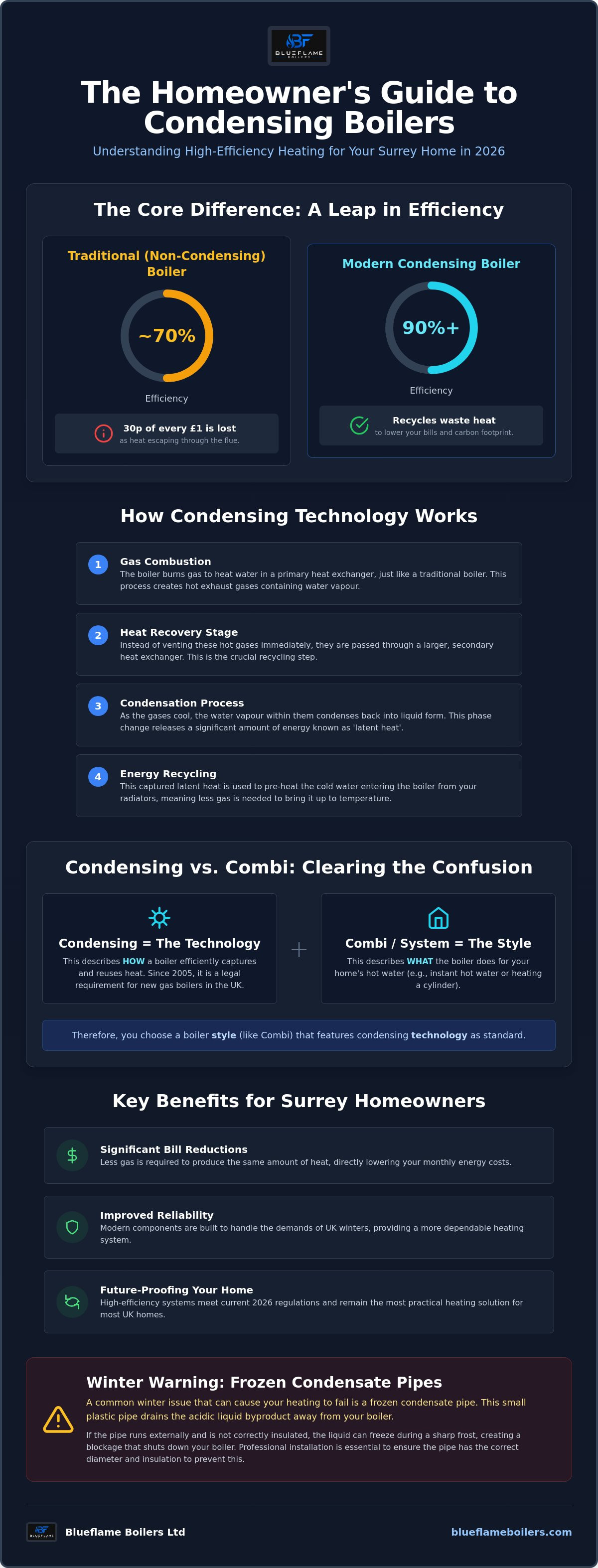
Since April 2005, almost every new gas boiler fitted in the UK has been a condensing model. This wasn't just a fleeting trend; it was a firm legal requirement designed to drag national energy efficiency out of the dark ages. But What is a condensing boiler? At its simplest, it's a high-efficiency appliance that captures and 'recycles' heat that would otherwise vanish through your flue pipe. By reusing this energy, these units achieve A-rated performance, often exceeding 90% efficiency.
Older, non-condensing units often operate at around 70% efficiency. This means for every pound you spend on gas, 30 pence is literally floating away into the Surrey sky. Modern technology ensures every unit of fuel works harder for your comfort. This shift significantly reduces the carbon footprint of homes in Epsom and Reigate, making it a cornerstone of sustainable living as we move through 2026. For homeowners looking to maximise their property's energy retention, resources such as fladderak-dakbeheer.nl provide guidance on how high-quality roofing can complement a high-efficiency heating system. The move to make these boilers mandatory has saved millions of tonnes of carbon emissions across the UK. For a typical local household, upgrading from an old G-rated boiler can significantly lower annual CO2 output whilst providing a much warmer living environment.
The Core Difference: Standard vs Condensing
Standard boilers are single-pass systems. They burn gas, heat the water, and then vent the hot exhaust gases immediately. A condensing boiler adds a vital second stage to this process. It uses a secondary heat exchanger to extract latent heat from those exhaust gases. As the water vapour in the flue gas cools, it turns back into liquid form, a process known as condensing. This releases energy that pre-heats the cold water entering the system, which means your boiler doesn't have to start from scratch when you turn on the tap or the heating.
Why 2026 Homeowners Favour Condensing Technology
In 2026, energy price volatility remains a top concern for families across Woking and beyond. Maximising fuel extraction isn't just about being "green"; it's about financial stability. These systems are also designed to work in harmony with modern smart thermostats. This allows for precision modulation, which means the boiler only works as hard as it needs to. If you are considering an upgrade, understanding the nuances of Professional Gas Boiler Installation in Surrey is the first step toward a more resilient home. It's a reliable way to ensure your property remains warm whilst keeping your overheads as low as possible. Key benefits for local residents include:
- Significant Bill Reductions: Less gas is required to produce the same amount of heat.
- Improved Reliability: Modern components are built to handle the demands of Surrey winters.
- Future-Proofing: High-efficiency gas systems remain the most practical solution for existing Surrey homes in 2026.
The Operational Principle: How Condensing Technology Works
The operational principle of a condensing boiler is a masterclass in thermal recycling. In a traditional system, the process is linear: gas burns, heat is transferred to your water, and the leftover hot gases are blasted out of the flue. Modern technology breaks this cycle by adding a recovery stage. Instead of allowing those scorching exhaust fumes to escape, the system redirects them through a secondary heat exchanger. This captures the energy that older units simply threw away, ensuring your home stays warmer for longer using less fuel.
Latent heat is the secret weapon here. When gas burns, it creates water vapour as a byproduct. In older systems, this vapour stays as steam and carries significant heat energy out into the atmosphere. A condensing system cools this vapour until it undergoes a phase change, turning back into liquid water. This transition releases a burst of energy, known as latent heat, which is then used to pre-heat the cold water returning from your radiators. It's a highly efficient loop that makes purchasing energy-efficient boilers one of the smartest financial moves a homeowner can make in 2026.
This liquid byproduct, called condensate, is slightly acidic. To handle this safely, every installation includes a dedicated condensate pipe. This plastic pipe carries the waste liquid away to a drain or soakaway. Whilst it's a simple component, it's vital for the continuous operation of your system. If you ever notice your heating failing during a particularly sharp Surrey frost, the condensate pipe is often the first place our engineers look. If you're concerned about your current setup, a quick boiler servicing can ensure your drainage lines are clear and correctly installed.
The Heat Exchanger: The Heart of the System
The primary and secondary heat exchangers are designed with large surface areas to maximise contact with the hot flue gases. To achieve maximum efficiency, the system must cool these gases below the 'dew point'. The dew point is the specific temperature, typically around 54°C for natural gas, at which water vapour begins to condense into liquid and release its stored energy. Because the resulting condensate is corrosive, manufacturers use high-grade materials like stainless steel or aluminium. These metals provide the necessary resistance to ensure the heart of your boiler doesn't degrade over time, even with constant exposure to moisture.
Vapour to Liquid: The Recycling Process
The efficiency gain during this process is dramatic. By the time the flue gases reach the secondary heat exchanger, the system has already extracted the majority of the 'sensible' heat. The condensing stage then tackles the remaining energy. This process can reduce flue gas temperatures from a wasteful 200°C down to roughly 50°C. This 150-degree difference represents the "free" heat that is pumped back into your central heating system. By the time the exhaust finally leaves your home, it's little more than a cool mist, proving that almost every penny spent on gas has been converted into warmth for your family.
Condensing vs Combi: Clearing Up the Confusion
One of the most frequent questions we hear from Epsom residents is whether they should opt for a condensing boiler or a combi. This is actually a misunderstanding of terms. 'Condensing' describes the internal technology used to recycle heat, whilst 'combi' refers to the way the boiler delivers hot water to your taps. In the UK, it isn't a choice between the two. Every new combi boiler is, by law, a condensing model. You are essentially choosing the "body style" of a machine that already has a high-efficiency engine under the hood.
The technology is now universal across all three main boiler styles. Whether you have a compact flat in the town centre or a large detached home in the Surrey Hills, your new appliance will use condensing technology to keep your bills low. The real decision lies in which delivery style fits your household's specific plumbing and hot water demands. Modern units are far more versatile than the bulky systems of the past, but picking the wrong style can lead to poor water pressure or wasted cupboard space.
Which Condensing Boiler Style Suits You?
Selecting the right style depends on your home's layout and your family's daily habits. We typically recommend different setups based on the property type:
- Combi Boilers: These are the most popular choice for smaller Surrey homes and flats. They are space-saving units that provide heat and hot water directly from the mains without needing any bulky tanks in the loft.
- System Boilers: If you have a larger family in Epsom with multiple bathrooms, a system boiler is often better. It works with a separate unvented water cylinder to ensure you don't lose water pressure when two people shower at the same time.
- Regular (Open Vent) Boilers: Often found in older Surrey properties, these require a tank in the loft and a hot water cylinder. They're usually the best option if your current pipework is older and might not handle the high pressure of a modern combi system.
Efficiency Comparison Across Boiler Types
Efficiency isn't just about the label on the box. A condensing boiler only reaches its full potential when it's sized correctly for your property. An oversized boiler will constantly 'cycle' on and off. This wastes gas and puts unnecessary strain on the internal components. It's like driving a sports car in stop-start traffic; you never get to the most efficient gear.
Modern 2026 standards now propose that new combination boilers must be able to modulate down to at least 15% of their maximum output. This means if you only need a tiny bit of heat to keep a room comfortable, the boiler can turn itself down rather than burning fuel at full blast. To keep these sophisticated modulating burners working at peak performance, regular maintenance is vital. You can find out more about keeping your system in top shape in The Ultimate Guide to Boiler Servicing in Epsom. Choosing a unit that matches your actual heat loss ensures you get the maximum return on your investment.
Maximising Efficiency and Preventing Common Issues
Living in Surrey brings a specific challenge that many national guides overlook: hard water. Limescale is the silent enemy of any condensing boiler. Over time, mineral deposits coat the internal surfaces of the heat exchanger, acting as an unwanted layer of insulation. This forces the burner to run hotter and longer to transfer heat to your water, which quietly erodes the A-rated efficiency you paid for. Without protection, a high-efficiency unit can quickly start behaving like an old, wasteful model.
Beyond limescale, "black sludge" or magnetite poses a significant risk to modern systems. Because condensing units use narrower internal waterways to maximise heat transfer, they are far more susceptible to blockages than the clunky boilers of the 1990s. Installing a high-quality magnetic filter is a simple, effective way to trap these metallic particles before they reach the secondary heat exchanger. This protection, combined with annual maintenance, is usually a strict requirement for keeping your manufacturer's warranty valid. If you haven't had your system checked recently, you can easily book a boiler servicing with our local team to ensure your protection remains in place.
Power Flushing and System Health
If your radiators have cold spots at the bottom or your boiler makes a "kettling" noise like a traditional tea kettle, your system is likely struggling with sludge buildup. This debris prevents the condensing process from working efficiently because the return water temperature stays too high. A professional power flush uses specialised chemicals and high-velocity pumps to clear this contamination. For older Surrey heating systems, this process can restore circulation and ensure your boiler isn't working twice as hard to heat a house full of blocked radiators.
Winter-Proofing Your Condensate Pipe
The "frozen condensate pipe" is a classic winter headache for homeowners in Epsom and Reigate. When the external plastic pipe freezes, the waste liquid backs up into the boiler, triggering an immediate safety shutdown. You can prevent this with a few simple steps:
- Apply Insulation: Fit weather-proof, UV-resistant lagging to any part of the condensate pipe located outside the property.
- Check the Fall: Ensure the pipe has a consistent downward slope (fall) so gravity pulls the liquid toward the drain before it has a chance to settle and freeze.
- Emergency Thawing: If your boiler cuts out during a frost, you can often fix it by pouring warm water over the external pipe. Never use boiling water, as the extreme temperature shift can crack the plastic.
Upgrading Your Heating with Blueflame Boilers
Choosing a new heating system is a significant investment for any household. At Blueflame Boilers, our Gas Safe registered engineers understand that a condensing boiler isn't just a box on the wall; it's the heart of your home's comfort. We've spent years serving Epsom, Reigate, and Woking, building a reputation for installations that prioritise efficiency and long-term reliability. We don't believe in one-size-fits-all solutions. Our team takes the time to assess your property's specific heat loss and hot water demands to ensure your new system is perfectly matched to your lifestyle.
Our approach is built on transparency and local community trust. We know that the technical side of heating can feel overwhelming, especially with the 2026 regulatory changes approaching. We focus on providing clear, honest advice that helps you make an informed decision. Whether you need a straightforward combi replacement or a complex transition to a system boiler with an unvented water cylinder, we handle every detail with methodical care. This ensures your home stays warm whilst your energy bills remain as low as possible.
Why Local Expertise Matters in Surrey
Surrey homeowners face unique challenges that national firms often overlook. Our engineers are intimately familiar with local conditions, from the specific mineral content of the water to the varied infrastructure of Surrey's water mains. This local knowledge allows us to recommend the right protective measures, such as advanced scale reducers or magnetic filters, to safeguard your condensing boiler from the start. We provide a fast, responsive service for residents in Weybridge, Cobham, and Sutton, ensuring you're never left in the cold. Our commitment extends beyond the initial fit; we offer comprehensive Gas Safety Checks (CP12) and ongoing maintenance to keep your system in peak condition for years to come.
Ready to Organise Your New Installation?
The first step toward a more efficient home is a professional survey. We'll visit your property to calculate the exact requirements for your heating and hot water. This prevents the common mistake of installing an oversized boiler, which wastes fuel and shortens the lifespan of the appliance. We can also help you integrate modern smart thermostats, giving you precision control over your environment and further reducing your carbon footprint. Experience the peace of mind that comes with a Blueflame professional installation. It's about more than just pipes and radiators; it's about making your home a more comfortable, cost-effective place to live.
Contact Blueflame Boilers for a bespoke installation quote and take the first step toward a more reliable Surrey home today.
Future-Proofing Your Surrey Home with Smarter Heating
Investing in a modern condensing boiler is one of the most effective ways to lower your energy bills whilst reducing your environmental impact. By capturing latent heat that older systems simply waste, you ensure every penny spent on gas works harder for your family. The key to long-term reliability lies in professional installation and regular maintenance, especially when dealing with the specific challenges of Surrey’s hard water and sharp winter frosts. A well-maintained system doesn't just save money; it provides peace of mind when the temperature drops.
At Blueflame Boilers, we combine local Epsom-based expertise with a deep understanding of high-efficiency condensing technology. Our Gas Safe Registered Engineers are dedicated to helping you find the perfect heating solution for your property’s unique needs. We focus on transparency and reliability, ensuring your upgrade is handled with methodical care from start to finish. Don't wait for the next cold snap to discover your system is underperforming. You can book your 2026 boiler upgrade with Blueflame Boilers today and enjoy a warmer, more efficient home for years to come.
Frequently Asked Questions
Is a condensing boiler the same as a combi boiler?
No, they aren't the same thing; 'condensing' refers to the internal heat-recovery technology, whilst 'combi' refers to the boiler's style and how it delivers water. In the UK, every new combi you buy is also a condensing boiler by law. You can also find this high-efficiency technology in system and regular boilers, so the choice depends on your home's specific plumbing needs.
How much money can a condensing boiler save me on my bills?
Savings vary based on your property and the age of your old system, but upgrading from an old G-rated boiler to a modern A-rated unit can significantly reduce your annual gas consumption. Because these units are over 90% efficient, you're no longer losing 30% of your fuel's energy through the flue. This results in direct, noticeable lowerings of your monthly utility bills from the moment of installation.
Do condensing boilers need a special type of flue?
Yes, they require specific flue materials like high-grade plastic or stainless steel to handle the slightly acidic water vapour produced during operation. Traditional brick chimneys or old metal flues aren't suitable because the moisture would cause them to corrode or crumble over time. Modern flue systems are designed to be weather-resistant and safely direct the cool exhaust gases away from your property.
What happens to the water produced by a condensing boiler?
The liquid, known as condensate, is safely discharged through a plastic pipe into your home’s internal wastewater system or an external soakaway. Because this liquid is mildly acidic, it must be handled by corrosion-resistant plastic materials rather than metal. A professional installer ensures this drainage is correctly sloped so that gravity pulls the liquid away before it can settle or cause a blockage.
Why does my condensing boiler produce more 'plume' or steam from the flue?
This is a natural result of the high-efficiency process known as pluming. Because the exhaust gases from a condensing boiler are much cooler than those from older systems, the water vapour condenses into a visible white mist as soon as it hits the cold outside air. It’s a positive sign that your boiler is successfully extracting maximum heat before venting the exhaust.
How long does a modern condensing boiler typically last?
You can typically expect a modern unit to last between 10 and 15 years. Its actual lifespan depends heavily on the quality of the initial installation and whether you keep up with annual professional servicing. Environmental factors like Surrey’s hard water can also impact longevity if protective measures, such as magnetic filters or scale reducers, aren't fitted to the system.
Can I replace my old non-condensing boiler with a new condensing model?
Yes, you can, and it's actually a legal requirement for almost all boiler replacements in the UK. The main difference in the installation process is the need to add a condensate drain pipe to handle the waste liquid. Our engineers can usually route this pipe to a nearby internal drain or sink with minimal disruption to your home's decor.
What should I do if my condensing boiler's condensate pipe freezes?
If your heating cuts out during a sharp frost, you can often thaw the external pipe by carefully pouring warm water over the frozen section. Never use boiling water, as the extreme temperature shift can crack the plastic pipework. Once the ice has melted and the liquid can flow freely again, you should be able to reset your boiler and resume normal operation.


