
What if some of the heat leaving your boiler could help warm your home instead? That’s the idea behind a condenser boiler, more commonly called a condensing boiler. The names can be confusing, but the principle is straightforward: the boiler captures some heat from its exhaust and reuses it to warm water in the heating system.
Whether that makes a noticeable difference to everyday heating depends on more than the boiler alone. The way the boiler runs, your radiators and controls, and the design of the wider heating system all matter. This guide explains how condensing technology works, what affects its performance and what to consider before an installation or service. If you’re planning an upgrade, make a note of your boiler’s symptoms, property layout and hot-water needs before discussing your options. Blueflame Boilers provides gas boiler installation and servicing, as well as heating system design and installation, for homes in Epsom and nearby Surrey communities.
Key Takeaways
- “Condenser boiler” usually means a condensing boiler, which recovers heat from flue gases to help warm the heating-system water.
- Follow the heat’s journey from gas combustion through heat transfer to the returning water to understand how recovery works.
- Boiler efficiency doesn’t guarantee identical savings in every home. Heating habits and energy tariffs also affect bills.
- Before discussing an upgrade, note your boiler’s symptoms, property layout, hot-water needs and existing heating controls.
- A property-specific assessment can help match the boiler and wider heating system to your home. Blueflame Boilers provides installation and system design support in Epsom and nearby Surrey communities.
What is a condenser boiler, and what does “condensing” mean?
A condensing boiler recovers heat from its flue gases and uses it to help warm water in the heating system. “Condenser boiler” is a common everyday name for this type of boiler, but condensing boiler is the more accurate term. It describes how the appliance reuses heat, rather than a separate category of boiler.
That distinction helps separate the boiler’s operation from claims about household bills. Heat recovery is part of the appliance’s process; the effect on energy use and costs depends on factors such as how the home is heated and the energy tariff. The technology does not produce the same savings in every household.
Is a condenser boiler the same as a condensing boiler?
In ordinary conversation, yes. People generally use “condenser boiler” to mean a condensing boiler. In this context, condensation happens when water vapour in hot flue gases cools and changes into liquid. This change releases heat that would otherwise leave with the gases. The Condensing boiler overview explains the principle and how it differs from a basic boiler that lets more heat escape through its flue.
The boiler isn’t a separate condenser attached to another heating appliance. Condensation is part of its heat-recovery process, as hot gases transfer heat to water in the system.
How does a condensing boiler heat a home?
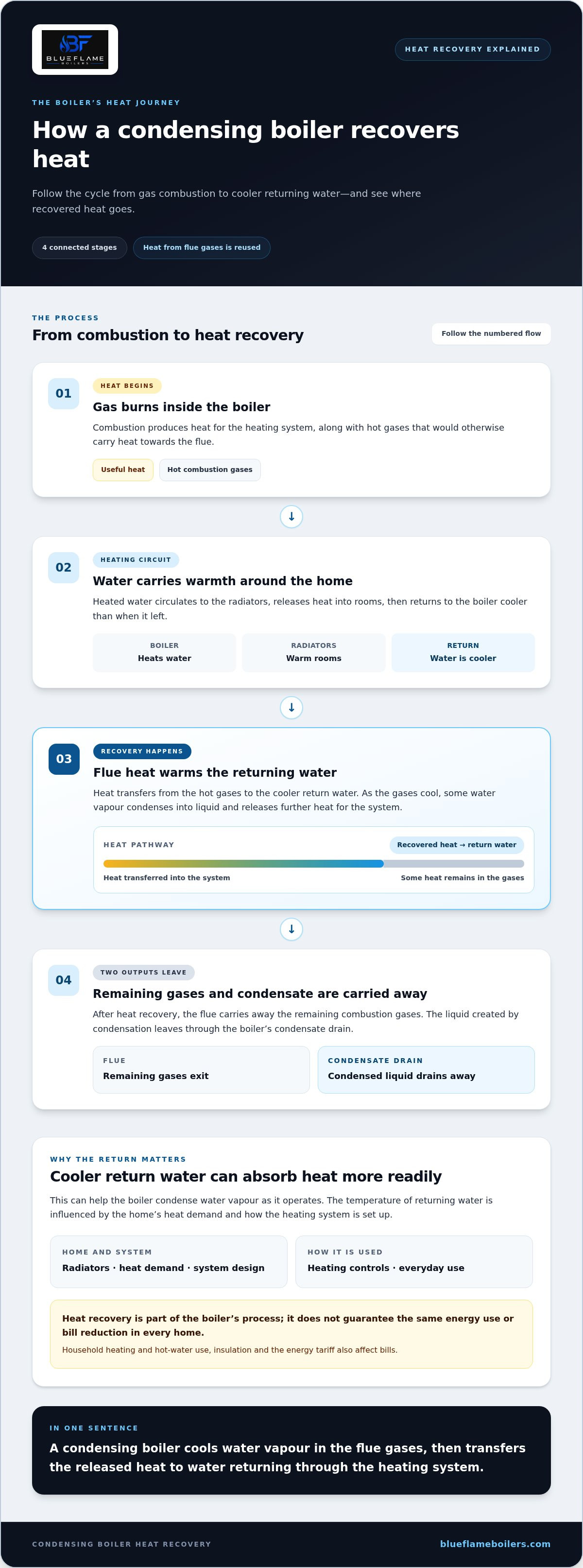
The boiler burns gas to produce heat. That heat warms water for central heating and, depending on the boiler and system, domestic hot water. During a typical heating cycle, warmed water circulates through radiators, releases heat into rooms, then returns to the boiler cooler than when it left.
Combustion also produces hot gases that leave through the flue. In a condensing boiler, heat from those gases transfers to the cooler water returning from the heating system. As some water vapour in the gases condenses, additional heat is recovered and used to warm the return water before it circulates again.
The practical principle is simple: the boiler heats water and captures some heat from its exhaust to support that job. How effectively the wider heating system uses the recovered heat is a separate matter, and it should not be confused with a guaranteed reduction in bills.
How does condensing boiler technology recover heat?
Heat recovery takes place during the boiler’s normal operating cycle:
- Gas burns inside the boiler, producing heat and hot combustion gases.
- Water is heated for the central heating system. It circulates to radiators, releases heat into rooms and returns to the boiler cooler than when it left.
- Heat transfers from the gases to the returning water. As the gases cool, some water vapour condenses into liquid, releasing further heat that can transfer into the system.
- The flue carries away the remaining gases from the boiler after the recovered heat has helped warm the returning water. Condensation also creates liquid that is carried away through the boiler’s condensate drain.
Condensation recovers heat by cooling water vapour in the flue gases and transferring the released heat to water returning through the heating system.
What happens to heat in the flue gases?
Combustion produces hot gases that can carry heat out through the flue. A condensing boiler transfers some of that heat to water in its heating circuit before the gases leave. As they cool, water vapour changes into liquid and releases heat. The flue still has an essential role: it carries the remaining combustion gases away from the appliance.
Why does the returning heating water matter?
The water returning from radiators affects how readily heat can be recovered. Cooler return water can absorb heat from the flue gases more readily, helping the boiler condense water vapour as it operates. Radiators, the home’s heat demand and the way the system is set up all influence the temperature of the returning water.
That’s why performance depends on more than the boiler. Heating controls, system design and everyday use affect how it runs and how much available heat recovery is put to use. The Energy Saving Trust also provides guidance on boiler types and controls, useful context when considering how an appliance fits into a home’s heating system.
To discuss how a gas boiler and heating system work together in your home, talk through your heating system with Blueflame Boilers.
Do condensing boilers always save energy? Separating fact from expectation
No. Condensing technology is designed to recover heat that might otherwise leave through the flue, but that does not guarantee the same energy use or bill reduction in every home. A condensing boiler can be part of an efficient heating setup, yet the result depends on how the complete system performs and how the household uses it.
Efficiency and cost are related, but they are not interchangeable. Bills also reflect how often and how long the heating and hot water are used, the home’s insulation and the energy tariff. A well-insulated home with suitable controls may need less heat to stay comfortable than a draughtier home with similar equipment. Treat broad savings claims as estimates, not promises about your own bills.
What affects a condensing boiler’s performance?
System design, controls, maintenance and daily habits all contribute. For example, heating schedules that match the household’s routine can avoid heating rooms unnecessarily. Thermostats and radiator controls help manage comfort, while regular servicing gives an engineer the opportunity to assess the boiler’s operation. The condition and layout of the heating system matter too.
Radiator performance is part of the picture. If rooms warm unevenly, or the system is set up in a way that does not suit the property, the boiler may not perform as expected. The temperature of water returning from the radiators also affects how readily the boiler can recover heat. Real-world efficiency varies with the heating system’s design and condition, water temperatures, controls, home insulation, household routines and energy tariff.
Does a condensing boiler need special radiators?
Not necessarily. Existing radiators may work with a replacement boiler, but their suitability depends on the complete heating system, including the boiler, radiator size and condition, controls and the home’s heating needs. There is no rule that every household must replace its radiators.
A heating engineer can assess how the current setup performs as a whole. They may consider whether rooms reach a comfortable temperature, how radiators distribute heat and whether the controls suit the household’s routine. This helps identify whether the existing radiators are suitable or whether changes could improve the overall system. Focus on how the home heats, rather than assuming a new boiler alone will deliver a particular result.
How to assess whether a condensing boiler suits your home
Before discussing a new boiler or changes to your heating system, gather a few details about how your home works day to day. This makes it easier to describe what you need and helps an engineer assess the whole setup, rather than focusing on the boiler alone. If you’re considering a condenser boiler, use this checklist to get started:
- Current boiler: Note its age if you know it, along with recurring faults, unusual noises or changes in how it operates.
- Heating performance: Record which rooms take longer to warm up, whether radiators heat unevenly and when the home fails to reach a comfortable temperature.
- Hot-water needs: Consider how many people use hot water and whether demand tends to happen at the same time.
- Property layout: Think about the number of rooms and floors, and which areas rely on central heating.
- Controls: Identify the thermostat, timers and radiator controls, then consider whether they suit your household’s routine.
These observations are not a diagnosis. They are useful clues for discussing whether the current boiler needs attention, a replacement or a wider system review. Blueflame Boilers’ gas boiler installation guide explains more about planning an installation.
What should homeowners check before considering an upgrade?
Look for patterns, not just one-off glitches. Note whether a heating or hot-water issue happens regularly, which rooms are affected and whether it began after a change to the system. If you know the boiler’s age, include it, but there is no need to guess or apply an arbitrary replacement age. The property’s layout, number of occupants, and heating and hot-water needs all help inform a suitable system assessment.
When is servicing relevant to efficiency and reliability?
Servicing gives an engineer the opportunity to assess the boiler’s condition and operation. It can support reliable running, but it is not a guaranteed way to reduce energy use or bills. A recurring fault needs diagnosis; when you are planning a replacement, the existing heating system and household requirements should be considered together. Blueflame Boilers provides gas boiler servicing and installation for homes in Epsom and nearby Surrey.
Planning a condensing boiler installation in Epsom and Surrey
Choosing a new boiler is also a chance to review how well the heating system suits your home. A suitable recommendation should account for the property, the equipment already in place and the way your household uses heating and hot water. That keeps the decision focused on everyday needs, not just the boiler itself.
What happens during professional installation planning?
An assessment can start with the existing boiler and heating layout: how rooms are heated, what radiators and controls are in place, and how hot water is supplied. Household routines and demand matter too. For example, a home with several occupants may have different needs from a smaller household, even if the properties have a similar layout.
This wider view helps an engineer consider whether the current system needs changes alongside a new boiler, or whether a broader heating-system design is appropriate. No single setup suits every property. The aim is to plan around the home and its existing system so the chosen condensing boiler and associated equipment work together as intended.
For an overview of the installation process, see the gas boiler installation guide. It is a useful starting point before discussing the details of your home.
Where can local homeowners get installation support?
Blueflame Boilers provides gas boiler installation and full heating system design for homes in Epsom and nearby parts of Surrey. An assessment considers the property’s layout, existing heating system and household requirements to help shape a practical installation plan.
Before discussing your project, note any recurring boiler issues, which rooms are hardest to heat, how many people use hot water and which controls you currently rely on. You do not need to know the technical answers. Clear observations about what happens at home give the discussion a useful starting point.
A well-planned installation considers more than the appliance. It looks at how the boiler fits into the heating system and the way your household lives. For homeowners around Epsom and Surrey, Blueflame Boilers offers a local route to discuss those needs and plan the next step.
Make a confident choice for your home heating
A condenser boiler usually means a condensing boiler: it recovers some heat from its flue gases and returns it to the heating process. But heat recovery alone does not guarantee a particular reduction in energy use or bills. Your home’s layout, heating controls, system condition and everyday needs all shape how well the overall setup performs.
Before planning an upgrade, note recurring boiler issues, how evenly rooms heat and what your household needs from its hot-water supply. A professional assessment can consider the boiler alongside the wider heating system. Blueflame Boilers’ certified engineers provide gas boiler installation, repair and annual servicing for homeowners in Epsom and nearby Surrey communities.
To discuss a gas boiler installation or heating system assessment, visit Blueflame Boilers’ website and get in touch.
Frequently Asked Questions
How does a condensing boiler work?
A condensing boiler burns gas to heat water for central heating and hot water. The combustion gases carry heat towards the flue, which takes them away from the appliance. Before they leave, the boiler transfers some of their heat to water returning from the heating system. As water vapour in the gases cools and condenses, it releases heat that can be reused. The result depends on the boiler and wider system.
Are condensing boilers more efficient than other boilers?
Condensing boilers are designed to recover some heat that would otherwise escape through the flue. This does not guarantee a particular reduction in household bills. Results depend on the boiler’s condition, heating-system design, controls, household heating habits and energy tariff. A professional assessment can consider how the boiler and the rest of the system work together, helping you understand what may affect performance in your home.
Do condensing boilers need a special radiator system?
No, a special radiator system is not automatically needed. Whether existing radiators are suitable depends on their condition and design, the boiler, the controls and how well the whole setup meets the home’s heating needs. A heating engineer can assess these parts together and explain whether adjustments are appropriate. Unevenly heated rooms are worth mentioning during an assessment, but they do not by themselves mean every radiator must be replaced.
Why does a condensing boiler produce water?
A condensing boiler produces condensate as water vapour in the flue gases cools and changes into liquid. This is a normal part of heat recovery, and the boiler is designed to manage the resulting water. If you notice a leak, a persistent fault or an unfamiliar change in operation, arrange a professional assessment rather than assuming it is routine condensate. Clear details about when the change began can help explain what is happening.
Can an older home have a condensing boiler installed?
An older home can be assessed for a gas boiler installation, but suitability depends on the individual property and its existing heating system. An engineer can consider the layout, current equipment, heating demand and hot-water needs before recommending a setup. Older properties do not all require the same changes. Blueflame Boilers provides gas boiler installation and heating-system design support for homeowners in Epsom and nearby Surrey communities.
Does a condensing boiler need regular servicing?
Regular servicing gives an engineer the opportunity to assess the boiler’s condition and operation, and identify issues that may need attention. It does not guarantee a particular efficiency level or prevent every fault. Blueflame Boilers provides annual servicing for residential and commercial properties in Epsom and nearby areas, including Ashtead, Leatherhead, Oxshot, Cobham, Weybridge, Ewell, Worcester Park, Cheam, Sutton, Carshalton, Banstead, Reigate, Tadworth, Woking, Bookham, Effingham, Horsley, Ripley and Kingswood.


